


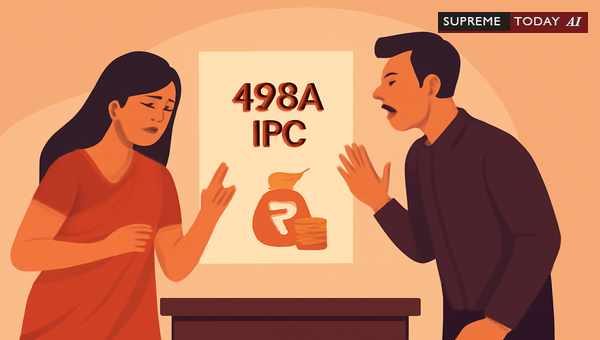
Specific Demand Required for 498A IPC Guilt?
In the realm of in India, stands as a critical shield against inflicted on married women, often linked to harassment. But a pressing question arises: Should there be a specific demand of amount or thing in case of 498A IPC to establish guilt? This query strikes at the heart of what constitutes sufficient evidence for conviction under this stringent provision.
While Section 498A aims to protect women from causing or driving them to suicide, courts have repeatedly emphasized that vague or general allegations fall short. This blog delves into the legal framework, evidentiary thresholds, and judicial insights to clarify when a case under 498A IPC holds water—or washes away due to lack of specificity.
Disclaimer: This article provides general information based on judicial precedents and is not a substitute for professional legal advice. Consult a qualified lawyer for case-specific guidance.
Understanding : The Legal Framework
Enacted to combat -related , punishes a husband or his relatives for subjecting a woman to . here includes conduct likely to drive her to suicide, cause , or harass her for like . However, the provision is not a blanket tool for all marital discord.
Courts mandate regarding allegations of and harassment. General or are deemed insufficient to establish guilt under 2016 0 Supreme(Tri) 102 2017 0 Supreme(HP) 286. As one judgment notes, Specific allegations are that, husband demanded amou.... highlighting the need for precision 2024 Supreme(Online)(Bom) 7270.
Without this, prosecutions risk acquittal, underscoring that emotional narratives alone do not suffice.
Key Requirements to Establish Guilt Under 498A IPC
To secure a conviction, the prosecution must meet rigorous standards. Here's a breakdown:
- Specific Allegations of and Harassment
Vague claims without dates, instances, or details fail the test. Courts insist on specific instances to avoid , a common pitfall in such cases. Exaggerated versions of incident are reflected in a large number of complaints and tendency of over implication is also reflected in a large number of cases – Courts have to be careful to i.... 2024 8 Supreme 361.
Clear Evidence of or Unlawful Demand
- A cornerstone is proving a specific demand for , property, or money. Mere suspicion or general harassment won't do. There must be clear evidence of a demand for or unlawful financial demands. The absence of such evidence can lead to acquittal... 2007 0 Supreme(Mad) 2226 2005 0 Supreme(P&H) 460. In cases lacking this, accused are often acquitted 2010 0 Supreme(P&H) 3393 2010 0 Supreme(Mad) 3430.
Further, the alleged demand of property or has not been proved to establish the case of under Section 498(A) of IPC 2021 0 Supreme(Mad) 2287 2021 0 Supreme(Mad) 1792.
- Testimonies from , documents, or direct proof are essential. from family members is inadmissible. The learned wrongly relied on the ... there is absolutely no evidence to establish guilt... under Section 498-A of the IPC 2017 0 Supreme(Bom) 2411.
In order to prove that the accused has committed an offence under Section 498-A IPC, the ingredients of the offence, namely meted out to the deceased must be proved by the prosecution by producing cogent and consistent evidence... 2020 0 Supreme(Kar) 188.
Driving Grave Harm
- must be continuous or severe, not isolated disagreements. '' for the purpose of Section 498-A IPC is to be established in the context of Section 498-A IPC... It is to be determined/inferred by considering the conduct of the man, weighing the gravity or ser.... 2025 0 Supreme(Gau) 103. No proof of the woman suffering due to such conduct leads to failure 2021 0 Supreme(Mad) 2287.
Judicial Precedents: Lessons from the Courts
Indian courts have shaped these requirements through landmark rulings:
Specificity Over Vagueness: Courts have consistently ruled that vague allegations without specific instances of or harassment do not meet the burden of proof required for conviction under 2009 0 Supreme(Mad) 4828 2004 0 Supreme(MP) 925.
Demand Proof Critical: In multiple cases, failure to establish a demand resulted in acquittals 2007 0 Supreme(Mad) 2226 2005 0 Supreme(P&H) 460. One ruling acquitted due to no specific material against the accused, even with Section 34 (): There is no scintilla of evidence against appellant to hold that he has committed offence under Section 498-A, IPC, even with aid of – Being husband of second accused... cannot be a ground... 2024 8 Supreme 361.
Warnings: Courts caution against roping in all relatives without evidence. Courts have to be careful to identify instances of over implication and to avert suffering of ignominy and inexpiable consequences by such persons 2024 8 Supreme 361.
Rejection: Reliance on family led to acquittal in a suicide case: Evidence from maternal relations lacked direct witnessing 2017 0 Supreme(Bom) 2411. Similarly, inconsistent witness testimonies undermined prosecution 2020 0 Supreme(Kar) 188.
Continuous Needed: Quashing proceedings where no continuous mental torture or demand was shown: under Section 498(A) IPC requires continuous evidence of mental torture; absence of demand... led to quashing of proceedings 2025 0 Supreme(Gau) 103.
These precedents illustrate a judicial trend favoring evidence-based justice over .
Insights from Additional Cases: Strengthening or Weakening 498A Claims
Recent judgments reinforce the specificity rule. In one, conviction was overturned for lack of proof that petitioners demanded , with no evidence of causing harm 2021 0 Supreme(Mad) 2287 2021 0 Supreme(Mad) 1792. Another highlighted emotional lower court approaches without legal evidence, leading to acquittal and fine refunds.
In death contexts, continuous harassment tied to specific demands is key: and on account of demand of till her last breath would make them liable for an offence punishable under Section 498-A... 2024 8 Supreme 361. Yet, without cogent proof, even long marriages with alleged suspicions fail 2020 0 Supreme(Kar) 188.
For complainants, this means documenting demands precisely—dates, amounts, witnesses. For accused, it offers defense against unsubstantiated claims.
Practical Recommendations for 498A IPC Cases
- For Prosecution/Complainants:
- Detail specific demands (e.g., Rs. 5 lakhs for car on date) with witnesses.
- Secure independent corroboration; avoid sole reliance on family.
Link conduct directly to harm or suicide risk.
For Accused/Defendants:
- Challenge vagueness via .
- Highlight absence of demand proof or inconsistencies.
Focus on: Ensure that all allegations are specific and supported by credible evidence. Gather corroborative testimonies and documentation... 2015 0 Supreme(Tri) 53.
Conclusion: Specificity is the Linchpin
To establish guilt under , prosecutions typically need specific, credible allegations of , clear evidence of a or unlawful demand (often detailing amount or thing), and robust corroboration. Failure here frequently results in acquittal, as courts prioritize preventing misuse while upholding justice 2007 0 Supreme(Mad) 2226 2017 0 Supreme(HP) 286.
Key Takeaways:- Vague claims invite dismissal.- Specific demand evidence is often pivotal.- Corroboration trumps .- Consult experts early for tailored strategy.
References: 2009 0 Supreme(Mad) 4828 2016 0 Supreme(Tri) 102 2017 0 Supreme(HP) 286 2007 0 Supreme(Mad) 2226 2005 0 Supreme(P&H) 460 2020 0 Supreme(Mad) 2346 2004 0 Supreme(MP) 925 2010 0 Supreme(P&H) 3393 2010 0 Supreme(Mad) 3430 2015 0 Supreme(Tri) 53 2024 8 Supreme 361 2024 Supreme(Online)(Bom) 7270 2025 0 Supreme(Gau) 103 2021 0 Supreme(Mad) 2287 2021 0 Supreme(Mad) 1792 2020 0 Supreme(Kar) 188 2017 0 Supreme(Bom) 2411.
Stay informed, stay protected—marital laws evolve, but evidence remains king.
#498AIPC, #DowryLaw, #IPCSection498A












