


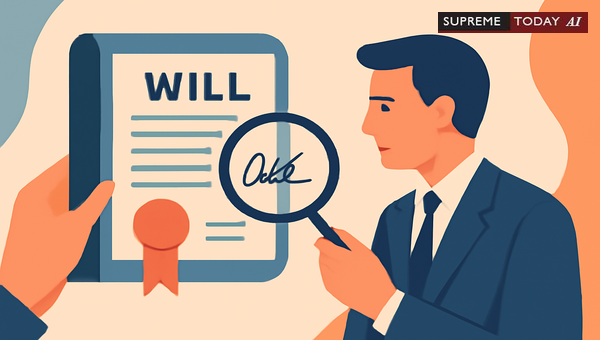
: Proving a Will is Forged in India
Introduction
Imagine discovering a family will that seems suspicious—signatures don't match, witnesses are absent, and it drastically alters inheritance shares. The question arises: does the person challenging the will to be forged have to establish his case? In Indian law, yes, the burden squarely rests on the challenger to prove forgery with clear, . Mere suspicion isn't enough. This blog delves into the legal framework, pivotal case laws, evidentiary standards, and practical challenges, drawing from landmark judgments and statutory provisions.
Note: This article provides general information based on case law and statutes. It is not legal advice. Consult a qualified lawyer for your specific situation.
Legal Framework for Forgery in Wills
Forgery is defined under as making a false document or altering one with intent to cause damage, injury, or deceive. Key elements include falsity, knowledge of falsity, and dishonest intent. Relevant sections include:
- : Forgery of valuable security, will, or authority.
- : Forgery for cheating.
- : Using a forged document as genuine.
- : Cheating, often paired with will forgery claims.
Under the (Section 63), a will's validity requires proof of proper execution, sound mind, and attestation. Failure to prove execution may invite forgery allegations, but the challenger must substantiate them. As held in **2017 0 Supreme(Cal) 962
A party alleging must discharge the onus by clear evidence... that Will was forged... is on the person who alleges it to be so.
The : On the Challenger
The person alleging forgery bears the heavy , especially in criminal proceedings. Courts demand direct or expert evidence, not conjecture. In **
there is no evidence on record to hold the accused liable for forgery or fabrication... forgery and fabrication must be proved by evidence, and mere failure to prove lawful execution does not imply forgery.
Witnesses must be or ; otherwise, claims fail. Similarly, **2023 0 Supreme(MP) 802
the appellant can be convicted... only when by leading , the prosecution proved its case to the hilt... prosecution could not establish its case .
This underscores that suspicion alone leads to acquittal.
Key Case Laws on Establishing Forgery
High Evidentiary Standards
A charge of forgery cannot be imposed on a person who is not the maker of the same.
Convictions require expert reports comparing signatures with admitted samples, plus independent corroboration. The in **
emphasized that forgery and fraud are matters of evidence, and the burden is on the prosecution to prove that the accused made or altered the document with fraudulent intent.
Without identifying the maker or proving forgery, no conviction follows.
Quashing Proceedings for Lack of Evidence
Courts quash baseless forgery claims. In **
if there is no evidence of forgery, proceedings should be quashed.
Criminal prosecution cannot be pursued for matters that are already under ... allegations were primarily civil in nature, relating to a dispute over a will.
Here, IPC Sections 420 and 467 charges were quashed as the will's validity was pending in .
Role of Expert Evidence and Presumptions
Handwriting expert reports (e.g., FSL) are crucial. **
absence of handwriting expert opinion... preclude conviction.
Without there being any evidence the Court cannot record an opinion that the will seems to be a created one... Whether the will is genuine or a forged document is to be considered on evidence adduced.
Presumptions may arise if a forged document is possessed, but rebuttable with proof.
Specialized Contexts
Even in religious disputes, challengers must prove forgery. **2017 0 Supreme(All) 1195
Plaintiff has right to challenge the aforesaid ‘Will’ as forged and fictitious.
Yet, validity hinged on customs and evidence of execution.
The plaintiff has come out with false and ... denies the execution and genuineness of the Will.
Prior settlement deeds complicated claims, prioritizing established rights.
Challenges in Proving Will Forgery
Proving forgery is arduous:
- Expert Analysis: Signatures, handwriting discrepancies via forensic reports.
- Witness Testimony: Attesting witnesses to execution; absence weakens propounder's case but doesn't prove forgery.
- Fraudulent Intent: Must show dishonest purpose.
- Civil vs. Criminal: Civil (e.g., 2017 0 Supreme(Cal) 962) requires propounder to prove execution first; criminal needs higher proof.
Suspicious circumstances (e.g., unnatural disposition) shift onus slightly but not to prove forgery outright.
Judicial Principles Guiding Courts
- : Accused entitled to benefit of doubt (2023 0 Supreme(MP) 802).
- No Evidence, No Forgery: As in , allegations must be pleaded and proved.
- Scrutiny: Proceedings quashed if abuse of process (2024 0 Supreme(Jhk) 376).
Courts protect against while ensuring genuine frauds are addressed.
Conclusion and Key Takeaways
Challenging a will as forged demands rigorous evidence: expert forensics, witness accounts, and proof of intent. The mantra from cases like and 2024 0 Supreme(Ker) 96 is clear—the challenger must establish their case beyond suspicion.
Key Takeaways:- Burden on the alleging party; prove with experts and direct evidence.- Mere execution failure ≠ forgery.- Criminal claims may be quashed if civil disputes dominate.- Always gather handwriting samples, witness statements early.
For heirs or executors, understanding this framework prevents wasted efforts. Seek professional or criminal counsel promptly.
References:-
, 2024 0 Supreme(Ker) 96,
, 2023 0 Supreme(MP) 802, 2024 0 Supreme(Jhk) 376, 2017 0 Supreme(All) 1195, 2017 0 Supreme(Cal) 962, 2016 0 Supreme(Mad) 64, 2014 0 Supreme(Ori) 286
Stay informed, protect your legacy wisely.
#ForgedWill #WillChallenge #IndianLaw















