Searching Case Laws & Precedent on Legal Query.....!
Analysing the retrieved Case Laws
Scanned Judgements…!



Searching Case Laws & Precedent on Legal Query.....!
Analysing the retrieved Case Laws
Scanned Judgements…!
Proof of Will – Mandatory Attestation and Evidence Requirements Section 68 of the Evidence Act mandates that a will must be proved by examining at least one attesting witness. If the signature of the testator is proved to be in his handwriting (Section 69), then the attestation of at least one witness must also be proved to be in his handwriting. The law emphasizes that wills cannot be proved solely based on their age; instead, proper proof of signatures and handwriting is essential. Certified copies of wills can be proved through official proof, such as by an employee from the Registrar's office, but the original must generally be proved unless exceptions apply. ["2023 2 Supreme 649"], ["2023 0 Supreme(Cal) 1354"], ["
Vijay Singh Yadav VS Krishna Yadav - Current Civil Cases
"], ["2024 0 Supreme(P&H) 440"]Legal Procedure for Proving Wills Wills must be proved according to the provisions of Sections 67 and 68 of the Evidence Act, which require examining attesting witnesses and establishing the handwriting/signature of the testator. The process involves primary evidence, such as the original will, unless exceptions permit secondary evidence under Sections 64 and 65. Secondary evidence, like certified copies, can be admissible if the original is lost or unavailable, but must still meet legal criteria for proof. The law also stipulates that the testator must have signed the will voluntarily and with sound mind. ["2023 2 Supreme 649"], ["2024 0 Supreme(Ker) 731"], ["2024 Supreme(Online)(MP) 37956"], ["2022 0 Supreme(HP) 610"]
Presumption and Age of Wills The presumption of regularity for documents over 30 years old (Section 90) does not apply to wills; they require explicit proof of execution. The age of a will alone does not suffice for proof; it must be established through proper legal procedures, including examining witnesses and verifying signatures. ["2023 2 Supreme 649"], ["2024 0 Supreme(Ker) 731"], ["
Vijay Singh Yadav VS Krishna Yadav - Current Civil Cases
"]Role of Witnesses and Signatures The identification and proof of signatures and handwriting of both the testator and attesting witnesses are crucial. If witnesses are unavailable, the will must be proved as per Section 69, demonstrating that at least one attestation is in the witness's handwriting. The witnesses' ability to testify about the execution and attestation process is vital for the will's validity. ["2023 0 Supreme(Cal) 1354"], ["2024 0 Supreme(P&H) 440"], ["2025 Supreme(Online)(TEL) 3292"]
Legal Precedents and Court Interpretations Courts have consistently held that a will is inadmissible unless properly proved in accordance with law. The proof involves examining witnesses, verifying signatures, and ensuring compliance with statutory requirements. The law also recognizes that a will can be proved by examining signatures of witnesses and the testator, and that secondary evidence like certified copies can suffice when original documents are lost, provided the proof is satisfactory. ["2024 0 Supreme(All) 2125"], ["02800084696"], ["2024 Supreme(Online)(MP) 37956"], ["2025 Supreme(Online)(TEL) 3292"]
Summary:A will must be proved through strict adherence to the provisions of the Evidence Act, primarily by examining attesting witnesses and establishing signatures and handwriting. Certified copies and secondary evidence are admissible under specific conditions, but the primary proof involves examining witnesses and following procedural requirements. The age of a will does not exempt it from proof, and its validity hinges on proper legal procedures being followed.
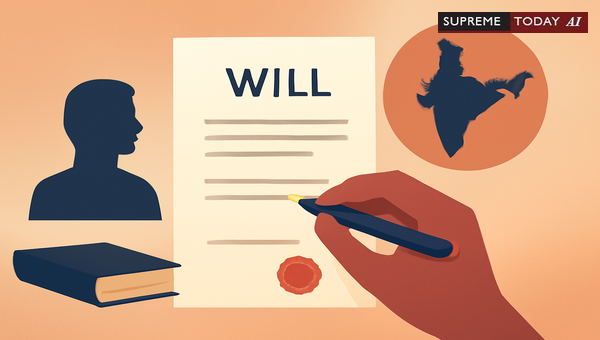
In the realm of inheritance and estate planning, few documents hold as much weight as a . But what happens when its validity is challenged in court? The question Will have Proved—often shorthand for whether a Will has been adequately proven—lies at the heart of many disputes in India. Understanding the legal framework for proving a Will is crucial for executors, beneficiaries, and legal practitioners alike.
This guide breaks down the essential principles, statutory requirements, and judicial precedents governing the proof of a Will. We'll explore how courts assess execution, , and any , drawing from key provisions like , and . Note: This is general information and not specific legal advice. Consult a qualified lawyer for your situation.
Proving a Will is not a mere formality; it requires rigorous evidence to satisfy the court's conscience. Under Indian law, a Will must be treated like any other document, demanding proof of the 's signature and proper by at least two witnesses. This is explicitly governed by Section 63 of the Indian Succession Act and Section 68 of the Indian Evidence Act
-
2018 0 Supreme(Del) 711.The (the person seeking to enforce the Will) must demonstrate that:- The signed the Will while of .- The signing occurred in the presence of at least two .- The witnesses signed in the 's presence and, typically, in each other's presence 2020 0 Supreme(Mad) 2
-
.Failure to establish these basics can render the Will invalid. For instance, courts have held that both the execution and of the Will must be proved, and if not, the Will cannot be considered legally valid 2020 0 Supreme(Mad) 2.
The onus lies squarely on the , particularly when cloud the document's authenticity. This includes proving the Will's genuineness and addressing any red flags, such as the 's mental state or inconsistencies in witness accounts 1992 0 Supreme(SC) 207 2020 0 Supreme(MP) 109.
In one case, the court emphasized, the onus of proving the Will includes demonstrating the absence of 2020 0 Supreme(Mad) 2. If witnesses are unavailable, alternative evidence—like handwriting experts—may suffice, but it must be compelling 2017 0 Supreme(Cal) 859.
At minimum, testimony from one attesting witness is required to confirm execution. As noted in judicial findings, the Will has been duly proved by one of the 2017 0 Supreme(Cal) 442
In The Goods of : Joydev Pal (Deceased) and Joydeb Paul VS Dipanwita Pal
. Cross-examination without substantive challenges to Section 63 compliance strengthens the proof, with the witness affirming, he has seen the putting his signature on the WillIn The Goods of : Joydev Pal (Deceased) and Joydeb Paul VS Dipanwita Pal
.If witnesses are dead or unavailable, courts may accept , but the bar remains high: A Court cannot act on facts which are not proved in the manner prescribed in the
.
Suspicion arises from factors like , , or . The must dispel these with cogent evidence. Courts demand that surrounding the execution of the Will, such as contradictions in witness statements or the 's mental state, these must be addressed to prove the Will's genuineness 1992 0 Supreme(SC) 207 2022 0 Supreme(Cal) 1356.
In a turned Will dispute, the court ruled that the need to prove the execution of the Will and remove any suspicion surrounding its execution, emphasizing the importance of providing cogent and convincing evidence to satisfy the conscience of the Court 2012 0 Supreme(Mad) 1558. Where proof falters, as in cases invoking , prior findings that a Will was also held to have been not proved bar relitigation 2018 0 Supreme(Del) 1277.
Conversely, when evidence aligns—such as handwriting expert testimony and unchallenged witness accounts—courts affirm validity: In my opinion, the Will has been proved to have been validly executed by the 2017 0 Supreme(Cal) 859. A Will is often presumed valid if evidence and other attending circumstances prevailing at the time of execution of Will supports that there could not have any doubt in mind of
In The Goods of : Joydev Pal (Deceased) and Joydeb Paul VS Dipanwita Pal
.Indian courts have shaped these principles through precedents:
Additional rulings reinforce this:- In a application, objections of failed due to lack of proof by the challenger, with the court granting after witness confirmation 2017 0 Supreme(Cal) 442.- Another testamentary suit saw allowed when the had fulfilled the requirements under Section 63, shifting the burden back to allege 2017 0 Supreme(Cal) 442.- In property disputes, unproven Wills yield to , as prevents rehashing settled issues 2018 0 Supreme(Del) 1277.
These cases illustrate that while the framework is strict, thorough preparation prevails.
To enhance chances of proving a Will:- Secure Witnesses Early: Ensure are alive and willing to testify.- Document Mental Capacity: Gather medical records or affidavits affirming the 's soundness.- Anticipate Challenges: Prepare rebuttals for suspicions, including expert opinions on handwriting or claims.- File for Promptly: In , proactive evidence presentation is key 2017 0 Supreme(Cal) 859.
The that the Will was forged or obtained under or lies with the party alleging it, reminding challengers of their evidentiary load 2017 0 Supreme(Cal) 442.
Proving a Will in India demands meticulous compliance with statutory mandates and judicial scrutiny. Generally, success hinges on robust witness testimony, clear execution proof, and dispelling suspicions. Courts consistently reject unproven Wills, as the deed in question has not been proved leads to dismissal
. Yet, where evidence shines, follows, securing the 's intentions.
Key Takeaways:- bears the burden under Sections 63 and 68.- One attesting witness suffices if credible.- Address suspicions proactively.- Leverage precedents like Lalitaben for strategy.
For personalized guidance, engage a specialist. This framework empowers informed navigation of Will disputes, upholding justice in succession matters.
#ProvingWill #IndianProbate #SuccessionAct


Section 68 of the Evidence Act requires the will to be proved by examining at least one attesting witness. ... Reverting back to Section 69 of the Evidence Act, we are of the view that the requirement therein would be if the signature of the person executing the document is proved to be in his handwriting, then attestation of one attesting witness is to be proved to be in his handwriting. ... In view of the above decision, wills cannot be #....

Section 59 of the Evidence Act lays down how a ‘fact’ can be proved. It says that all facts, except the contents of documents or electronic records, may be proved by oral evidence. ... B2 document, all that may be proved is that the document contains a ‘statement of fact’ that delivery was effected, but whether such delivery was actually made or not will not be proved by such production or marking. ... Such circumstances s....

an employee from the office of Registrar concerned has proved certified copy of the Will. ... Hence, in such case, handwriting of one attesting witness and of the person executing the Will are required to be proved. ... In his evidence, DW-1 has deposed that ‘he had seen the Will and Registry office came and proved the Will’. 23. ... Probal Kumar Mukherjee, learned senior advocate submits that original Will was lost and husband of the propo....

It is submitted by counsel for petitioners that in the Niyam, 2018 it is nowhere mentioned that before acting upon Will it should be duly proved. ... In the abovenoted case, this Court has stated that the following three aspects must be proved by a propounder: (Bharpur Singh case [Bharpur Singh v. ... Will means a valid Will, duly proved by the Propounder of the Will in accordance with the law laid down by the Supreme Court. 36. ... Will h....

The finding cannot be given on the basis of will unless the same was proved. The will is inadmissible in evidence unless it has been proved. 6. ... P.W.1 Ranjit Singh also have proved the pedigree given in the plaint and stated that the plaintiff is the son of Rajuta Devi who was the real sister's of Sheodin singh. Pratap Bahadur Singh, defendant No. 8 has also proved the above facts in his statement. ... It is not require....

It was held that Will may be proved by examining the witnesses, who were able to prove the handwriting of the executant. In that case before this Court, signature of one of the attesting witness was identified by Sub-Registrar, who had registered the Will. It was held that Will was validly proved. ... In the aforesaid facts and circumstances, when none of the attesting witness is available, the Will is required to be proved as per Section 6....

It is submitted by counsel for petitioners that in the Niyam, 2018 it is nowhere mentioned that before acting upon Will it should be duly proved. ... In the abovenoted case, this Court has stated that the following three aspects must be proved by a propounder: [Bharpur Singh v. Shamsher Singh, Will means a valid Will, duly proved by the Propounder of the Will in accordance with the law laid down by the Supreme Court. 36. ... It has also....

Reverting back to Section 69 of the Evidence Act, we are of the view that the requirement therein would be if the signature of the person executing the document is proved to be in his handwriting, then attestation of one attesting witness is to be proved to be in his handwriting. ... It is thus seen that the Will has to be proved in a manner known to law under Section 68 of the Indian Evidence Act by examining the attesting witnesses. ... H....

—Documents must be proved by primary evidence except in the cases hereinafter mentioned. 65. ... While accepting the prayer made on behalf of the defendants, court below observed in the order that merely granting prayer to lead secondary evidence regarding document does not mean that it is taken to be proved, rather, the same is required to be proved in accordance with law and no prejudice shall ... Atharv Sharma, Advocate, appearing for th....
The deed in question has not been proved. ... A Court cannot act on facts which are not proved in the manner prescribed in the Evidence Ordinance. ... by court if it is not proved in accordance with the procedure laid down in section 68 of the Evidence Ordinance. ... However, there are certain situations where even the law accepts that certain documents need not be further proved. ... I do not argue against the view t....

Will was also held to have been not proved therein. Therefore, the present question as to whether the suit property was partitioned by the Late Sh. Har Dutt Sharma already stands decided against the defendants and therefore, the same is required to be held res judicata.

In my opinion, the Will has been proved to have been validly executed by the testator.
It is very pertinent to note that although, learned counsel for the defendant cross-examined the attesting witness, but no suggestion has been given with regard to the requirements of Section 63 of the Indian Succession Act. I have already held that the Will has been duly proved by one of the attesting witnesses. Even the question raised by the defendant to the attesting witness on box could not have shaken the witness, rather, the attesting witness has confirmed in the box t....
I have already held that the Will has been duly proved by one of the attesting witnesses. Even the question raised by the defendant to the attesting witness on box could not have shaken the witness, rather, the attesting witness has confirmed in the box that he has seen the testator putting his signature on the Will. It is very pertinent to note that although, learned counsel for the defendant cross-examined the attesting witness, but no suggestion has been given with regard ....

Therefore, we will have to see whether the Will has been proved or not. According to his evidence, he came to know about the Will only in the year 2000 when his brother Mayakesavan the 1st defendant in the suit produced the Will before the Panchayat which was convened to settle the difference between the parties due to the pendency of O.S.No.155 of 2000 filed by his sons. In this case, the 2nd defendant/ 1st respondent herein relied upon the Will and therefore the burden is o....


An indispensable Tool for Legal Professionals, Endorsed by Various High Court and Judicial Officers
Please visit our Training & Support
Center or Contact Us for assistance

Scan Me!
India’s Legal research and Law Firm App, Download now!


For Daily Legal Updates, Join us on :



 Back to top


