Searching Case Laws & Precedent on Legal Query.....!
Analysing the retrieved Case Laws
Scanned Judgements…!



Searching Case Laws & Precedent on Legal Query.....!
Analysing the retrieved Case Laws
Scanned Judgements…!
Babulu Kundu VS State of Orissa - Crimes
"], the notes were seized months after the death (seized on 1-2 November 1987), with suspicion cast on the delay, which raises grave suspicion on the genuineness of the prosecution case.ISHWARBHAI SANABHAI NAYI (BARBER) vs STATE OF GUJARAT - Gujarat
"]). However, courts often find that the content of the notes is unreal or rhetoric, and do not conclusively establish instigation or abetment (the suicide note by itself does not carry the case any further ["2012 0 Supreme(Guj) 570"], ["ISHWARBHAI SANABHAI NAYI (BARBER) vs STATE OF GUJARAT - Gujarat
"]).Babulu Kundu VS State of Orissa - Crimes
"]).In some cases, the court notes that the contents of the note are somewhat unreal or rhetoric, and the mere presence of a note does not automatically imply culpability or abetment (["
ISHWARBHAI SANABHAI NAYI (BARBER) vs STATE OF GUJARAT - Gujarat
"]).Impact of Delayed FIR and Investigation
Babulu Kundu VS State of Orissa - Crimes
"], and ["BHAGIRATH AND ANOTHER Vs State - Allahabad"] mention that FIR delays without proper explanation or delayed examination of the writings for months cast suspicion and raise doubts about the case's genuineness.In some judgments, the delay is considered a procedural flaw that can justify bail or weaken the case against the accused (delayed FIR and investigation justifiably raise suspicion ["1993 0 Supreme(Ori) 132"], ["BHAGIRATH AND ANOTHER Vs State - Allahabad"]).
Suicide Note as Evidence of Instigation or Abetment
Satyendra Kumar Jain vs State - Delhi
"]).Satyendra Kumar Jain vs State - Delhi
"]).Analysis and ConclusionThe overarching insight from these cases is that delayed recovery and examination of suicide notes significantly affect the assessment of their credibility and probative value. Courts tend to scrutinize delays, considering them as factors that may undermine the genuineness of the evidence. Suicide notes, while relevant, are generally not sufficient alone to establish abetment or instigation, especially when content is vague, unreal, or inconsistent with other evidence. The timing of the note's recovery, expert opinions on handwriting, and the content of the note are all critical factors in judicial evaluation. Ultimately, courts emphasize a holistic approach, requiring corroborative evidence beyond the suicide note to establish criminal liability for abetment or instigation of suicide.
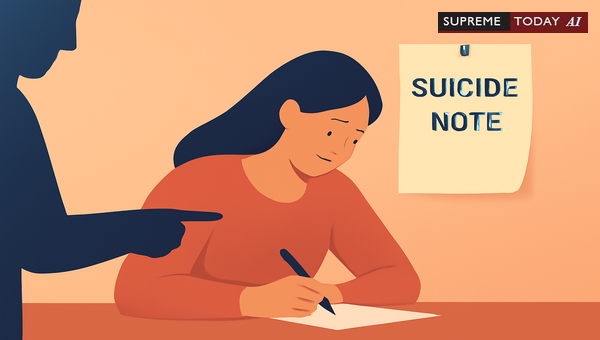
In tragic cases of suicide, a note left behind by the deceased often becomes central to investigations, especially when abetment charges under are invoked. But what happens when the suicide occurs long after an alleged incident, and the note itself is delayed or lacks clear links to recent provocation? The question arises: What is the effect of a delayed suicide and a delayed note?
This blog post delves into Indian judicial interpretations, highlighting how timing critically influences whether such notes can prove or abetment. Drawing from key judgments, we'll explore the legal principles, exceptions, and practical implications. Note that this is general information based on precedents and not specific legal advice—consult a qualified lawyer for individual cases.
punishes with imprisonment up to 10 years and a fine. To establish this offense, the prosecution must prove a close between the accused's acts and the suicide. Mere harassment or emotional distress isn't enough; there must be active or aid that leaves the deceased with no alternative but to end their life. 2010 6 Supreme 376
Courts emphasize (guilty intent) and . As held in various cases, the act attributed should not only be proximate to time of suicide but should also be of such a nature that deceased was left with no alternative but to take drastic step of committing suicide. 2025 3 Supreme 228
A delayed suicide—occurring days, weeks, or months after alleged provocation—significantly weakens abetment claims. Similarly, a delayed note loses if not linked to recent conduct.
In one landmark observation, courts noted: There is no proximity between the alleged occurrence of utterance of the so-called instigative words on and the commission of suicide by Brijesh Chander inasmuch as it was committed only on . 2024 3 Supreme 310 The suicide note did not reference this incident, leading to the conclusion that it failed to establish causation.
Generally, a suicide note written long after the alleged incident diminishes its as evidence of or abetment.2024 3 Supreme 310 Courts have consistently ruled that emotional or grievance-laden notes, especially delayed ones, cannot equate to incitement. 2010 6 Supreme 376
Delayed notes raise suspicions about authenticity and motive. For instance, a suicide note discovered after the suicide was viewed with suspicion, as courts avoid delving into merits at preliminary stages but note such delays. 2019 0 Supreme(Cal) 824
In debt-related cases, mere financial pressure without direct links fails: A mere debt does not establish without a direct causal link between the alleged conduct and the act of suicide. 2016 Supreme(Online)(KER) 3616 Here, pre-arrest bail was granted due to lack of evidence connecting delayed payments to the suicide, attributing it to personal reasons.
Delayed FIRs compound issues. In a case involving a delay without explanation, and a pending forensic report on the note, courts weighed overall facts cautiously.
Prosecution must show recent conduct, explicit threats, or direct incitement near the suicide time. Absent this, a delayed note alone is insufficient: The circumstances stated in Exhibit P-59 do not suggest that a person making such a statement would, under the normal circumstances, commit suicide after more than five and a half months. 2000 6 Supreme 570
In another acquittal, unreliable eyewitnesses, delayed FIR, and no persuasive led to reversal: It might be that Sahab Kaur committed suicide because of the quarrel with the accused but it could not be said that Sahab Kaur was persuaded to commit suicide because of the by the accused. 1978 0 Supreme(Raj) 381
Conviction requires clear intent: Abetment to commit suicide involves a mental process of instigating a person or intentionally aiding... Without a positive proximate act... conviction cannot be sustained. 2025 3 Supreme 228 Inconsistencies in evidence, like unrecovered items or no poison traces, further weaken cases.
A suicide note explicitly blaming family torture was upheld as evidence due to its recency and nexus, denying quashing. 2019 0 Supreme(Guj) 362 However, prior suicide attempts for other reasons (e.g., finances) can be trial defenses but don't discredit fresh notes outright.
While delays generally weaken cases, exceptions exist:- Explicit links to recent acts: If proven threats or conduct immediately precede suicide and the note references them, timing becomes secondary. 2024 3 Supreme 310- Supported by other evidence: Forensic reports, eyewitnesses, or recoveries can bolster delayed notes, though courts scrutinize authenticity.- Continuous harassment: Ongoing torture with a culminating note may suffice, but isolated past events rarely do.
Emotional notes without recent incitement remain inadequate: Courts should avoid relying solely on delayed notes that do not explicitly or implicitly connect recent conduct to the act of suicide.
In bail matters, delays often favor absent strong links.
In summary, while suicide notes hold evidentiary weight, their delayed nature typically undermines abetment charges, demanding robust proof of immediacy and intent. This principle safeguards against misuse while ensuring justice in genuine cases.
This post synthesizes judicial trends for informational purposes. Legal outcomes vary; seek professional advice.
#IPC306, #AbetmentSuicide, #DelayedSuicideNote


Durga Lal refused to give the suicide note. Mr. Durga Lal had told him that he will give the suicide note to the appropriate authority as and when the time comes. ... A suicide note was discovered by another nurse, Miss. Nirupama Ganguli, Subsequently, Miss. Ganguli handed over the said suicide note to Mr. Durga Lal, the Upper Division Clerk, working at the Centre. ... Chaudhary, vehemently argued that the Charge No. 1 about withholding of the #HL_ST....

... Thus, as per the expert’s opinion, writing in suicide note, is in hand-writing of the deceased. The suicide note at Exh.9 reads, thus : ‘I am madly in love. ... It is true that expert opinion on the suicide note is in favour of the prosecution. ... Even otherwise, the suicide note by itself does not carry the case any further. On the basis of suicide note, it cannot be said that accused has instigated or has in....

Thus, as per the expert’s opinion, writing in suicide note, is in hand-writing of the deceased. The suicide note at Exh.9 reads, thus : “I am madly in love. ... It is true that expert opinion on the suicide note is in favour of the prosecution. ... Even otherwise, the suicide note by itself does not carry the case any further. On the basis of suicide note, it cannot be said that accused has instigated or has inten....

It appears that Prabhakaran committed suicide for his own reasons. That the petitioner herein owed some money to the deceased, or the petitioner delayed payment, cannot be a reason for commission of suicide by Prabhakaran. ... When the petitioner delayed payment under some pretext, it worried Prabhakaran much. Due to disappointment, he committed suicide on 22.01.2016. It is alleged that commission of suicide by Prabhakaran was abetted by the petitioner herein. ... The suicid....

The-answer of the petitioner was No Sir Ext. 6/2, suicide note, was at least net a letter. The question never mentioned as to which letter it was referring. There were two letters. ... During the investigation, the investigating officer seized two letters Exts. 4/1 and 6/1 purported to have been written by the deceased to her father and a suicide note left by her in a diary exhibited as Ext. 512 in the case. On the report of the investigation officer the F. I. ... section 113-A of the Evidence Act the petitioner to have ....

The-answer of the petitioner was "No Sir" Ext. 6/2, suicide note, was at least net a letter. The question never mentioned as to which letter it was referring. There were two letters. ... suicide. ... During the investigation, the investigating officer seized two letters Exts. 4/1 and 6/1 purported to have been written by the deceased to her father and a suicide note left by her in a diary exhibited as Ext. 512 in the case. ... A reference to the evidence of the investigating officer P.W. 17 does snot sh....

of the present case is delayed by 21 day without any explanation. ... He further submitted that one suicide note is said to be found in the handwriting of deceased which was sent for Forensic examination but no report has been received so far. ... Learned AGA opposed the application and submitted that a suicide note in the handwriting of deceased is found, which was sent to Forensic examination but report is still awaited. ... Upon consideration of overall facts an....

I am, therefore, definitely of the opinion that the learned Sessions Judge was be error in believing the three eye witnesses without considering the effect of the delayed FIR and the earlier statements of P.W. 1 Ram Lubhai and P.W. 2 Mtlkiyat Singh. ... It might be that Sahab Kaur committed suicide because of the quarrel with the accused but it could not hi said that Sahab Kaur was persuaded to commit suicide because of the instigation by the accused Such a retort during the quarrel could hardly have any persuasive #HL_S....

The socalled suicide note did not refer to any such occurrence. ... The translated version of the suicide note is reproduced hereinbelow: Suicide Note(on first page): I, Kehri Singh s/o Chander Pal Singh have committed suicide and there are 3 persons who compelled me to commit suicide namely 1) Narendra Kumar Sharma, Address ... The deceased thereafter committed suicide and left behind a suicide note#HL_....
Suicide note was also found in the hand writing of deceased. Evidently accused received money, giving threat her, which he used to buy the vehicle. Applicant deserves no sympathy. ... (ii) Delayed FIR was lodged without proper explanation. ... the applicant who is responsible for victim's suicide. ... Admittedly, both were having some relation but accused is not responsible for her suicide. (v) Applicant is in jail since 04.10.2021, having no criminal history. ... ....

00 to them and thereafter started giving them ornaments. He also gave them his passbook and cheque books after signing on the cheques. Because of such blackmailing, he had to misappropriate money from his office for which he was suspended. It is stated that he was totally ruined and, therefore, he had committed suicide as he had no other alternative. 2009 is that appellant No. 3 had joined his office following the illness of the existing cleaner. She used to come to the office daily for cleaning purposes. Slowly they developed intimacy. It is alleged that appellant No. 3 had performed ‘black....

Note: The Judgement is delayed essentially due to Covid-19 situation initially. Secondly, I had Covid-19 infection and also had certain post Covid-19 issues from almost mid April, 2021 till mid July, 2021. Consequently, the connected miscellaneous petitions are closed.

The promised homes are delayed, then delayed further, and then delayed even further. A development project for a society demands commitment, fidelity, respect and honesty.

Another decision in Mandan Mohan Singh Vs. State of Gujarat and Anr. in Criminal Appeal no.1291 of 2008 has been cited by the petitioners. In that case the suicide note was discovered 17 days after the deceased committed suicide and such suicide note suffers from cloud of suspicion.
The contents of the suicide note is to the following effect:- Dipen, in full conscious, declare that due to my family, i.e. Nikita Patel and her father Shri Harshadbhai Patel and Gauriben Patel, who is my mother-in-law and brother-in-law Dipakbhai Patel and Manishbhai Patel and all their sons are frequently giving mental torture to me and therefore, I cannot give proper answer to my community and due to their torture, I end my life and my father-in-law and brother-in-law, i.e. Considering the legal preposition as to abetment under Section 107 read with Section 306 and on pe....


An indispensable Tool for Legal Professionals, Endorsed by Various High Court and Judicial Officers
Please visit our Training & Support
Center or Contact Us for assistance

Scan Me!
India’s Legal research and Law Firm App, Download now!


For Daily Legal Updates, Join us on :



 Back to top


