


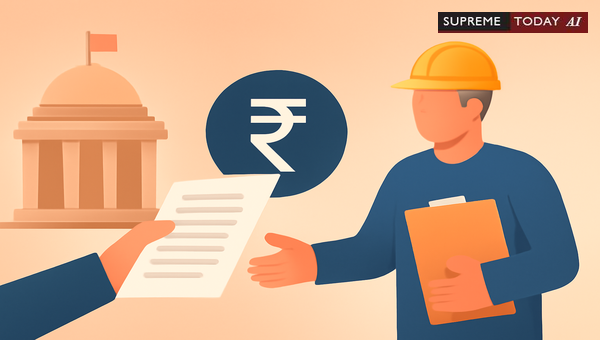
Payment for Work Done Without a Government Contract in India
Imagine you've completed urgent work for a , but there's no formal contract in place. Can you still get paid? This is a common dilemma for contractors and service providers dealing with government entities. Bill Payment for Work Done Without Contract with Government raises critical questions about compensation rights under Indian law. In this post, we'll explore the legal principles, key conditions, case analyses, and practical steps to help you navigate such situations.
Note: This article provides general information based on legal principles and cases. It is not a substitute for professional legal advice. Consult a qualified lawyer for your specific circumstances.
Understanding the Core Legal Principle: and Section 70
When no formal contract exists, the doctrine of —Latin for —comes into play. This principle allows recovery of reasonable compensation for services rendered or work done, provided certain conditions are met. , 1872, is the cornerstone here. It states: if a person lawfully does anything for another... not intending to do so gratuitously, and such other person enjoys the benefit thereof, the latter is bound to make compensation to the former... 1961 0 Supreme(SC) 385 2024 0 Supreme(Mad) 128.
Key Conditions for a Successful Claim
To claim payment under Section 70, three essential requisites must typically be satisfied:- : The work must be done legally, without coercion or illegality.- Intention to receive compensation: You must have acted with the expectation of payment, not as a free service.- Benefit to the other party: The government (or recipient) must have enjoyed or utilized the benefit of the work. 1961 0 Supreme(SC) 385.
These conditions ensure fairness, preventing where one party profits without paying.
Case Insights: Government Acceptance and Prior Dealings
In scenarios involving government work, courts have often sided with contractors when evidence shows acceptance and benefit. For instance, in a relevant case, the respondent performed work without a formal contract, but the government used it despite quality objections. This usage indicated recognition that the work was for remuneration, not gratuitous. Previous payments for similar work under analogous circumstances further bolstered the expectation of compensation. The government's urgent need and immediate utilization of the work sealed the claim under . 1961 0 Supreme(SC) 385.
Even where certification is typically required for bills, if the government delays or refuses certification for reasons not attributable to the contractor, payment may still be due based on work performed. Quality disputes can arise, but proven benefit often overrides them. 2016 0 Supreme(Bom) 345 2013 0 Supreme(Pat) 1178.
Integrating Related Legal Precedents and Disputes
Government contracts frequently involve additional complexities like arbitration, escalations, and bill disputes. Drawing from other sources, consider these insights:
In payment disputes, partial payments during work progress without demur do not necessarily create disputes unless the authority refuses full settlement post-bill submission. Dispute can only arise when after submission of bill the authority refuses to pay any amount or wants adjustment of amount earlier paid etc. According to us if any part amount of bill is paid during the progress of the work without demur, such payment can not lead to any dispute. 2007 0 Supreme(All) 2849.
in contracts (or even independent ones) can enforce claims. Courts have upheld awards for losses, overheads, and escalations when work is accepted, even if delayed. For example, under the , claims for interest, loss of profits, and damages from executed work are sustainable if not against . 2009 0 Supreme(AP) 944 2007 0 Supreme(All) 2849.
Final bills and measurements are pivotal. Till a final bill is prepared and accepted, full payment may not be deemed due, but disputes over quality require re-execution only if contractually mandated. Limitation periods (e.g., ) apply from acknowledgment or refusal points. 2001 0 Supreme(Guj) 64.
In cases of changed items or underpayments, contractors have claimed escalations for materials and labor. It is submitted that the claimant was not paid as per work done and since the rates were not decided for the changed items the payment made to the claimant was always less. 2023 Supreme(Online)(Pat) 10571.
These precedents highlight that while formalities matter, courts prioritize equity when benefits are received.
Limitations and Potential Counterarguments
Government entities often raise defenses like lack of certification, poor quality, or absence of agreement. However:- Certification hurdles: If non-certification stems from the employer's side, may still apply. 2016 0 Supreme(Bom) 345.- Quality issues: Objections don't negate benefit if the work was used. 2013 0 Supreme(Pat) 1178.- Time bars: Claims must be timely; proceedings before non-judicial bodies (e.g., Housing Commissioners) don't always toll limitation under . 2001 0 Supreme(Guj) 64.
Arbitration refusals or delays can complicate matters, but independent arbitration agreements under the 1996 Act hold strong. 2007 0 Supreme(All) 2849.
Practical Recommendations for Contractors
If you've done work without a contract:1. Document everything: Keep records of communications, work performed, urgency requests, and any prior payments.2. Submit a detailed bill: Reflect actual work, rates (based on market or past dealings), and cite Section 70.3. Negotiate formally: Approach the department, referencing benefits received.4. Escalate if needed: Invoke arbitration if clauses exist, or file a civil suit. Awards for escalations, interests, and losses have been upheld. 2009 0 Supreme(AP) 944.5. Seek extensions judiciously: For additional work, ensure time extensions align with agreement terms to claim compensations. 2005 0 Supreme(Del) 419.
Conclusion and Key Takeaways
Under , contractors may generally claim payment on for work done without a formal government contract, especially if the government benefited and payment was intended. Cases affirm this when urgency, prior dealings, and acceptance are evident. 1961 0 Supreme(SC) 385 2024 0 Supreme(Mad) 128.
Key Takeaways:- Prove the three requisites: lawful work, payment intent, and benefit.- Leverage precedents on bills, arbitration, and escalations.- Act promptly to avoid limitation issues.
While risks like quality disputes exist, the law favors fairness. For tailored guidance, consult a legal expert. Stay informed, document diligently, and protect your rights in government dealings.















