


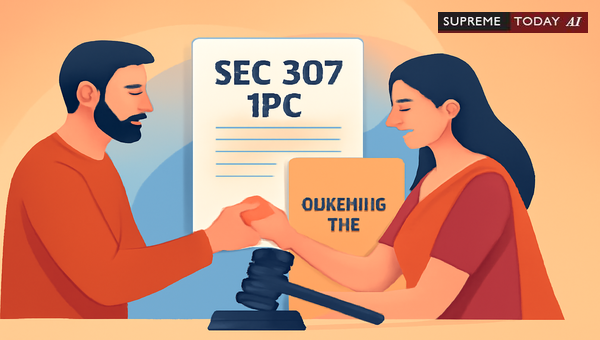
Can Be Quashed on Spousal Compromise?
In , couples often seek to bury the hatchet through compromise, hoping to quash criminal cases filed amid heated conflicts. A common question arises: 307 can be Quashed if there is Compromise between Husband and Wife? This query frequently surfaces in cases involving , which deals with —a grave accusation that can stem from domestic altercations.
While settlements can resolve many private matters, stands out due to its classification as a . This article delves into the legal consensus from and judgments, examining when—or if—such cases can be quashed under . Note that this is general information based on precedents and not specific legal advice; consult a qualified lawyer for your situation.
The Nature of : A Crime Against Society
punishes attempts to murder, carrying a potential life sentence or up to 10 years imprisonment. Courts view it as a serious offence not just against an individual but society at large. Offences under are categorized as heinous and serious, and are treated as crimes against society, not just private disputes 2018 0 Supreme(Tri) 190.
The has emphasized that such cases threaten public peace and safety, distinguishing them from purely personal disputes. Even in husband-wife conflicts, using weapons or causing grave injuries elevates the matter beyond private reconciliation. The has clarified that offences like attempted murder () are not private disputes and cannot be summarily disposed of through mutual settlement, especially when the injury is grave or involves weapons 2018 0 Supreme(Tri) 190 2020 0 Supreme(Cal) 250.
Judicial Precedents: Caution in Quashing Serious Offences
Indian courts wield under to quash FIRs or proceedings if they . However, this power is exercised sparingly for like Section 307.
- In and , courts ruled that Section 307 cases involving grave harm or weapons are unsuitable for quashing based solely on settlement. The court must scrutinize evidence and societal impact 2018 0 Supreme(Tri) 190 2020 0 Supreme(Cal) 250.
- reiterated: while under Section 482 Cr.P.C. are wide, they are not to be exercised to quash grave offences like , which are not private in nature 2023 0 Supreme(J&K) 66.
- The stresses upholding public interest: The object of criminal law is to uphold public interest, and offences like attempted murder are against societal order, thus generally non-amenable to quashing on compromise alone 2018 0 Supreme(Tri) 190.
These rulings establish that compromise alone rarely suffices; courts examine injury nature, evidence strength, and broader implications 2017 0 Supreme(Del) 2562.
Exceptions: Rare Scenarios Where Quashing Occurs
While the default is denial, exceptions exist if the case lacks gravity or public interest:
- Quashing may occur if evidence is weak, injuries minor, and proceedings serve no purpose—though rare for Section 307 2018 0 Supreme(Tri) 190 2020 0 Supreme(Cal) 250.
- In matrimonial contexts, courts are lenient for private wrongs like cruelty under , where compromise resolves family discord. For instance, in a case involving Sections 498A and 109 RPC, proceedings were quashed post-settlement as the wrong was private or personal in nature and conviction remote 2023 0 Supreme(J&K) 175.
- Another precedent quashed multiple FIRs including Section 307 in a matrimonial dispute after amicable settlement and mutual divorce: should be put to rest if the parties have arrived at a genuine settlement 2023 0 Supreme(Del) 5224. However, this highlights exceptional circumstances, not the norm.
Contrastingly, for heinous cases: Serious and heinous offences affecting society at large should not be quashed on the basis of a settlement between the parties 2022 0 Supreme(All) 889. In a Section 307 assault case, quashing was denied despite compromise due to serious injuries and societal duty to prosecute 2022 0 Supreme(All) 889.
High Courts have quashed lesser matrimonial FIRs on compromise to promote harmony: the aim and object of law is not only to punish the culprit, but, the objective of the law is also to maintain peace, tranquility and harmony in society 2022 0 Supreme(MP) 335. Yet, Section 307's gravity typically overrides this.
Integrating Broader Context from Case Law
Other judgments reinforce nuance:
- in family disputes may be quashed if personal: in cases of family disputes where the wrong is private or personal in nature and the parties have resolved their entire dispute, the may quash criminal proceedings 2023 0 Supreme(J&K) 175.
- A kidnapping FIR () was quashed post-settlement in a private dispute, with tree-planting as condition 2023 0 Supreme(Del) 4760.
- However, for Section 307 with weapons or grave harm, courts prioritize deterrence: offences involving serious harm or weapons are not suitable for quashing based on settlement 2020 0 Supreme(Cal) 250.
Even in compromises, courts condition relief, ensuring no moral turpitude or public interest breach, as in a negligence death case quashed for lacking 2024 0 Supreme(P&H) 1313.
Practical Recommendations for Parties Involved
- Avoid expecting automatic quashing: Settlements help lesser charges or sentencing but rarely erase Section 307 proceedings.
- Evaluate case specifics: Assess injury severity, evidence, and precedents with counsel.
- Alternative uses of compromise: Useful for minor offences or , fostering peace without full dismissal.
- Legal practitioners should argue societal impact minimally while highlighting private roots, but success is limited for grave cases.
Key Takeaways
- is generally not quashable solely on husband-wife compromise due to its heinous nature against society 2018 0 Supreme(Tri) 190 2020 0 Supreme(Cal) 250.
- Courts exercise cautiously, prioritizing public interest over private settlements 2017 0 Supreme(Del) 2562.
- Exceptions are narrow: weak evidence, minor injuries, or purely private matrimonial contexts without societal repercussions.
- Matrimonial harmony is valued, but not at the expense of deterring violent crimes.
In summary, while compromises heal family rifts, they seldom extinguish charges. The legal position upholds: such offences cannot be quashed merely because the husband and wife have settled their dispute, especially when the injury is grave or involves weapons 2018 0 Supreme(Tri) 190.
Disclaimer: This article provides general insights from judicial precedents and is not legal advice. Laws evolve, and outcomes depend on facts. Seek professional counsel for personalized guidance.
#Section307IPC, #QuashingFIR, #MatrimonialLaw












