


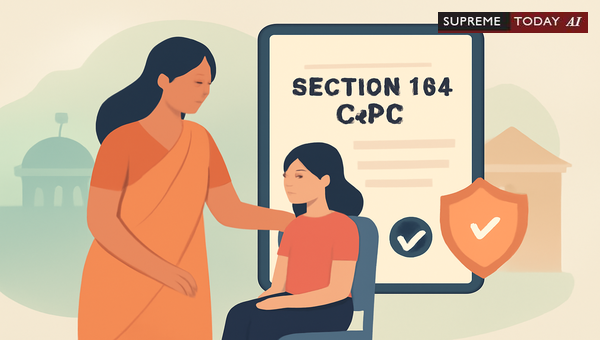
No Circular Mandating 164 CrPC Statements at Sakhi Centres
Introduction
In criminal cases, especially those involving vulnerable victims like children or survivors of sexual offences, the recording of statements under plays a pivotal role. This provision allows a Magistrate to record statements to ensure they are , often serving as crucial evidence. A common query among legal practitioners, investigators, and advocates is: Is there any circular of according to which statement of victim under 164 CrPC is to be recorded at the place of victim or Sakhi centre but not in the court?
This question arises amid growing emphasis on victim-centric procedures, particularly in sensitive cases. Sakhi Centres, one-stop facilities for women and children in distress, are increasingly referenced for providing safe spaces. However, does the have a binding circular on this? Let's delve into the legal landscape, judicial precedents, and guidelines to provide clarity.
Understanding : Core Provisions
empowers Magistrates to record statements and confessions during investigations. Key requirements include:- Magistrate's Direct Involvement: The statement must be recorded by a Magistrate, ensuring like explaining rights, testing voluntariness, and competency, especially for children or those with mental disabilities. 2024 0 Supreme(SC) 1292 2000 5 Supreme 444- Safeguards for Vulnerability: Courts stress , , and , particularly in .
Typically, these statements are recorded in a court setting. However, exceptions may apply for victim comfort, but are they mandated by a specific circular?
The Specific Query: Circular?
After thorough review of available judicial documents and guidelines, there is no specific circular or directive issued by the mandating that victim statements under be recorded exclusively at the victim's place or a Sakhi Centre instead of in court.2024 0 Supreme(Del) 50
This absence is notable. While procedural norms emphasize Magistrate involvement in controlled environments, no circular enforces location-specific recording outside court premises as a general rule.
Key Points from Analysis
- Legal provisions prioritize strict safeguards over location mandates. 2024 0 Supreme(SC) 1292
- and High Court judgments focus on manner (, voluntariness) rather than fixed locations. 2024 0 Supreme(Del) 50
- For special cases (e.g., minors in sexual offences), courts may direct recording at victim-friendly sites, but these are case-specific, not circular-driven.
and Broader Judicial Guidelines
The has issued directions prioritizing victim :- Statements of minors should preferably be recorded before a Lady Magistrate with . 2024 0 Supreme(Del) 50- Interim guidelines suggest recording at the nearest Magistrate’s court or safe locations for child victims or those with disabilities, ensuring comfort. 2024 0 Supreme(Del) 50
These are broad, applicable nationwide, but not Rajasthan-specific circulars. echo this, emphasizing procedural correctness over rigid locations.
Insights from Case Laws and Other Jurisdictions
While no Rajasthan circular exists, other cases illustrate evolving practices:
- In a matter, reference to a SAKHI One Stop Centre at a district hospital appears in context, but the statement was recorded before the jurisdictional Magistrate. The victim did not make serious allegations against the petitioner.
- noted a prosecutrix's statement under recorded in the Centre, Balod, with Sakhi Centre officers advising her, before an Executive Magistrate.
These examples show Sakhi Centres facilitating recordings in specific instances, but not as a mandated alternative to court via circular.
Other precedents highlight statement reliability:- Contradictions between Section 164 statements and trial testimony often lead to acquittals, underscoring procedural integrity. 2022 0 Supreme(All) 1556 (From the materials placed on record it appears that the statement of the victim (P.W.-1) was recorded under wherein she did not allege... but in the statement recorded under Section 164 Cr.P.C.)- In rape appeals, inconsistencies in victim statements under versus court recordings raise . 2016 0 Supreme(All) 3855 (I am aware that the statement of the victim recorded under Section 164 Cr.P.C., is only a previous statement... but the contradictions... strike at the root of the case.)- Courts stress that medical evidence and consistent testimony are vital; mere suspicion isn't proof. 2018 0 Supreme(Bom) 2023
These cases from various (e.g., Bihar, Allahabad) reinforce that while locations like Sakhi Centres may be used judiciously, the focus remains on and safeguards, not location mandates.
2018 0 Supreme(Cal) 71
Jurisdictional and Procedural Nuances
- Rajasthan Context: Documents reference directions for safe locations in sexual offences, but no local circular shifts from court-based recording. 2025 2 Supreme 303
- Exceptions: In vulnerable cases, courts may order recording at residences or centres for , per judicial discretion. 2024 0 Supreme(Del) 50
- Limitations: Specific directives are case-bound, not general policy from .
Recommendations for Practitioners
- Follow guidelines: Prioritize , voluntariness, and victim comfort. 2024 0 Supreme(Del) 50
- For vulnerable victims, request location adjustments via court orders, considering Sakhi Centres where available.
- Ensure Magistrate oversight; avoid presuming non-court locations without direction.
- Investigation agencies should document safeguards meticulously to prevent evidentiary challenges.
Conclusion and Key Takeaways
In summary, no explicit circular requires victim statements at the victim's place or Sakhi Centres over court premises. Practices lean toward flexibility for , guided by directives and case-specific orders. This victim-centric evolution protects without altering core CrPC mandates.
Key Takeaways:- No Rajasthan-specific circular exists. 2024 0 Supreme(Del) 50- Emphasize universally.- Use Sakhi Centres judiciously in special cases.- Reliability hinges on consistency and voluntariness.
This article provides general information based on reviewed documents and is not legal advice. Consult a qualified lawyer for case-specific guidance.
References:1. 2024 0 Supreme(Del) 50: directions on safe recording.2. 2000 5 Supreme 444: .3. 2025 2 Supreme 303: observations.4. Various High Court cases as cited.
#Section164CrPC, #RajasthanHighCourt, #VictimRights












