


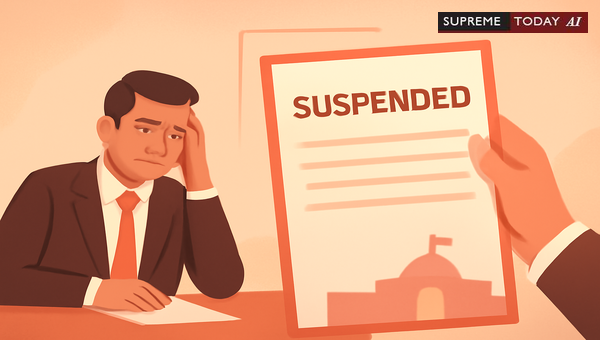
Court Reinstate Municipal Chairman: No Found
In the realm of local governance, the suspension of elected officials like municipal chairmen can spark significant controversy. A common query arises: of Municipality in Inquiry Held that no Court Reinstate the Chairman. This question touches on critical aspects of under the (and its successor, the Act), particularly Sections 63 and 39, which govern removal and suspension proceedings.
This blog post delves into the legal framework, key court findings, and precedents that guide when a court may reinstate a suspended chairman upon determining no occurred. While this provides general insights, it is not legal advice—consult a qualified attorney for specific cases.
Background on Suspension of Municipal Chairmen
Under the , empowers the to suspend a Chairman or Member pending inquiry into allegations of misconduct. Suspension typically follows a alleging serious irregularities, , or other grave issues. However, courts scrutinize such actions to prevent arbitrariness, especially given the for elected representatives.
The proceedings commence when the applies its mind to the preliminary report and decides on action under (2). As noted, The has the authority to suspend the Chairman at this stage without a pre-decisional hearing 1992 0 Supreme(Raj) 931. Yet, this power is not absolute—suspension must be based on substantial evidence of serious misconduct, not mere allegations.
Key Legal Principles Governing Suspension and Reinstatement
Courts have outlined several principles to balance governmental authority with the rights of elected officials:
- Commencement of Proceedings and Suspension Authority:
- Suspension is an interim measure pending inquiry, not a punishment. Suspension of a Chairman or a Member of a Municipal Board pending enquiry being an interim measure, the suspension does not result in civil or evil consequences and it is not penal in character 2021 0 Supreme(Raj) 119.
It requires the government's based on a preliminary report. Without this, suspension may be quashed 1985 0 Supreme(Raj) 817.
Grounds for Suspension:
- Allegations must indicate or sufficient to justify interim removal. The alleged misconduct must be of a serious nature to warrant suspension. In cases where the misconduct is not gross or does not significantly impede the inquiry, the suspension may be deemed arbitrary 2005 0 Supreme(Raj) 1261 2007 0 Supreme(Raj) 2414.
Vague or unsubstantiated claims, including , do not suffice. Courts demand substantial evidence before upholding suspension 1992 0 Supreme(Raj) 931.
Judicial Review and Procedural Safeguards:
- Courts review for arbitrariness, political motivation, or procedural lapses. Suspension of an elected representative must be based on sufficient grounds and , not arbitrary or politically motivated actions 2025 0 Supreme(Raj) 1689.
apply, though pre-decisional hearings may not always be mandatory at the preliminary stage. However, , lapses like denying report access can lead to 2004 0 Supreme(Cal) 592.
Reinstatement When No Found:
- If the inquiry concludes no , courts typically order reinstatement. If the inquiry concludes that there was no , the court may order reinstatement of the Chairman 2005 0 Supreme(Raj) 1261 2007 0 Supreme(Raj) 2414.
- In one case, the court quashed suspension as proceedings contravened (4), noting, The order of suspension under (4) of the Act cannot be sustained as the case is in contravention of the provisions of (4) of the Act 1985 0 Supreme(Raj) 817.
Insights from Related Precedents
Several judgments reinforce these principles, emphasizing caution in suspending elected representatives:
Required: In a challenge to suspension under of the Act, the court quashed orders where Enquiry found no offence committed by petitioner, stressing, suspension should not be arbitrary and must be based on of the 2025 0 Supreme(Raj) 1689.
Collective Decision-Making: Chairmen aren't solely liable for board decisions. The Chairman alone cannot be held responsible for grant of patta, because he has to rely upon the report of... 2025 0 Supreme(Raj) 2038. Suspension was revoked as actions were collective and served public interest.
Interim Nature and Expedited Inquiries: Courts direct speedy inquiries to minimize disruption. Upholding a suspension in one instance, the court noted it followed considering preliminary enquiry report and after due application of mind, but urged expedition 2021 0 Supreme(Raj) 119.
Natural Justice Violations: In non-Rajasthan cases, similar themes emerge. For instance, dismissal was quashed for denying enquiry report access, highlighting, The require that a be provided with a copy of the enquiry report 2004 0 Supreme(Cal) 592. Though for employees, the analogy applies to procedural fairness for chairmen.
Non-Arbitrary Exercise: Enough safeguards have been provided in the Section so that no arbitrary, capricious or mala fide suspension may take place 2021 0 Supreme(Raj) 119. Courts intervene where evidence lacks or motives appear suspect.
These cases illustrate that while the State holds supervisory power, judicial oversight ensures fairness, particularly distinguishing elected roles from government servants: This Court is of the firm view that the case of an elected representative such as Chairman... cannot be equated with that of a Government servant 2025 0 Supreme(Raj) 2038.
Practical Implications and Recommendations
For municipalities, governments, and chairmen facing suspension:- Substantiate Allegations: Ensure preliminary reports detail serious, evidence-backed misconduct before suspending.- Adhere to Procedures: Comply with 's proviso for inquiry by the State or delegated officers, considering explanations 1985 0 Supreme(Raj) 817.- Prepare for Review: Elected officials should challenge via under if suspension appears mala fide or unsubstantiated.- Expedite Inquiries: Delays undermine legitimacy; courts may direct completion timelines.
Conclusion and Key Takeaways
The legal framework under the Rajasthan Municipalities Act prioritizes procedural integrity and evidence in suspending chairmen. Courts reinstate where no is proven, safeguarding democratic mandates. Key takeaway: Suspension is a serious interim step requiring robust justification—mere allegations fall short.
- Suspension valid on serious preliminary findings but quashable if arbitrary 1992 0 Supreme(Raj) 931.
- Reinstatement follows clean inquiries 2005 0 Supreme(Raj) 1261 2007 0 Supreme(Raj) 2414.
- Always prioritize natural justice and .
Stay informed on evolving precedents. For tailored advice, seek professional legal counsel.
References:- 1992 0 Supreme(Raj) 931 2005 0 Supreme(Raj) 1261 2007 0 Supreme(Raj) 2414 1985 0 Supreme(Raj) 817 2025 0 Supreme(Raj) 1689 2025 0 Supreme(Raj) 2038 2021 0 Supreme(Raj) 119 2004 0 Supreme(Cal) 592
#MunicipalLaw #ChairmanSuspension #RajasthanAct












