


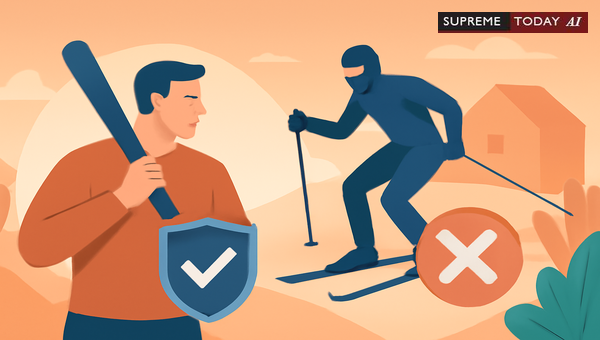
Can You Use to Defend Your Right of Way?
Imagine driving to your property only to find a neighbor's vehicle or debris blocking your established right of way. Frustration mounts, and you wonder: Can minimum be used to protect your right of way in removing an obstacle created by the defendant? This common scenario raises critical questions about self-help remedies, private defense, and the boundaries of lawful force.
In this guide, we'll break down the legal principles governing such situations. Drawing from judicial precedents, we'll explore when force is permissible, the necessity of , and real-world applications. Note: This is general information based on legal precedents and not specific legal advice. Consult a qualified attorney for your circumstances.
The Legal Foundation:
Under principles of private defense—often rooted in statutes like the —individuals may use force to protect property rights, including like rights of way. The law recognizes that a person in possession of land or with a legal right of way is entitled to use to safeguard it. As established, a person exercising a right should be allowed to do so without hindrance, and that any obstruction that is created or removed must be within the permissible limits 1970 0 Supreme(MP) 89.
Key to this is the concept of private defense, which permits resisting unlawful interference or obstruction. Courts have clarified that this includes preventing or obstacles from impeding access, but only through proportionate means. Private defense includes the right to prevent unlawful interference but must be proportionate and exercised in 1998 0 Supreme(Raj) 689.
Core Requirements for Using Force
To qualify as lawful:- Necessity: Force must be the minimum required to remove the obstruction or restore access.- : It should match the threat—e.g., pushing a movable barrier, not wielding a weapon.- : Actions must be defensive, not aggressive or retaliatory.
Excessive force crosses into criminal territory. Excessive force beyond what is necessary for self-protection or defense of property is not justified and can lead to criminal liability 1998 0 Supreme(Raj) 689 1969 0 Supreme(SC) 401.
: The Critical Test
is the linchpin. Courts assess whether the force was just enough to prevent obstruction or interference, not more. For instance, in property disputes, a possessor may resist obstructors proportionately. A person in possession of land or property is entitled to use to protect his possession 2003 8 Supreme 928.
This mirrors broader standards, even in public order contexts: Police's use of force must be reasonable and justified, especially in the context of peaceful demonstrations 2008 0 Supreme(Del) 1041. Applied to private right-of-way disputes, it means gentle physical removal of a non-violent obstacle is typically defensible, but escalation risks liability.
Limitations and Exceptions
Not all force is excused:- Excessive Acts: Causing injury when minimal effort suffices is unlawful. Acts in excess—such as causing grievous injury or death when only minimal force was necessary—are not justified 2008 0 Supreme(Del) 1041 1969 0 Supreme(SC) 401.- Premeditation: Planned violence voids the defense.- Peaceful Alternatives: If dialogue or authorities can resolve it, force may be deemed unnecessary. The right does not permit violence or excessive force in situations where peaceful resistance suffices 1970 0 Supreme(MP) 89.
Insights from Key Cases
Judicial rulings provide concrete guidance. In one matter involving a private road, the court noted: The may further have to consider... whether the force used for prevention of any trespass on a private road belonging to the accused was right or more than sufficient as to tantamount to a criminal offence 2009 0 Supreme(Bom) 664. Here, process was issued against alleged obstructors, emphasizing that even evidence of force requires scrutiny—reinforcing that self-help must be measured.
Another case highlighted family disputes where force was used to remove persons: It is established beyond reasonable doubt that appellants used force in removing Moti from the house of her mother 2007 0 Supreme(Raj) 2186. Though extreme, it underscores that disproportionate removal tactics can lead to severe consequences like .
In property quarrels, violence over obstacles has been condemned: Hoshiar Singh was set on fire in the process of removing this obstacle from their way 2005 0 Supreme(P&H) 121. The court upheld murder convictions, stressing that private defense fails when force exceeds bounds.
Public rights cases also inform: Permissions for processions were granted after courts removed state-created obstacles, lamenting continuous problems created by the State by refusing permission and the Court's inevitable exercise of removing the obstacle 2018 0 Supreme(Mad) 3324. This illustrates judicial preference for minimal intervention over vigilante force.
Even international analogies align, as in U.S. cases evaluating vehicle stops: The next question is whether the force Defendants used... was excessive, or whether the were objectively reasonable under the circumstances. Graham v. Connor provides the framework 2023 Supreme(US)(ca9) 382. remains universal.
A bund dispute case further clarifies: The accused... who had stationed themselves at the bund for maintaining by force or by a show of force a right which they bona fide believed to have possessed did not constitute an 1999 0 Supreme(Mad) 2431. Yet, the plea of self-defense was unavailable if the initial act was unlawful, highlighting bona fides' role.
Practical Application to Right-of-Way Disputes
Applying this to your scenario: Yes, minimum is generally permissible to protect a right of way by removing a defendant's obstacle, if proportionate and necessary. For example:- Permissible: Manually shifting a parked vehicle or barrier blocking access, without damage or harm.- Risky/Impermissible: Striking the obstructer or using tools causing injury.
In a public road access complaint under IPC Sections 341, 431, etc., courts refused to quash proceedings, noting: Whether road is private one... is not shown distinctly... At stage of issue of process only the most evidence is to be seen 2009 0 Supreme(Bom) 664. This cautions that disputed rights demand caution—force isn't a substitute for court orders.
Recommendations for Safe Resolution
To minimize risks:- Document Everything: Photos, witnesses, prior notices of the right of way.- Seek Alternatives First: Notify the obstructer, involve police for removal.- Use Minimal Force: Only what's needed; call authorities if resistance escalates.- Know Your Rights: Verify easement via deeds or surveys.- Avoid Escalation: Any resistance should be proportionate to the threat posed, avoiding violence or use of deadly weapons unless absolutely necessary.
Authorities must scrutinize force: Force must be employed in and with due care; acts in excess are criminally liable 2008 0 Supreme(Del) 1041.
Conclusion and Key Takeaways
In summary, the law supports using minimum to defend your right of way from obstructions, but strictly within private defense limits—proportionate, necessary, and in . Excessive actions invite liability, as courts demand restraint.
Key Takeaways:- Force is okay if minimal and matched to the threat 1998 0 Supreme(Raj) 689 1970 0 Supreme(MP) 89.- trumps all—excess is criminal 1969 0 Supreme(SC) 401.- Prioritize de-escalation and documentation.- For easement disputes, litigation often beats self-help.
Stay informed, act judiciously, and protect your rights responsibly. For tailored guidance, reach out to a legal professional.
References:- 1970 0 Supreme(MP) 89, 1998 0 Supreme(Raj) 689, 1969 0 Supreme(SC) 401, 2008 0 Supreme(Del) 1041, 2003 8 Supreme 928, 2009 0 Supreme(Bom) 664, 2007 0 Supreme(Raj) 2186, 2005 0 Supreme(P&H) 121, 2018 0 Supreme(Mad) 3324, 1999 0 Supreme(Mad) 2431, 2023 Supreme(US)(ca9) 382
#ReasonableForce #RightOfWay #PrivateDefense















