




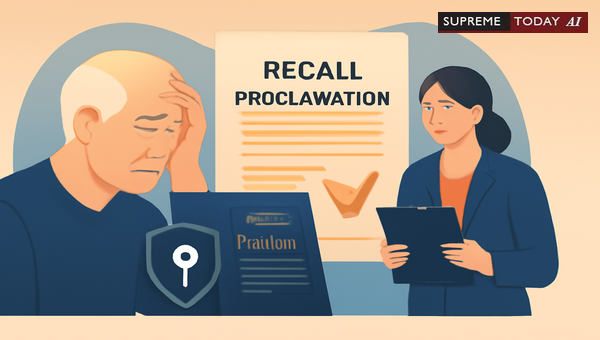
Can a Power of Attorney Recall a Under for a Dementia Accused?
In the evolving landscape of Indian criminal law, the has replaced key provisions of the , including Section 84 on proclamations against . But what happens when the accused suffers from dementia? Can a holder step in to file an application to recall such a ? This question arises frequently in cases involving elderly or mentally incapacitated individuals facing criminal charges.
This post delves into the legal nuances, drawing from judicial precedents and statutory principles. We'll examine the challenges, evidentiary burdens, and practical recommendations. Note: This is general information, not specific legal advice. Consult a qualified lawyer for your situation.
Understanding and Proclamations
empowers courts to issue a when an accused is absconding or avoiding arrest. This public notice requires the accused to appear within , failing which their property may be attached. Recalling such a typically demands proof that the accused was available, the issuance was erroneous, or circumstances have changed—such as mental incapacity preventing appearance. 2015 0 Supreme(Gau) 453
The query at hand: Can an application to recall issued under be filed by power of attorney of dementia accused? Courts approach this cautiously, especially when mental health is invoked, often intersecting with Section 84 of the Bharatiya Nyaya Sanhita (BNS, replacing ), which exempts acts by persons of . 2015 0 Supreme(Chh) 302
Main Legal Challenges in Using POA for Dementia Accused
Burden of Proving Unsoundness of Mind
Under (formerly ), Nothing is an offence which is done by a person who, at the time of doing it, by reason of unsoundness of mind, is incapable of knowing the nature of the act, or that he is doing what is either wrong or contrary to law. 2015 0 Supreme(Chh) 302 The burden lies squarely on the accused or their representatives to prove this with , not mere assertions. Courts presume sanity unless rebutted by medical or . 2006 0 Supreme(Gau) 477
A POA holder filing to recall a BNSS on dementia grounds faces hurdles:- Mental State at Relevant Time: must show incapacity precisely when the offense occurred or was issued, not just current dementia. Casual statements via POA won't suffice. 2006 0 Supreme(Gau) 477- POA Validity: General POAs may not authorize decisions on mental incapacity or criminal defenses. Courts prefer court-appointed guardians for incapacitated persons. 2024 Supreme(AUS)(WASAT) 10744
Judicial Precedents on Requirements
In key rulings:- The defense must provide clear, medical, or expert ; history alone is inadequate. For example, in , medical exams were deemed essential. 2006 0 Supreme(Gau) 477- Mere dementia doesn't automatically exempt; it must impair cognition at the offense time. 2006 0 Supreme(Gau) 477
Related BNSS cases reinforce procedural rigor. In under (analogous to ), courts prevent abuse where conviction seems impossible, but only with strong grounds. 2025 0 Supreme(Gau) 372
Role of Power of Attorney in Mental Incapacity Cases
POAs are common for financial matters, but in criminal contexts involving dementia:- Capacity Presumption: Execution of POA presumes the principal's capacity unless proven otherwise. No of coercion or incapacity at execution invalidates it. 2024 Supreme(AUS)(WASAT) 10744- Limitations: A POA doesn't confer powers for liberty-affecting decisions like contesting proclamations. offer alternatives but require specific authorization. 2024 Supreme(AUS)(WASAT) 10744- Guardian Preference: For dementia cases, seek court-appointed under relevant laws to legitimize actions.
Other sources highlight : Authorities under one law can't decide issues under another, underscoring need for proper forums. 2016 0 Supreme(Guj) 909
Integrating BNSS Procedures and Principles
BNSS emphasizes liberty: is the rule and jail is the exception. 2025 0 Supreme(Ker) 575 2025 0 Supreme(Ker) 500 2025 0 Supreme(Ker) 709 In recalls, similar principles apply—arrest/ must be justified, not routine.
- Courts grant under for offenses with max 3-year punishment if no antecedents, directing surrender for interrogation. 2025 0 Supreme(Ker) 575
- Conditions ensure cooperation, mirroring recall applications. 2025 0 Supreme(Ker) 500
For dementia accused, combine with or reports, as in employment termination cases invoking mental health provisions.
Practical Steps and Recommendations
To strengthen a recall application via POA:1. Gather Medical : Obtain expert reports on mental state at offense/ time. 2015 0 Supreme(Chh) 302 2006 0 Supreme(Gau) 4772. Validate POA: Ensure it explicitly covers ; prefer .3. File with Proof: Demonstrate erroneous due to incapacity, rebutting absconding presumption.4. Comply with : Notices under (ex-) must follow prescribed modes, not WhatsApp.
Pavankumar VS State of Karnataka Through Adugodi P. S. , Rep. by State Public Prosecutor
Without these, courts are unlikely to accept, as casual assertions or representations through a POA do not suffice. 2006 0 Supreme(Gau) 477
Exceptions and Alternative Recourses
- Formal Declarations: Prior legal/medical incapacity records bolster claims.
- Quashing Powers: Invoke BNSS 528 if proceedings abuse process. 2025 0 Supreme(Gau) 372
- Applications: Seek interim relief under BNSS 482, emphasizing . 2025 0 Supreme(Ker) 709
Key Takeaways
- POA-based applications to recall BNSS Section 84 proclamations for dementia accused face evidentiary and authority hurdles. 2015 0 Supreme(Chh) 302 2006 0 Supreme(Gau) 477
- Success hinges on cogent medical proof of unsoundness at the relevant time, beyond POA claims.
- Opt for guardianships and structured to navigate courts effectively.
References:- 2015 0 Supreme(Chh) 302: Burden and under Section 84 .- 2006 0 Supreme(Gau) 477: Proof requirements for .- 2024 Supreme(AUS)(WASAT) 10744: POA in dementia contexts.
This analysis highlights the interplay of procedural (BNSS) and substantive (BNS/) laws. Stay informed on updates, as 2023 laws continue evolving.
#BNSS2023 #DementiaLaw #POALegal















