


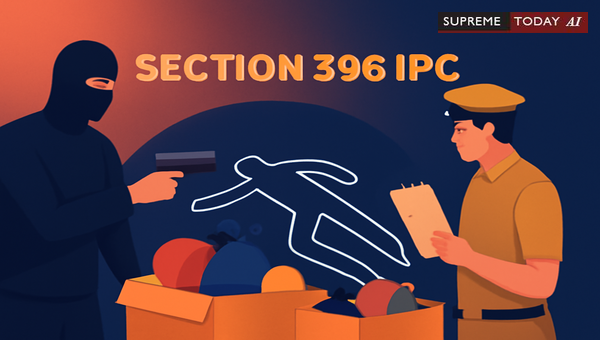
Is Recovery of Looted Articles Required for Section 396 IPC Conviction?
In high-stakes criminal cases involving under , a common question arises: Whether the Recovery of Looted Articles is Necessary to Bring the Accused Guilty under Section 396 IPC? This issue is critical for prosecutors, defense lawyers, and those navigating India's criminal justice system. Recovery of stolen property often plays a role, but is it indispensable? This blog post delves into the legal principles, judicial precedents, and practical implications, drawing from rulings and related cases.
We'll examine why courts have repeatedly held that such recovery is not strictly necessary, provided other robust evidence exists. Whether you're a legal professional or simply interested in criminal law, understanding this can clarify misconceptions around evidence in dacoity cases.
What is Section 396 IPC?
Section 396 IPC punishes , where five or more persons conjointly commit or attempt dacoity, and in the course of that offence, at least one murder occurs. The punishment is death or life imprisonment, reflecting the gravity of combining robbery with homicide.
Key ingredients include:- Commission of dacoity (robbery by five or more persons).- Murder committed in the course of or in furtherance of the dacoity.
Notably, the section focuses on participation in the dacoity and the murder element, not on post-crime recovery of loot. As courts emphasize, the core is proving the accused's role in the dacoity-murder nexus2000 5 Supreme 61.
Is Recovery of Looted Articles Strictly Necessary?
The short answer: No. Recovery of looted or stolen articles is not a mandatory element for conviction under Section 396 IPC. Courts have consistently ruled that other direct or —such as eyewitness accounts, confessional statements, , or —can independently establish guilt.
Legal Principles
To secure a conviction, prosecution must demonstrate:- The accused participated in the dacoity.- Murder occurred during its course.
Recovery serves as but is not an essential ingredient. The has clarified: the recovery of stolen articles is not a necessary condition for conviction under Section 396 IPC 2000 5 Supreme 61. Other evidence like eyewitness testimony, confessions, , and circumstances suffices.
In contrast, mere possession of stolen property might lead to charges under (dishonestly receiving stolen property), but not Section 396 without proof of dacoity-murder participation 1969 0 Supreme(SC) 433.
Judicial Precedents: Convictions Without Recovery
Indian courts, especially the , have upheld convictions sans recovery when evidence convincingly links the accused.
Rulings
In a 1988 judgment, the Court noted that is not substantive evidence and recovery of articles is necessary to sustain conviction based solely on identification. However, suspicious identification alone cannot sustain conviction without corroboration—but this underscores recovery's supportive, not mandatory, role 2015 4 Supreme 519.
Another ruling clarified: if a person in possession of stolen property cannot be shown to have participated in the dacoity or murder, conviction under Section 396 is not sustainable. Recovery alone does not establish participation1997 3 Supreme 397.
Critically, recovery of looted articles is not a (essential condition). Absence did not preclude conviction based on other evidence proving murder in the course of dacoity2009 0 Supreme(SC) 26.
Explicitly: recovery is not essential; courts rely on eyewitnesses, confessions, etc. 2000 5 Supreme 61.
Insights from Other Cases
Recent judgments reinforce this flexibility:
In a case involving bombs and robbery, conviction under Section 396 was set aside due to sloppy prosecution evidence not connecting the accused, despite claims of identification and loot. Silence under couldn't fill gaps 2021 0 Supreme(Jhk) 581. This highlights that weak evidence, recovery or not, fails.
CCTV footage, DNA, and recovery of stolen articles corroborated convictions under Sections 396 and 412, even with electronic evidence issues. upheld guilt 2024 0 Supreme(P&H) 1213.
Where no cogent evidence linked an accused to dacoity-murder, conviction was quashed, emphasizing proof beyond recovery 2022 0 Supreme(Telangana) 609.
Child witness testimony with omissions led to acquittal; victim appeals limited, stressing case-specific merits 2022 0 Supreme(Telangana) 609.
Convictions under Section 396/412 modified to lesser offences like Section 411 when recovery delayed or identification weak, showing recovery's evidentiary weight but not primacy 2023 0 Supreme(Cal) 1300.
In a dacoity appeal, lack of recovery evidence (e.g., licensed gun) challenged Section 396, but court upheld life sentences under based on other proof, setting aside for insufficient receipt evidence 2020 0 Supreme(All) 553.
Circumstantial chains, including recoveries, corroborated eyewitnesses, proving conspiracy and murder 2018 0 Supreme(Del) 1290.
These cases illustrate: Recovery strengthens but doesn't define cases. Courts demand a complete evidentiary chain excluding innocence hypotheses 2016 0 Supreme(Raj) 698.
When Recovery Matters: Corroboration and Limitations
While not required, recovery via disclosure (under ) powerfully corroborates. However:- Mere possession post-dacoity doesn't prove Section 396 guilt 1969 0 Supreme(SC) 433.- In weak cases, its absence may tip scales toward acquittal 2014 0 Supreme(All) 2953.- Always pursue it as additional proof, alongside eyewitnesses or forensics.
Exceptions: If evidence is doubtful, lack of recovery influences assessment—but doesn't auto-acquit.
Practical Recommendations for Legal Practitioners
- Prioritize direct evidence: Secure eyewitness statements, confessions (voluntary), and scene linkages.
- Build circumstantial webs: , , DNA/CCTV.
- Use recovery strategically: As corroboration, ensuring compliance (memos, witnesses).
- Defense strategy: Challenge weak links, especially sans recovery.
Key Takeaways
- Recovery of looted articles is not prerequisite for Section 396 IPC guilt.
- Eyewitnesses, confessions, circumstances suffice2000 5 Supreme 61.
- Courts convict sans recovery if participation and murder proved 2009 0 Supreme(SC) 26.
- Always holistic evidence assessment.
Disclaimer: This post provides general information based on precedents and is not legal advice. Consult a qualified lawyer for case-specific guidance, as outcomes vary.
In conclusion, Section 396 IPC prioritizes proving the dacoity-murder link over loot recovery. This judicial stance ensures justice relies on comprehensive proof, not single elements. Stay informed on evolving case law for robust defenses or prosecutions.
#Section396IPC, #DacoityWithMurder, #IPCConviction












