


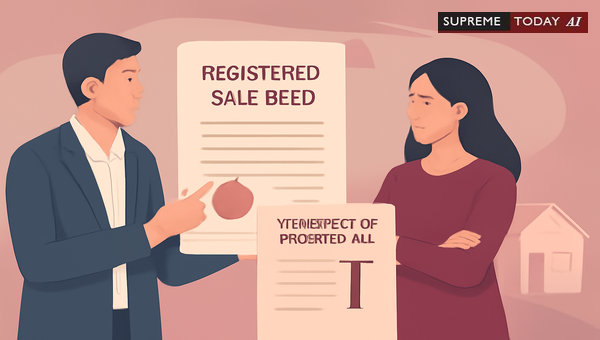
: Understanding Presumption of Registered Documents in Property Disputes
In the realm of property law, few issues spark as much contention as disputes over title and ownership. Imagine a scenario where a registered is challenged, raising questions about its validity, the transfer of ownership, and the role of or . This is precisely the landscape of the case , a pivotal judgment that clarifies critical principles under Indian law. Whether you're a property owner, buyer, or legal professional, grasping these rulings can safeguard your interests in land transactions.
This blog delves into the case , examining its implications for registered documents, property transfers, and evidentiary standards. We'll break down the court's findings, key legal principles, and related precedents to provide a comprehensive overview.
Background of the Case
The dispute in centered on a suit for , , and over disputed land. The plaintiff relied on a registered to assert ownership, supported by in revenue records. Defendants contested the deed's execution and the land's identity, leading to a multi-level appellate review. Ultimately, the court upheld the plaintiff's claim, emphasizing the strength of registered instruments. 2019 0 Supreme(Gau) 999
This case underscores common pitfalls in property litigation, where parties often challenge documents without sufficient rebuttal evidence. It serves as a reminder that proper documentation is paramount in immovable property dealings.
Key Legal Principles Established
1. for Registered Sale Deeds
A cornerstone of the judgment is the attached to registered documents under the . The court held that a registered is presumed to be duly executed and genuine unless rebutted by cogent evidence. Without such proof, courts cannot lightly dismiss it. 2019 0 Supreme(Gau) 999
This principle aligns with Part-XI of the Registration Act, which outlines duties of registering officers. In , the court elaborated: This Court in , dealing with the presumption associated with the certified copy of a registered sale-deed held as follows: Part-XI of the provides for the duties and powers of the Officers. 2018 0 Supreme(Gau) 738
Practical Tip: Parties challenging a registered deed must present strong counter-evidence, such as fraud proof or execution flaws, rather than mere denials.
2. Requirements for Valid Property Transfer Under Section 54 TPA
, mandates that sales of immovable property worth Rs. 100 or more require a . The ruling clarifies that is not essential for title transfer; the registered deed alone suffices. 2017 0 Supreme(Gau) 488
This reinforces that ownership passes upon execution and registration, streamlining transactions. In related contexts, courts have upheld gift deeds and subsequent sales similarly, provided no procedural lapses. 2017 0 Supreme(Gau) 1169
3. Role of Mutation and as Evidence of Title
in revenue records carry a presumption of correctness and support claims of title, though they do not confer ownership independently. The court stressed giving due weight to these unless rebutted. further bolsters the case. 2019 0 Supreme(Gau) 999
In the instant matter, the plaintiff's mutation and evidence tipped the scales, as defendants failed to disprove them.
Court's Findings and Analysis
The higher court found:- Plaintiff proved the 's execution and mutation in his favor, establishing title.- Defendants provided no cogent evidence to rebut the registered deed's presumption. 2019 0 Supreme(Gau) 999 2017 0 Supreme(Gau) 488
Additionally, on , the certified copy of the was admissible under . The court noted: The court discussed the admissibility of a certified copy of a sale-deed as ... The certified copy of the sale-deed was admissible as and that the defendants failed to discharge their burden. 2018 0 Supreme(Gau) 738
Defendants' failure to object during marking of exhibits or cross-examine witnesses sealed their fate. This echoes holdings where unobjected documents gain presumptive value. 2017 0 Supreme(Gau) 1169
The first appellate court's perverse findings on land identity were overturned, restoring the trial court's decree for the plaintiff. 2018 0 Supreme(Gau) 738
Broader Implications from Related Precedents
While is landmark, it intersects with other rulings:- In land disputes, plaintiffs must identify suit land precisely; mismatches can derail claims. 2018 0 Supreme(Gau) 738- Gift deeds, like sale deeds, transfer title upon registration if unchallenged. 2017 0 Supreme(Gau) 1169
These principles extend to eviction and rent matters under acts like , where documentary presumptions hold sway, though execution modes differ. Note: Unrelated cases with similar names (e.g., Sheo Kumar Singh matters) highlight the prevalence of such disputes but do not alter core holdings here.
Recommendations for Property Stakeholders
To navigate similar disputes:- Secure Registration: Always register deeds for immovable property over Rs. 100 to invoke presumptions.- Document and Mutation: Promptly update records post-transfer; they serve as vital evidence.- Prepare Rebuttals: Challengers need specific, credible proof—avoid unsubstantiated denials.- Exhibit Handling: Object timely to in trials to preserve challenges.
Consult professionals for case-specific advice, as outcomes vary by facts.
Conclusion and Key Takeaways
fortifies the sanctity of registered documents in property law, emphasizing rebuttable presumptions, registration's primacy, and mutation's evidentiary role. It cautions against weak challenges and promotes meticulous record-keeping.
Key Takeaways:- Registered sale deeds enjoy genuineness presumption unless disproved. 2019 0 Supreme(Gau) 999- Title transfers via registration, sans delivery. 2017 0 Supreme(Gau) 488- Mutation aids title proof but requires corroboration.
Disclaimer: This analysis is for informational purposes only and does not constitute legal advice. Laws evolve, and applications depend on specific circumstances. Seek qualified counsel for personalized guidance.
References: 2019 0 Supreme(Gau) 999 2017 0 Supreme(Gau) 488 2018 0 Supreme(Gau) 738 2017 0 Supreme(Gau) 1169
#PropertyLaw #LandDisputes #RegisteredDeeds












