


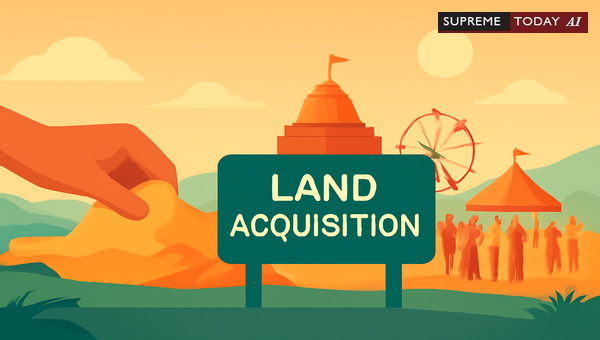
Religious Fair Land Acquisition: Does It Serve a ?
In India, land acquisition for development projects often sparks debates over what truly constitutes a . Imagine a vibrant religious fair, or jatra, deeply embedded in community traditions—can the government acquire private land for such an event under the , 1894? This question tests the boundaries of , balancing with . Whether the acquisition of private land for holding a religious fair (jatra) constitutes a within Section 3(f) of the Act is not straightforward, but courts have provided evolving guidance. This post explores the legal landscape, drawing from key judgments to offer insights—note: this is general information, not specific legal advice; consult a qualified lawyer for your situation.
Understanding Under Section 3(f)
, 1894, provides an inclusive definition of , covering uses like infrastructure, housing, and . However, it's not exhaustive. Courts have emphasized that the concept is dynamic, evolving with constitutional values, including and under . under the is not static and must evolve with constitutional and societal values 2011 0 Supreme(SC) 267.
Historically rigid, the interpretation now accommodates broader societal interests. like this Act demand , yet the scope of can be expanded to include diverse , including religious events, if they align with public interest 2011 0 Supreme(SC) 267. This shift reflects India's cultural fabric, where religious and community events foster social harmony.
Religious and Cultural Facilities: Eligible for ?
Religious fairs like jatra—annual gatherings with rituals, processions, and cultural performances—serve more than spiritual needs; they promote community bonding and cultural preservation. Courts have extended to include construction of religious or cultural facilities, including temples or places for religious events, viewing them as integral to societal and 2011 0 Supreme(SC) 267.
This aligns with , which permits state support for religious activities benefiting the public, provided they don't favor sects. For instance, if a jatra draws thousands, enhancing local economy and identity, it may qualify—generally speaking. However, the purpose must be genuine, not a pretext for private gain.
Judicial Evolution and Key Precedents
Broadening the Scope
The and have progressively widened . In cases involving , acquisitions for community pathways to burial grounds were upheld as serving public welfare, even for specific groups like the , emphasizing 2014 0 Supreme(Mad) 4015. Similarly, power projects generating electricity for the state were deemed public purposes, justifying clauses amid crises 2011 0 Supreme(MP) 390.
The inclusive definition of does not restrict its ambit and scope 2011 0 Supreme(MP) 390. This supports including cultural events if they advance planned development or social welfare.
Strict Safeguards and Limitations
Despite flexibility, boundaries exist. Acquisitions can't be repurposed from public to private without ; violations render them void 2024 Supreme(Online)(MP) 41195. Land acquired for cannot be repurposed for private use without ; failure to comply with statutory requirements renders acquisition void 2024 Supreme(Online)(MP) 41195.
Procedural compliance is crucial. Non-adherence to hearings or lack of sanctioned schemes invalidates proceedings. In one case, acquisition for premises lacking under Section 3(f) was set aside due to procedural lapses and disputes suggesting private motives 2024 0 Supreme(Cal) 242. The judgment establishes the importance of satisfying the requirement under Section 3(f) and the need for compliance with the of 2024 0 Supreme(Cal) 242.
or doom acquisitions. Agreements with middlemen to influence government for private societies were quashed as opposed to , lacking genuine schemes or approvals 2016 6 Supreme 650. Neither a scheme framed by the respondent-Society nor prior approval granted by the state government – Acquisition proceedings cannot be said to be one for ‘’ 2016 6 Supreme 650.
under requires real justification; arbitrary invocation fails 2006 0 Supreme(Raj) 1234. Even state-funded projects for companies qualify if public-oriented, but controlling interests don't override funding tests 2025 0 Supreme(Bom) 135.
Land reserved for public use can't shift to private, as seen in municipal layout disputes 2013 0 Supreme(Mad) 3854. Land reserved for cannot be used for private purposes 2013 0 Supreme(Mad) 3854.
Applying to Religious Fairs (Jatra)
For a jatra, demonstrate community-wide benefits: social harmony, cultural preservation, economic boost. It must align with constitutional mandates, avoiding sectarian bias. Courts caution: The must be genuine and not merely for private or religious interests disguised as public benefit. The acquisition must be for a purpose that genuinely benefits the community 2011 0 Supreme(SC) 267.
- Pros: Evolves with societal values; supports cultural identity.
- Cons: Risk of abuse; needs clear public benefit over private.
- Procedures: Follow strictly; provide hearings.
Practical Recommendations
If pursuing acquisition for a jatra:- Articulate societal benefits in notifications.- Secure government approval and schemes.- Ensure transparency to counter claims.- Offer per evolving laws like the .
When proposing land acquisition for religious or cultural purposes, clearly demonstrate the societal and community benefits involved 2011 0 Supreme(SC) 267.
Key Takeaways
- under Section 3(f) is inclusive and dynamic, potentially covering religious fairs if serving broader interests 2011 0 Supreme(SC) 267.
- Strict procedures and genuine intent are non-negotiable 2024 Supreme(Online)(MP) 41195 2024 0 Supreme(Cal) 242.
- Balance property rights () with welfare 2025 0 Supreme(Bom) 135.
Land acquisition remains contentious, but judicial trends favor inclusive interpretations for cultural needs. Stay informed on updates, as laws evolve—this overview is for educational purposes; seek professional advice.
References:- 2011 0 Supreme(SC) 267: Core on evolving .- 2024 Supreme(Online)(MP) 41195, 2024 0 Supreme(Cal) 242, 2025 0 Supreme(Bom) 135, 2016 6 Supreme 650, 2014 0 Supreme(Mad) 4015, 2013 0 Supreme(Mad) 3854, 2011 0 Supreme(MP) 390, 2006 0 Supreme(Raj) 1234: Supporting cases on procedures and limits.
#LandAcquisition, #PublicPurpose, #IndianLaw












