


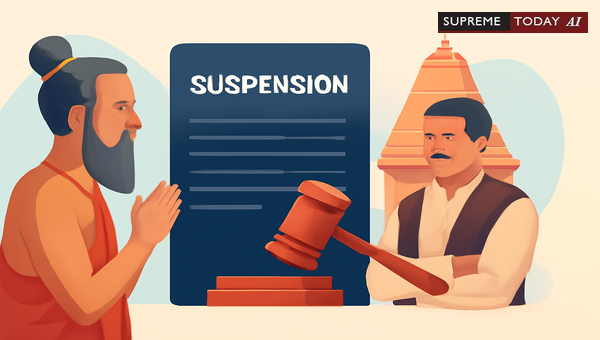
Remedy for a Suspended Temple Priest (Santhi) Under the
Imagine serving as a dedicated santhi (priest) in a revered temple, only to face sudden suspension by the trustees. What recourse do you have? Many temple priests in Tamil Nadu grapple with this question: What is the remedy for a santhi of a temple working under the (HR&CE Act), if suspended by the trustees? Is (e) suitable for this situation? This post breaks down the legal landscape, drawing from key case law and statutory principles to guide you.
Important Disclaimer: This article provides general information based on legal precedents and is not a substitute for professional legal advice. Consult a qualified lawyer for your specific case.
Understanding Trustee Authority in Temple Management
Under the , 1959 (HR&CE Act), trustees hold primary responsibility for temple administration, including staff appointments. vests powers to appoint temple staff, such as priests, solely with the trustees. As established in relevant case law, the powers to appoint temple staff, including office-holders like priests, are vested solely in the trustees under of the 2006 0 Supreme(Mad) 982. Administrative orders by officers without trustee approval are invalid 2006 0 Supreme(Mad) 982.
This authority extends to management decisions, but it must align with legal bounds. Trustees cannot act arbitrarily; their actions are subject to principles of natural justice and judicial scrutiny.
The Issue of Suspension: No Specific Statutory Provision
The HR&CE Act does not explicitly outline procedures for suspending temple priests. Unlike declarations on temple nature or hereditary trusteeships under , suspension falls under general administrative powers of trustees. If trustees suspend a priest, it must be within their scope, following fair procedure.
Courts have emphasized that disciplinary actions like suspension require proper authority. If initiated by an unauthorized officer or without due process, such orders are liable to be quashed. For instance, principles from temple ownership disputes highlight that management powers are strictly delineated 2006 0 Supreme(Mad) 2802.
Is (e) the Right Remedy?
of the HR&CE Act empowers authorities to inquire into various matters, such as whether a temple is public or private ((a)), hereditary nature of trusteeship ((b)), or specific endowments 2011 0 Supreme(Mad) 4694 2023 0 Supreme(Mad) 3195. Subsection (e) typically relates to schemes for administration or other regulatory aspects, but it is not tailored for individual employee suspensions like a priest's.
Case law repeatedly directs parties to exhaust remedies for institutional disputes before civil courts: temple, cannot approach the Civil Court without exhausting the remedy provided under the , 1959 2011 0 Supreme(Mad) 4694. However, for priest suspension, (e) is generally not suitable, as it does not address personal disciplinary actions. Instead, it applies to broader endowment or trusteeship declarations 2023 0 Supreme(Mad) 3345.
Priests should assess if their issue ties into a larger declaration (e.g., appointment validity), but suspension challenges typically bypass direct petitions.
Primary Legal Remedy: Writ Petition Under Article 226
The cornerstone remedy for a suspended temple priest is filing a writ petition in the under . Courts review whether the suspension was:- Illegal or arbitrary- Beyond trustees' powers- Violative of natural justice
Judicial intervention ensures administrative actions stay within legal limits. In the key case, courts set aside invalid orders lacking trustee approval 2006 0 Supreme(Mad) 982. The can quash suspensions found mala fide or procedurally flawed.
Supporting precedents affirm writs as viable when statutory remedies are absent or inadequate:- Challenges to departmental actions often succeed via certiorari 2022 Supreme(Online)(Mad) 86840.- Even in trusteeship disputes, writs quash improper orders under 2022 0 Supreme(Mad) 3707.
Judicial Review and Key Case Insights
Courts play a pivotal role in balancing trustee autonomy with employee rights. For example:- In endowment nature disputes, determinations under prevail, but overreach invites review 2023 0 Supreme(Mad) 3345. provides a mechanism for determining the nature of endowments 2023 0 Supreme(Mad) 3345.- Private vs. public temple classifications affect oversight, with remedies under Sections 63 and 70 2017 0 Supreme(Mad) 1297 2017 0 Supreme(Mad) 1538.- Hereditary trustee claims require (b) declarations before further action 2022 0 Supreme(Mad) 3707.
A related ruling notes: the remedy open to the plaintiffs is to file a petition under of the Hindu Religious Charitable and Endowment Act 1959 for appointment of trustees 2006 0 Supreme(Mad) 2802, underscoring statutory exhaustion, but for suspensions, writs fill the gap.
In one instance, petitioners challenging temple status were directed to HR&CE authorities under (a), confirming public access and management 2017 0 Supreme(Mad) 1297. These cases reinforce that while trustees manage daily affairs, courts safeguard against abuse.
Exceptions and When Suspension May Hold
Suspensions by authorized trustees, backed by a trust deed or regulations, and following due process (notice, hearing), may withstand challenge. If linked to endowment schemes, inquiries could apply indirectly 2023 0 Supreme(Mad) 3195.
However, illegal encroachments or unrelated disputes do not justify suspension without evidence 2012 0 Supreme(Mad) 1849.
Practical Recommendations for Temple Priests
If suspended:1. Gather Evidence: Document the suspension order, trustee authority, and procedural lapses.2. File Writ Petition Promptly: Approach the under Article 226, arguing illegality.3. Exhaust if Applicable: For intertwined issues (e.g., hereditary rights), consider first 2011 0 Supreme(Mad) 4694.4. Seek Interim Relief: Request stay on suspension to resume duties.5. Trustees' Best Practices: Document reasons, provide hearings, and stay within powers to mitigate challenges.
Conclusion and Key Takeaways
Suspended temple priests under the HR&CE Act typically rely on writ petitions rather than (e), which suits institutional declarations. Trustees wield significant power, but it is not absolute—judicial review protects against arbitrariness 2006 0 Supreme(Mad) 982.
Key Takeaways:- Trustees appoint/manage under ; suspensions need authority.- No direct statutory suspension remedy; writs under Article 226 are primary.- (e) not ideal for individual suspensions.- Always prioritize natural justice to avoid quashing.
Stay informed on evolving case law, and for personalized guidance, consult a specialist in HR&CE matters. Temples are sacred spaces; fair administration upholds their sanctity.
#HRCEAct #TemplePriestRemedy #HinduEndowments












