


How Agents Can Legally Represent Owners in NI Act Cases When Owner is Abroad
In the world of business transactions, bounced cheques under the (NI Act), particularly Section 138, can lead to significant legal battles. Imagine you're an agent managing affairs for an original owner who's now in the USA. A pressing question arises: In NI Act, I am the Agent to the Original Owner and now I want to act on behalf of him, the Actual Owner is in USA, how am I eligible to act on behalf of him?
This scenario is common for NRIs or owners abroad handling complaints. While agents can represent principals, strict legal authorization is key. This post breaks down the requirements, drawing from court precedents and legal principles. Note: This is general information, not specific legal advice. Consult a qualified lawyer for your case.
Understanding the NI Act and Agent's Role
The NI Act governs negotiable instruments like cheques. Section 138 makes due to insufficient funds a criminal offence, allowing the payee (or holder) to file a complaint. But what if the payee/owner is abroad?
An agent is defined broadly as a person employed to do any act for another, or to represent another in dealings with third persons. 2025 Supreme(Online)(Del) 2953 This includes filing complaints or defending cases. However, courts emphasize that mere agency isn't enough—formal authorization is required.
In NI Act proceedings, especially under Sections 138 and 141 (for companies/directors), representatives must prove their standing. Without it, petitions or complaints risk dismissal for lack of .
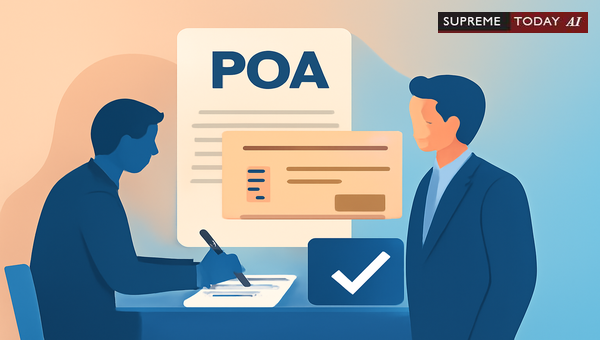
Key Requirement: (PoA)
To act on behalf of the owner, you typically need a duly executed . Courts have consistently ruled that informal arrangements or oral agency don't suffice.
Spousal Representation Example: Even a spouse managing property can't file writs without PoA. A spouse cannot file a on behalf of the other spouse without a duly executed . 2025 0 Supreme(Ker) 2604 The dismissed a petition where the wife represented her abroad husband, stressing (Section 120) doesn't extend to filing without authorization. (Paras 7-8)
General Agent Rules: Only a person who is authorised to act on behalf of the owner or purports to act on behalf of the owner may be deemed to be an agent. 2014 0 Supreme(Jhk) 942 Without a statement or indication from the owner, no exists.
For NI Act, a registered or notarized PoA specifying authority to institute legal proceedings (e.g., file under Section 138) is ideal. If the owner is in the USA, execute the PoA there (notarized/) and register it in India if needed.
Steps for Eligibility as Agent
- Obtain PoA: Principal (owner) grants specific powers via written PoA, ideally registered under the .
- Verify Scope: PoA must explicitly allow NI Act actions, like filing complaints or appearing in court.
- File with Proof: Attach PoA to the complaint. Courts verify authenticity.
- For Abroad Owners: Use video conferencing for verification if needed; comply with for recognized agents. 2025 0 Supreme(Ker) 2604 (Paras 9-11)
Court Precedents on Unauthorized Representation
Indian courts dismiss cases lacking proper agency:
Dismissal: In a land classification case, the petitioner (wife of abroad owner) lacked PoA. Court held: Neither the provisions in the Evidence Act, CPC, the Rules, nor the precedents... aid the petitioner in filing the on behalf of her husband without a . 2025 0 Supreme(Ker) 2604 Petition dismissed for no .
Parallel: An unregistered agreement to sell didn't confer standing. holder filed forms, but without registered ownership transfer, claims failed. 2021 0 Supreme(Guj) 280
Mining Act Analogy: No prosecution without proof. There is nothing on record to show that any such statement was furnished by the owner... enabling agent to act. 2014 0 Supreme(SC) 187 Similar scrutiny applies to NI Act.
In NI Act contexts, Section 141 requires directors/partners to be liable only if linked to the drawer. Agents for complainants must mirror this rigor. 2014 0 Supreme(SC) 187
Special Considerations for Owners in USA
With the principal in the USA:
- Execution Abroad: PoA can be executed under US law, but for Indian courts, apostille under Hague Convention or Indian Embassy attestation is crucial.
- Virtual Presence: Owners can affirm via affidavit/video, but agent still needs PoA.
- Mutation/Records: Like inheritance cases, update records post-authorization. A Will specified property limits; intent matters. 2016 0 Supreme(P&H) 1248
| Scenario | PoA Required? | Court Outcome ||----------|---------------|---------------|| Spouse filing writ 2025 0 Supreme(Ker) 2604 | Yes | Dismissed || Unregistered agreement 2021 0 Supreme(Guj) 280 | Yes for standing | Claims rejected || No owner statement 2014 0 Supreme(Jhk) 942 | Yes | No deemed agent |
Integrating Other Legal Contexts
Principles from CPC, Evidence Act, and specific statutes reinforce NI Act needs:
- CPC Order III: Recognized agents need PoA for suits. 2025 0 Supreme(Ker) 2604
- Rent Control: Oral claims of ownership failed without proof. 2005 0 Supreme(Bom) 1464
In , timelines are tight (30 days to file complaint). Delay due to absent PoA can bar remedies.
Potential Challenges and Solutions
- Challenge: PoA disputed as vague. Solution: Use irrevocable PoA with specific clauses.
- Challenge: Owner unreachable. Solution: Durable PoA pre-departure.
- NI Act Specific: Complaint must show agent's authority; else, acquittal possible.
Courts interpret documents by intent, as in Wills. 2016 0 Supreme(P&H) 1248 Ensure PoA reflects clear intent.
Key Takeaways
- Always Secure PoA: Essential for eligibility in NI Act actions.
- Document Everything: Attach verified copies; get attested if abroad.
- Seek Timely Advice: NI Act has strict limitation periods.
- Court Trend: Strict on —better safe with formalities.
Acting without proper authority risks dismissal, costs, and delays. For owners in USA, proactive PoA setup prevents issues. This overview draws from precedents; individual cases vary. Engage a lawyer specializing in NI Act for tailored guidance.
Word count approx. 1050. Sources cited for educational purposes.
#NIACT #ChequeBounce #PowerOfAttorney















