SupremeToday Landscape Ad
AI Thinking

AI Thinking...

Searching Case Laws & Precedent on Legal Query.....!

Scanned Judgements…!

Checking relevance for Narayani VS Sreedharan...

2011 0 Supreme(Ker) 823 : A joint will can be revoked by one party during the lifetime of the other, unless there is a specific agreement not to revoke it. The court held that even if a mutual will is executed, in the absence of a provision prohibiting revocation, each party remains free to revoke their will during their lifetime. The fact that one party has died without revoking the will does not prevent the survivor from revoking the disposition made in the will, even if they have received benefits from the deceased party''''s estate. This applies to joint wills as well, where each executant retains the right to modify or revoke their own testamentary disposition during their lifetime, unless there is an express agreement to the contrary.Checking relevance for Mathew VS Vasudevan...

1990 0 Supreme(Ker) 525 : A joint will can generally be revoked by one party during the lifetime of the other, but only if it is a true ''''Joint Will'''' and not a ''''Mutual Will''''. However, if the will is a Mutual Will—created by an agreement between the testators not to revoke the will, and where the surviving testator has received benefits under the deceased''''s will—then the surviving testator cannot revoke the will after the death of the other party. The key distinction is that Mutual Wills are irrevocable by the survivor after the death of the other testator, even if the will was executed jointly, provided both conditions are met: (1) the surviving testator has received benefits under the deceased''''s will, and (2) there was an agreement (express or implied) not to revoke the will. In such cases, the survivor is bound by the agreement and cannot revoke or modify the will, even though they may have the legal power to do so under general testamentary law. This principle is supported by English law (Dufour v. Pereira), Indian precedents (Kuppuswami v. Perumal, Dilhurshankar v. Controller of Estate Duty), and authoritative treatises like Halsbury''''s Laws of England and American Jurisprudence.Checking relevance for G. Princelal VS G. Prasanna Kumar...

2009 0 Supreme(Ker) 439 : A joint will can be revoked by the surviving testator during the lifetime of the other testator, but only after the death of one of the testators. The document explicitly states that on the death of one testator, the surviving testator shall have the absolute right to execute any document whatsoever, including the right to cancel or vary the will. This is confirmed in clause 15 of the joint will, which grants the surviving testator the power to revoke the will or vary its terms. The court held that such a provision makes the will revocable by the surviving testator after the death of the other, and that the surviving testator (Sarasamma) had the legal authority to revoke the joint will and execute other documents (Exts. A2 to A4) during her lifetime after the death of the first testator.Checking relevance for Mary C. P. VS C. P. Thomas...

1970 0 Supreme(Ker) 248 : A joint will can be revoked by one party during the lifetime of the other. The judgment explicitly states: ''''Joint wills are revocable at any time by either of the testators during their joint lives, or, after the death of one of them, by the survivor.'''' This directly answers the user''''s query by confirming that revocation is permitted by one party while the other is still alive.Checking relevance for SOURI RAJALU NAIDU VS KOTHANDARAMA NAIDU...

Checking relevance for Vadakkayil Gopalan VS Vadakkayil Paru...

2013 0 Supreme(Ker) 306 : The legal document confirms that a joint will can be revoked by one party during the lifetime of the other. This is demonstrated by the case where both testatrices (sisters) executed a joint and mutual will (Ext.B1), which revoked all earlier bequests, including a prior joint will (Ext.A1). The court found that the execution of Ext.B1 by both parties constituted a valid revocation of the earlier joint will, even though one of the testatrices had previously executed a different will (Ext.A1). The court emphasized that the testatrices had the intent and capacity to revoke prior wills through the execution of a new joint will, and that the revocation was effective upon the execution of the new will. This establishes that a joint will can be revoked by one party during the lifetime of the other, provided the revocation is done through a new will executed by both parties, which is consistent with the principles of will revocation under the Indian Succession Act.


AI Overview

AI Overview...

  • Revocability of Wills during lifetime - A will can generally be revoked at any time by the testator during their lifetime, either jointly or separately, unless there is an agreement or specific clause stating otherwise. Both joint and mutual wills are revocable during the lifetime of the testators, either jointly or individually, and can be revoked by one party without the consent of the other, unless an enforceable agreement or stipulation prevents this ["2023 0 Supreme(Mad) 2956"], ["2009 Supreme(Online)(Ker) 20580"], ["

    FERNANDO et al v. ALWIS et al

    "], ["

    ARIYAWATHIE MEEMADUMA V. JEEWANI BUDHIKA MEEMADUMA

    "], ["

    MARY NONA et al. v. EDWARD DE SILVA

    "], ["1996 0 Supreme(Mad) 774"], ["

    K. A. Meeran Mohideen VS Sheik Amjad - Current Civil Cases

    "], ["DILHARSHANKAR C. BHACHECHA vs THE CONTROLLER OF ESTATE DUTY, AHMEDABAD - Supreme Court"], ["1990 0 Supreme(Ker) 525"], ["2025 0 Supreme(Mad) 4884"].
  • Effect of Agreement or Conditions - If there is a mutual agreement not to revoke the will after a certain point or after one party's death, the survivor may be bound by that agreement. However, in the absence of such an agreement, each testator retains the right to revoke or alter their will during their lifetime ["2023 0 Supreme(Mad) 2956"], ["

    FERNANDO et al v. ALWIS et al

    "], ["2025 0 Supreme(Mad) 4884"].
  • Specific Cases of Revocation - Certain documents or wills specify that revocation can occur only through formal acts such as executing a new deed or a registered revocation. For example, a registered Power of Attorney or a will can be revoked only via a formal registered deed ["

    SINNAMMAH v. NALLANATHAR

    "], ["2025 0 Supreme(Kar) 2435"].
  • Revocation After Death - Once a testator dies, revocation is generally not possible unless explicitly provided for in the will or through legal procedures such as probate revocation. The will's effect after death depends on whether it was revoked during the testator's lifetime or remains valid ["2009 Supreme(Online)(Ker) 20580"], ["

    MARY NONA et al. v. EDWARD DE SILVA

    "].
  • Joint and Mutual Wills - Joint wills, made by two persons, are revocable during their joint lives but typically become irrevocable after the death of one, unless there is an agreement to the contrary. After one testator's death, the surviving testator can usually revoke or alter the will unless bound by a prior agreement ["2023 0 Supreme(Mad) 2956"], ["2009 Supreme(Online)(Ker) 20580"], ["

    FERNANDO et al v. ALWIS et al

    "], ["1996 0 Supreme(Mad) 774"].

Analysis and Conclusion:A will can generally be revoked by one party during the lifetime of the other unless there is a specific contractual or legal restriction, such as an agreement not to revoke or a clause in the will that restricts revocation. Once a testator passes away, revocation is typically no longer possible unless explicitly allowed by law or the will itself. The key factor is whether the will was revoked during the lifetime of the testator; post-death revocation is usually not permissible.

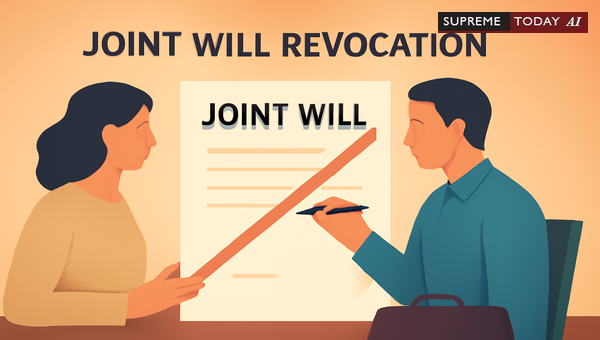
Joint Will Revocation During Lifetime: Judicial Principles on Testamentary Freedom

Can One Party Revoke a Joint Will During the Lifetime of the Other?

Planning your estate with a loved one often involves creating a joint will to ensure your wishes are honored after both pass away. But what happens if one spouse changes their mind? A common question arises: whether a joint will can be revoked by one party during the lifetime of the other. This issue touches on fundamental principles of testamentary freedom and mutual agreements in estate law, particularly under frameworks like the Indian Succession Act, 1925.

In this comprehensive guide, we'll explore the legal landscape, key principles, exceptions, and practical advice. While this provides general insights based on established precedents, it's not a substitute for personalized legal counsel—consult a qualified attorney for your specific situation.

Understanding Joint Wills

A joint will is a single testamentary document executed by two or more persons, typically spouses, disposing of their properties either jointly or individually. It often reflects a shared vision for asset distribution after both testators' deaths. As noted in legal texts, a joint will is in effect two or more wills; it operates on the death of each testator as his Will disposing of his own separate property 2011 0 Supreme(Ker) 823.

Upon the first testator's death, the will is admitted to probate for their estate. The survivor may then use it for their own estate if unchanged. However, the revocability of such wills during both parties' lifetimes is a critical consideration.

The General Rule: Revocability During Joint Lifetimes

Yes, generally, a joint will can be revoked by one party during the lifetime of the other. The default legal position upholds each testator's right to testamentary freedom, allowing revocation or alteration at any time before death, absent any binding agreement to the contrary.

Key points include:- A joint will is generally revocable at any time by either of the testators during their joint lifetime 2011 0 Supreme(Ker) 823.- Joint Wills are revocable at any time by either of the testators during their joint lives, or after the death of one of them, by the survivor 2005 0 Supreme(Mad) 606.- Under Section 62 of the Indian Succession Act, 1925, a will can be revoked or altered by the testator during his or her life time 2013 0 Supreme(All) 2049.

This principle ensures individuals retain control over their estates. For instance, if no explicit clause restricts changes, one testator may execute a new will without the other's consent 2011 0 Supreme(Ker) 823. Courts emphasize that each testator retains the inherent right to revoke or alter the joint will during their lifetime in the absence of prohibitions 2011 0 Supreme(Ker) 823.

Legal Principles Governing Revocation

The revocability hinges on the absence of an express or implied agreement not to revoke. Legal authorities like Halsbury’s Laws of England, referenced in precedents, clarify: joint wills are revocable at any time by either testator during their lifetime or by the survivor after the death of the first, unless there is an express or implied agreement not to revoke 2011 0 Supreme(Ker) 823.

In practice:- No mutual promise? Full revocation rights apply.- Joint execution alone? Insufficient to imply irrevocability; mutual benefits or execution don't create binding contracts without clear intent 2011 0 Supreme(Ker) 823.

A will's nature as ambulatory—effective only at death—further supports this. A Will can always be revoked at any point of time by the testor during his life time 2005 0 Supreme(Kar) 646.

Exceptions: When a Joint Will May Be Irrevocable

Revocation isn't absolute. If testators enter a mutual or reciprocal agreement not to revoke, the will may become binding post one party's death.

  • Express clauses: Explicit language in the will prohibiting unilateral changes.
  • Implied agreements: Inferred from circumstances, like shared recitals of mutual promises 2011 0 Supreme(Ker) 823.
  • Post-death effect: The survivor typically cannot revoke if bound by such an agreement 2011 0 Supreme(Ker) 823.

Courts scrutinize intent: The irrevocability of a joint will depends on the existence of an agreement or understanding not to revoke, which may be inferred from the circumstances or expressed in the will 2011 0 Supreme(Ker) 823. Without proof, the presumption favors revocability.

Insights from Case Law and Related Precedents

Judicial decisions reinforce these principles. In analyzed cases, wills explicitly reserving revocation rights were upheld as alterable 2011 0 Supreme(Ker) 823. Similarly, Will made by two persons, to take effect after the death of both, will not be admitted to probate during the life of either highlights revocability during joint lives 2005 0 Supreme(Mad) 606.

Broader contexts affirm individual autonomy:- Revocation of prior wills via subsequent ones is valid if executed properly 2013 0 Supreme(All) 2049.- Even in land reform cases, there is no prohibition for transfer of a land... through a Will, underscoring revocability until death 2005 0 Supreme(Kar) 646.

In probate disputes, courts dismiss revocation claims without 'just cause' or caveatable interest, but this doesn't override lifetime revocation rights for testators themselves (e.g., Succession Act, Section 263 discussions in related filings).

These examples illustrate that unless a contractual mutuality is proven, one party's revocation stands, protecting personal autonomy while honoring proven pacts.

Practical Recommendations for Couples

To avoid disputes:- Draft clearly: Include clauses specifying revocability or irrevocability conditions 2011 0 Supreme(Ker) 823.- Consider separate wills: Often simpler, allowing independent changes without implications.- Mutual wills alternative: Explicitly state binding promises if desired.- Seek evidence: Document agreements separately for enforceability.- Review regularly: Life changes warrant updates; consult lawyers periodically.

Courts examine will language and circumstances in disputes, so precision matters 2011 0 Supreme(Ker) 823.

Key Takeaways

  • Default rule: Joint wills are revocable by either party during joint lifetimes unless restricted by express/implied agreement 2011 0 Supreme(Ker) 823 2005 0 Supreme(Mad) 606.
  • Intent is key: Prove mutuality for irrevocability; otherwise, testamentary freedom prevails.
  • Plan wisely: Clear drafting prevents litigation; professional advice ensures compliance.

Estate planning is about peace of mind. Understanding revocation rights empowers informed decisions. For tailored guidance, reach out to a legal expert familiar with your jurisdiction's nuances.

This article draws from general legal principles and cited documents for informational purposes only.

#JointWill #WillRevocation #EstatePlanning
Chat Download
Chat Print
Chat R ALL
Landmark
Strategy
Argument
Risk
Chat Voice Bottom Icon
Chat Sent Bottom Icon
SupremeToday Portrait Ad
logo-black

An indispensable Tool for Legal Professionals, Endorsed by Various High Court and Judicial Officers

Please visit our Training & Support
Center or Contact Us for assistance

qr

Scan Me!

India’s Legal research and Law Firm App, Download now!

For Daily Legal Updates, Join us on :

whatsapp-icon Back to top