


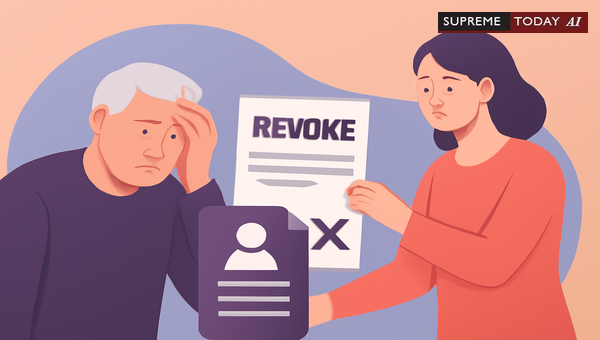
Revoking Due to Health Issues in India
In legal proceedings, situations may arise where a defendant's health, particularly mental health, impacts their ability to manage affairs or hold (PoA). The question often arises: What is the procedure for taking power from a defendant due to health issues? This is a critical issue in India, balancing individual rights with the need to protect vulnerable persons. This post explores the process, drawing from key legal principles, case insights, and statutory frameworks. Note that this is general information and not specific legal advice—consult a qualified lawyer for your circumstances.
Understanding and Mental Capacity
A is a legal instrument allowing one person () to delegate authority to another () to act on their behalf. However, its validity hinges on the 's at execution. If health issues, especially , emerge later, the PoA may be challenged or revoked.
Key principle: A valid PoA requires the to be of at signing. Post-execution incapacity does not automatically invalidate it unless proven otherwise through legal channels. Medical evidence is foundational, as courts prioritize protecting incapacitated individuals' interests.
Step-by-Step Procedure for Revoking or Transferring Power
The process typically involves these stages:
1. Establishing via Medical Assessment
Medical evidence is crucial. Courts require professional evaluations to confirm the defendant's inability to manage affairs.
In one case, F.C. Mehra was under treatment for gross dementia, with the capacity to understand and sign documents being significantly impaired2011 0 Supreme(Bom) 481. Petitioners claimed Mehra was sound when executing the PoA, supported by his affidavit, but complainant evidence showed compromised mental health, questioning validity 2011 0 Supreme(Bom) 481.
Similarly, courts emphasize medical opinion and the role of mental health authorities in determining capacity, particularly when deterioration affects document execution like PoA 2020 0 Supreme(Bom) 29.
- Obtain assessments from qualified neurologists or psychiatrists.
- Use certified medical reports or court-appointed experts.
- Family history or ongoing treatment records strengthen claims, as seen in cases noting family history of mental health issues
kazi ashfaq shams plaintiff- petitioner vs kazi tareq shams defendant-opposite party - 2024 Supreme(
kazi ashfaq shams plaintiff- petitioner vs kazi tareq shams defendant-opposite party - Supreme Court)(SC) 13259.
2. Challenging or Revoking the Existing PoA
If incapacity is established:- The PoA can be challenged in court if executed during incompetence.- Even competent-time PoAs may face scrutiny if health declines sharply post-execution.
A valid PoA executed when competent remains effective unless revoked judicially. However, if the person is found to lack mental capacity, the PoA can be challenged or revoked2011 0 Supreme(Bom) 481.
3. Seeking Court Intervention
Court oversight is often necessary, especially in disputes.
Courts may:- Appoint a neurologist for evaluation 2011 0 Supreme(Bom) 481.- Assess evidence and validate/invalidate documents.- Appoint a or .
Under the , mental health assessments and authority roles are key, with procedures for transfer and assessment of mental health, emphasizing medical opinion and court orders2020 0 Supreme(Bom) 29. Judicial inquiry determines if a person is mentally ill, akin to Bangladesh's processes
kazi ashfaq shams plaintiff- petitioner vs kazi ehsanul haque and others defendants-opposite parties - 2024 Supreme(
kazi ashfaq shams plaintiff- petitioner vs kazi tareq shams defendant-opposite party - Supreme Court)(SC) 13258.In guardianship matters, courts invoke civil laws for appointing representatives, ensuring .
4. Appointing a or Legal Representative
If incapacity is proven:- Courts appoint guardians under guardianship laws.- Powers transfer to the for financial/legal affairs.
Courts can appoint a or under applicable law if incapacity is established2011 0 Supreme(Bom) 481. This protects interests without abrupt power vacuums.
Relevant Legal Frameworks and Case Insights
While no single statute details revocation solely for health, principles derive from:- : PoA as agency terminates on incapacity if not durable.- : Mandates capacity assessments 2020 0 Supreme(Bom) 29.- : For appointing guardians.
Broader contexts highlight health's legal weight:- Transfers ignoring health conditions may be challenged if violating rules 2018 0 Supreme(J&K) 26.- Health ailments affecting counsel performance underscore procedural fairness
SMT. SATYABHAMA W/O BALAJI BIRADAR Vs KUMARI PREETI AND ANR
.In eviction or property disputes, due procedure protects parties, even amid health claims—defendants aren't from lawful steps if notices comply 2019 0 Supreme(Bom) 188.
Exceptions:- Pre-incapacity PoAs hold unless challenged.- Evidence must be conclusive and court-validated.- Judicial oversight mandatory in disputes.
Practical Recommendations
To navigate this:- Secure comprehensive medical assessments early from professionals.- Approach courts promptly for validation/revocation if incapacity suspected.- Align with , and guardianship laws.- In disputes, gather affidavits, treatment records, and witness statements.
For instance, requesting neurologist appointments proved pivotal 2011 0 Supreme(Bom) 481. When health bars actions, like embassy visits due to issues, alternatives must follow legal paths 2020 0 Supreme(P&H) 1426.
Key Takeaways
- requires medical proof before power revocation.
- Court intervention safeguards processes, appointing guardians as needed.
- Valid PoAs persist post-execution unless judicially overturned.
- Always prioritize to avoid challenges.
Summary: Transferring or taking power from a defendant due to health involves medical evaluation and court validation. Mechanisms like orders, guardianships, or PoA revocation protect interests 2020 0 Supreme(Bom) 29 2011 0 Supreme(Bom) 481.
This framework ensures fairness. For personalized guidance, seek expert legal counsel, as outcomes vary by facts and jurisdiction.
#PoARevocation, #MentalHealthLaw, #IndianLaw















