


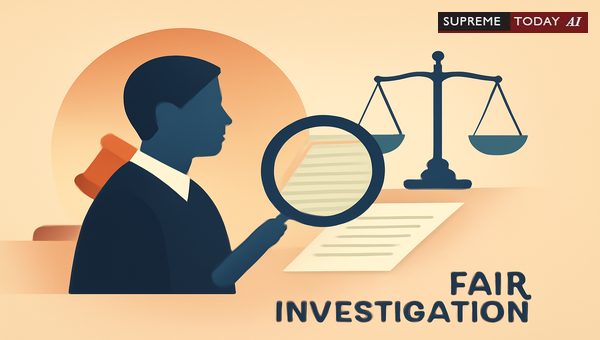
What Is in Indian Law?
In the realm of criminal justice, the phrase often arises when questioning the integrity of police probes or legal proceedings. But what is exactly? It is more than a procedural formality—it's a cornerstone of justice in India, ensuring that truth emerges without bias or manipulation. This blog post delves into its definition, principles, constitutional roots, and judicial safeguards, drawing from key legal precedents. Whether you're a concerned citizen, legal professional, or facing a case, understanding this concept is crucial. Note: This is general information, not specific legal advice. Consult a qualified lawyer for personalized guidance.
Definition and Importance of
A is a legal mandate in criminal cases, primarily the responsibility of the investigating officer. It must be unbiased, honest, just, and conducted strictly in accordance with the law. The ultimate goal is to bring out the truth of the case before a competent court 2019 0 Supreme(Jhk) 1448 2021 0 Supreme(Cal) 268.
This principle is deeply rooted in the . guarantees the right to life and personal liberty, which courts have interpreted to include the right to a . Importantly, a cannot exist without a 2021 0 Supreme(Cal) 390 2022 0 Supreme(Gau) 1441. As emphasized in judicial observations, is the foundation of a 2022 0 Supreme(Cal) 575 2022 0 Supreme(Cal) 252 2022 0 Supreme(Cal) 761 2021 0 Supreme(All) 1525.
Without fairness at the investigation stage, the entire trial collapses, undermining public trust in the justice system. It's not just about the accused; victims and society also benefit from impartial probes that uncover the full truth 2023 0 Supreme(All) 283 2024 0 Supreme(P&H) 257.
Key Principles of
Courts have outlined several core principles to ensure investigations meet constitutional standards. These are typically applied to prevent miscarriages of justice:
Impartiality: Probes must be free from bias, prejudice, or intent. Any manipulation or intent undermines the integrity of the investigation and, consequently, the trial 2017 0 Supreme(Pat) 1469 2018 0 Supreme(UK) 402. Investigations tainted by deceit or fraud cannot stand 2024 0 Supreme(AP) 1111 2025 0 Supreme(Guj) 1095 2024 0 Supreme(Raj) 637.
Thoroughness: Officers must explore all aspects, including evidence favorable to the accused. A complete investigation considers every angle, even if it means giving the where gaps exist, such as there may not have been any such weapons/articles found, to be seized 2022 0 Supreme(Cal) 252.
Transparency: The process should be manifestly fair, not only in practice but also in public perception
. This builds confidence in the system.
Documentation: All facts must be recorded contemporaneously for accuracy and accountability 2017 0 Supreme(Guj) 198 2013 0 Supreme(Tri) 9.
Additionally, is described as a fundamental constitutional right under , requiring probes to be fair, transparent, judicious, unbiased, and in accordance with law 2023 0 Supreme(All) 1594 2023 0 Supreme(Cal) 1427 2025 0 Supreme(Guj) 1095 2024 0 Supreme(Bom) 774 2024 0 Supreme(Raj) 637 2023 2 Supreme 406 2024 0 Supreme(J&K) 160. Fair, just and proper investigation is essence of 2021 0 Supreme(UK) 669.
Judicial Oversight and Remedies
Courts play a pivotal role in upholding these standards. They have the duty to monitor investigations and intervene when flaws are evident. This includes directing further investigations, re-investigations, or transferring cases to independent agencies like the if bias is suspected.
For instance, if by appears to be not possible due to involvement of officers in conspiracy or evidence tampering, courts may order a switch 2021 0 Supreme(All) 1525. Judges assess whether deficiencies go to the root of the prosecution case and discredits in toto, ensuring no undue prejudice 2022 0 Supreme(Cal) 761.
Both accused and victims have stakes in fairness, reflecting public interest 2022 0 Supreme(J&K) 48 2021 0 Supreme(Pat) 30. Courts can order re-investigation if the process is tainted or unfair, as a sham or biased investigation undermines justice 2023 0 Supreme(All) 1594 2024 0 Supreme(J&K) 160. Investigation is the structure on which the trial is based. It is an attribute of 2021 0 Supreme(UK) 669.
When Is an Investigation Deemed Unfair?
Common red flags include:- Bias or Political Influence: Higher officers protecting accused or destroying evidence 2021 0 Supreme(All) 1525.- Incomplete Probes: Ignoring or rushing conclusions 2021 0 Supreme(Cal) 390 2011 0 Supreme(Gau) 383.- Lack of Transparency: Secretive processes or unexplained delays
.
In such cases, higher courts like or the may step in, typically under or inherent powers, to prevent abuse of process 2018 0 Supreme(UK) 402 2018 0 Supreme(Ker) 731.
: Rights of Victims and Society
Fairness extends beyond the accused. Victims' rights to a thorough probe are equally vital, balancing interests 2023 0 Supreme(All) 283. A robust investigation sustains public confidence in the criminal justice system and upholds the 2023 0 Supreme(All) 1594 2024 0 Supreme(Raj) 637.
Conclusion and Key Takeaways
is indispensable for a under , demanding unbiased, thorough, transparent, and well-documented processes. Courts' oversight ensures accountability, protecting rights and justice for all.
Key Takeaways:- is constitutionally mandated and foundational to trials 2022 0 Supreme(Cal) 575.- Principles: Impartiality, thoroughness, transparency, documentation.- Courts can direct re-probes or transfers if flawed 2023 0 Supreme(All) 1594.- Applies to accused, victims, and public interest.
Recommendations:- For Legal Practitioners: Advocate for compliance and judicial intervention when needed.- For Individuals: Know your rights; seek counsel if an investigation seems unfair 2017 0 Supreme(Guj) 198.
By prioritizing fair investigations, India strengthens its criminal justice framework. Stay informed and vigilant.
References: 2019 0 Supreme(Jhk) 1448 2021 0 Supreme(Cal) 268 2021 0 Supreme(Cal) 390 2022 0 Supreme(Gau) 1441 2017 0 Supreme(Pat) 1469 2018 0 Supreme(UK) 402 2011 0 Supreme(Gau) 383
2017 0 Supreme(Guj) 198 2013 0 Supreme(Tri) 9 2018 0 Supreme(Ker) 731 2022 0 Supreme(J&K) 48 2021 0 Supreme(Pat) 30 2022 0 Supreme(Cal) 575 2022 0 Supreme(Cal) 252 2022 0 Supreme(Cal) 761 2021 0 Supreme(All) 1525 2021 0 Supreme(UK) 669 2023 0 Supreme(All) 1594 2023 0 Supreme(Cal) 1427 2025 0 Supreme(Guj) 1095 2024 0 Supreme(Bom) 774 2024 0 Supreme(Raj) 637 2023 2 Supreme 406 2024 0 Supreme(J&K) 160 2023 0 Supreme(All) 283 2024 0 Supreme(AP) 1111 2024 0 Supreme(P&H) 257 #FairInvestigation, #IndianLaw, #FairTrial












