


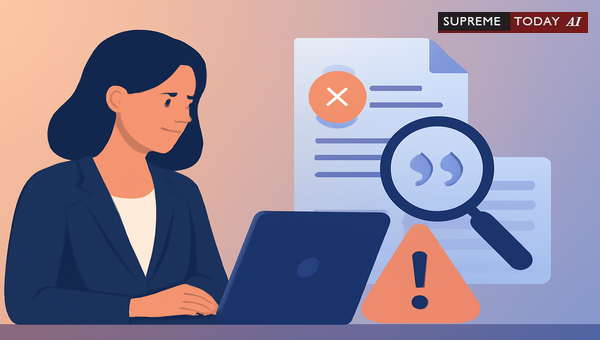
AI-Generated Fake Case Citations: Legal Risks Exposed
In the era of rapid technological advancement, generative AI tools like have revolutionized legal research. However, they've also introduced significant pitfalls. Lawyers and judges have cited non-existent cases— generated by AI—leading to and . But what does the law say about cases where case laws and citations generated using generative AI tools are inaccurate and fake due to unverified use?
This post delves into this pressing issue, drawing from legal principles on , interpretation, and emerging AI discussions in judgments. While no document directly rules on AI , core tenets of apply universally. Note: This is general information, not legal advice. Consult a qualified attorney for specific cases.
The Growing Problem of AI in Courts
Generative AI excels at producing fluent text but often fabricates details, including fictitious case names, citations, and holdings. Real-world examples abound: In , lawyers were sanctioned for submitting a brief with six fake cases invented by . Similar incidents have surfaced globally, raising questions about accountability.
The legal question at hand—cases where case laws, citations are generated using generative AI tools being inaccurate and fake due to unverified use—highlights the need for vigilance. Courts demand precision; errors undermine justice. As explored below, principles from established cases emphasize verified sources. 2013 0 Supreme(SC) 1116
Core Legal Principles on
Legal documents underscore that accuracy in citations is foundational to sound judgments. While not addressing AI explicitly, they infer strict standards applicable to any unverified reference.
Importance of Precise Legal Interpretation
In 2013 0 Supreme(SC) 1116, the court distinguishes between facts inferred from documents and their legal effect, noting: A question of law involving the application of any principle of law, is a question of law. or constitutes reversible error, warranting if substantial. This principle directly implicates AI outputs: Fabricated citations misapply law, akin to misinterpreting precedents. 2013 0 Supreme(SC) 1116
Similarly, 2025 0 Supreme(Jhk) 51 stresses accurate reasoning in compensation claims for motor vehicle accidents, implying reliance on authentic sources to determine liability and damages. Incorrect references erode case foundations. 2025 0 Supreme(Jhk) 51
and
Burden-shifting and proof standards hinge on correct precedents. 2013 0 Supreme(SC) 1116 highlights: Misapplication or of legal texts can lead to errors. AI-generated fakes mislead courts on applicable law, potentially altering outcomes. Legal professionals bear the duty to verify, as unverified AI use invites . 2013 0 Supreme(SC) 1116
Insights from AI-Related Judicial Discussions
Emerging cases touch on AI's role, reinforcing verification needs.
Prerequisites for AI in Legal Systems
Courts recognize AI's potential but stress infrastructure. In 2021 0 Supreme(Del) 2113, it's noted: A prerequisite to usage of AI Tools in these fields was availability of structural digital database of all the cases. Without verified databases, AI risks inaccuracies—echoing fake citation woes. Guidelines for proclaimed offenders emphasize verifiable processes, extendable to AI. 2021 0 Supreme(Del) 2113
Likewise, 2021 0 Supreme(Del) 831 details a AI Committee: A Sub Committee was formed by the AI Committee of ... A prerequisite to usage of AI Tools... structural digital database. This underscores systemic readiness before AI integration, preventing unverified outputs. 2021 0 Supreme(Del) 831
AI in Creative and Evidentiary Contexts
2025 Supreme(US)(cadc) 66 examines : Dr. Stephen Thaler created a generative artificial intelligence named the 'Creativity Machine.'... Congress... avoid using the word 'author' by itself to cover non-human entities. While copyright-focused, it questions AI reliability, paralleling citation authenticity. 2025 Supreme(US)(cadc) 66
In privacy and publication, 2022 0 Supreme(Ker) 950 observes: They are now using AI tools to identify the needs... The publication of any valid records is protected... Judgments forming part of Court records are public documents. AI aids search but demands accuracy; fake citations violate under . 2022 0 Supreme(Ker) 950
Analogies from Forgery and Cases
Fake citations mirror cases, where courts demand proof.
- In 2025 0 Supreme(Bom) 1121, allegations of forged Aadhaar, PAN cards: Possession of identity documents is insufficient... shifts to the accused if allegations of . Fake citations shift scrutiny to the filer. 2025 0 Supreme(Bom) 1121
- 2026 0 Supreme(Ori) 52 on : Merely repeating allegations... does not constitute under Intentional fakes, however, trigger action. 2026 0 Supreme(Ori) 52
These illustrate courts' intolerance for fabrications, applicable to AI lapses.
Risks and Consequences of Unverified AI Use
- and Reprimands: Courts may fine or disbar for negligence.
- Judgment Overturns: Substantial errors lead to appeals. 2013 0 Supreme(SC) 1116
- Ethical Violations: requires verification.
- National Security Analogies: Forgery cases like 2025 Supreme(Online)(Bom) 5929 treat fakes as threats to integrity. 2025 Supreme(Online)(Bom) 5929
Recommendations for Legal Professionals
To mitigate risks:1. Always Verify: Cross-check AI outputs against official databases like SCC Online or Westlaw.2. Disclose AI Use: Some jurisdictions require it.3. Adopt Guidelines: Follow court AI committees' advice for digital verification. 2021 0 Supreme(Del) 8314. Train on : Understand AI limits.
Institutions should mandate protocols, as implied in AI committee reports. 2021 0 Supreme(Del) 2113
Key Takeaways
- Accuracy in citations upholds justice; AI fakes betray it. 2013 0 Supreme(SC) 1116 2025 0 Supreme(Jhk) 51
- Verification is non-negotiable, especially with AI's rise.
- Courts evolve toward AI guidelines, prioritizing structured data.
In conclusion, while direct precedents on AI fake citations are nascent, foundational principles demand rigorous checks. As AI permeates law, blending innovation with caution ensures integrity. Stay informed, verify diligently, and prioritize authenticity.
References:1. 2025 0 Supreme(Jhk) 512. 2013 0 Supreme(SC) 11163. 2021 0 Supreme(Del) 21134. 2021 0 Supreme(Del) 8315. 2025 Supreme(US)(cadc) 666. 2022 0 Supreme(Ker) 9507. 2025 0 Supreme(Bom) 11218. 2026 0 Supreme(Ori) 52
#AIFakeCitations, #LegalAI, #CaseLawAccuracy















