


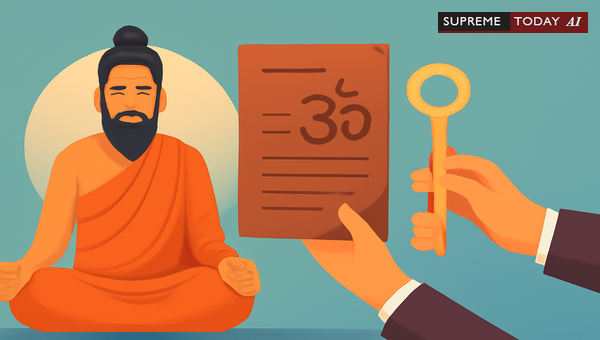
Succession: Hindu Act or Religious Customs?
In the intricate world of Indian inheritance law, few topics spark as much debate as the succession of a . When a person renounces worldly life to become a —an ascetic in the Hindu tradition—what happens to their property? Is the Succession of governed by Succession Act or not? This question often arises in family disputes or institutional claims, blending personal laws, customs, and statutory provisions.
This blog post delves into the legal position, drawing from judicial precedents and key sources. We'll explore why religious customs typically take precedence over the , (HSA), while highlighting exceptions. Note: This is general information, not legal advice. Consult a qualified lawyer for specific cases.
Understanding and
A undergoes , a formal renunciation of worldly attachments, including family ties. This leads to , severing natural inheritance rights under . However, courts recognize that Sanyasis can own and acquire property post-renunciation. Succession then follows special rules, not general family lines.
As noted in legal analyses, A person who becomes a suffers but retains rights to acquire and hold property, which devolves according to special rules of inheritance rather than natural succession 2025 Supreme(Online)(Ker) 57861 2024 0 Supreme(Kar) 347 2024 Supreme(Online)(MAD) 9297. The (disciple) often succeeds as the 2014 0 Supreme(Del) 1326.
Legal Framework: Customs Over Statutory Law
Primary Governance by and Customs
The succession rights of a are primarily governed by and the customs of the religious order, not the HSA. Once is taken, natural relations are severed. Courts have held: Once a person renounces the world and takes Sanyas, their natural relations and inheritance rights under are considered severed. The court has explicitly held that a can own property, and the (disciple) can succeed as the 2014 0 Supreme(Del) 1326.
The HSA does not automatically apply to ascetics unless specified by custom or religious institution order 1982 0 Supreme(HP) 12. , dealing with general succession, is inapplicable; instead, religious order customs prevail 1982 0 Supreme(HP) 12.
Role of the
The HSA, , and amendments aim at uniform succession among Hindus but carve out space for customs. For Sanyasis, succession is not governed by Section 8 of the , which deals with general succession, but by the customs of the religious order 1982 0 Supreme(HP) 12.
In contrast, general Hindu families follow HSA rules, as seen in cases like: The succession was to be governed by the provisions of the 2017 0 Supreme(P&H) 474 2001 0 Supreme(P&H) 1090. But for monastic orders, customs dominate.
Judicial Precedents and Case Law
Courts consistently rule that succession hinges on proving religious order customs. Courts have consistently held that the succession rights of a are determined by the customs of the religious order, not by statutory succession laws 1982 0 Supreme(HP) 12.
In disputed cases without natural heirs, customs must be established: In cases where a has not left behind a or where succession is disputed, the courts have emphasized the importance of proving the customs or traditions of the religious order to establish succession rights 2017 7 Supreme 262 1982 0 Supreme(HP) 12.
Related precedents include wills involving Sanyasis: In the matter of and In the matter of the Last Will and Testament of Late Dasari Lakshmikanthamma Wife of Dasari Raju 2022 Supreme(Online)(Mad) 63342. This shows the , applies for wills but not overriding customs.
The has clarified in analogous contexts that specific community laws yield to customs or later statutes, but for Sanyasis, religious rules persist 2000 0 Supreme(Ker) 682.
Property Rights, Wills, and Nuances
Despite , upon taking means that property devolves not to the ’s natural heirs but to the institution or according to custom. However, Sanyasis can still own and acquire property, and their rights are governed by special inheritance rules 2024 Supreme(Online)(MAD) 9297.
Sanyasis may execute wills under ISA: The Indian Succession Act, , does not prevent a from making a Will 2024 Supreme(Online)(DEL) 11210 2025 0 Supreme(Bom) 1085. follows ascetic rules, not relatives.
For mathadipathis (heads of religious institutions), succession is by custom: Succession to religious institutions like is often governed by custom or specific rules laid down by the institution or founder, not solely by statutory law 2025 Supreme(Online)(Ker) 57861.
Exceptions and Limitations
Not all cases are straightforward:- If the individual hasn't fully renounced or followed customs, HSA may apply.- Property acquired as institutional might belong to the order.- The applicability of the to Sanyasis depends on whether the ascetic has been recognized as such under the relevant customs and whether the order considers property acquired by the ascetic as belonging to the religious institution.
In non- Hindu contexts, HSA governs explicitly, e.g., They are governed by the in matters of succession 2000 0 Supreme(P&H) 117. Scheduled Tribes may be exempt under 2023 1 Supreme 652.
Practical Recommendations
Facing a succession dispute? Consider these steps:1. Verify customs: Document the religious order's traditions.2. Prove status: Establish recognition under those customs.3. Prioritize customs over statutes: Courts favor proven traditions.4. Check for wills: ISA allows Sanyasis to will property.5. Seek succession certificate: Under ISA for procedural needs 2025 0 Supreme(Ori) 107.
Verify the specific customs and traditions of the religious order involved. Establish whether the individual was recognized as a according to those customs. In disputes, focus on proving the customs of the religious order rather than relying solely on statutory succession laws.
Key Takeaways and Conclusion
Generally, succession is governed by religious order customs, not the . Renunciation severs natural ties, with Chelas or institutions succeeding per tradition. While Sanyasis retain property rights and can make wills, statutory laws like HSA or ISA play supportive roles.
This aligns with precedents: Customs prevail unless unproven or inapplicable 1982 0 Supreme(HP) 12 2014 0 Supreme(Del) 1326. For clarity in complex cases, professional legal guidance is essential.
Summary:- Customs > HSA for Sanyasis.- , but property rights persist.- Prove order traditions in court.
Stay informed on evolving Indian succession laws—customs often hold the key to monastic legacies.
(Word count: 1028. Sources cited are for illustrative purposes; full documents provide deeper context.)
#SanyasiSuccession #HinduLaw #InheritanceRights












