Back
Back





IN THE HIGH COURT OF JUDICATURE AT MADRAS
THE HON'BLE MR.JUSTICE V.LAKSHMINARAYANAN
S.Sambamurthy (Died) – Appellant
Versus
C.Dhanammal – Respondents
S.A.No.1321 of 2013
Decided on : 23-01-2024
WILL - Partition and Succession - Hindu Succession Act, Sections 14(1), 14(2); Indian Succession Act, Sections 97, 105 - The court interpreted the provisions of the Hindu Succession Act and the Indian Succession Act to determine the nature of the property rights conferred by a will. It emphasized that a life estate granted to a widow does not automatically convert into an absolute estate if the will explicitly restricts her rights. The court concluded that the plaintiffs were entitled to a share in the property as the will did not grant absolute rights to the life estate holders, thus reversing the lower court's decision.
Fact of the Case:
The case involves a dispute over the partition of property bequeathed by Velusamy Chettiyar through a will. The will divided the property into two schedules, with specific rights granted to his sons and their descendants. The plaintiffs, descendants of the eldest son, contested the claim of the defendants, descendants of the second son, over the B schedule property, arguing that the life estate granted to the second son's wife did not confer absolute ownership upon her death.
Finding of the Court:
The court found that the will clearly delineated the rights of the parties involved, and the life estate granted to Dhanammal, the second wife of Jaganathan, did not convert into an absolute estate. The court held that the provisions of the Hindu Succession Act, particularly Section 14(2), applied, confirming that the plaintiffs were entitled to a share in the property.
Issues: 1. Whether the appellate court misinterpreted the will, granting absolute rights to a limited right holder. 2. Whether the provisions of Section 97 of the Indian Succession Act were applicable, considering the will's stipulations. 3. Whether the life estate granted to Dhanammal matured into an absolute estate upon the death of Arunagiri.
Ratio Decidendi: The court established that a will can impose restrictions on property rights, and a life estate does not automatically convert into an absolute estate unless explicitly stated. The interpretation of the will must reflect the testator's intent, and the provisions of the Hindu Succession Act must be applied accordingly.
Final Decision: The second appeal was allowed, the suit for partition was decreed as prayed for, and the judgment of the lower appellate court was set aside.
JUDGMENT :
THE HON'BLE MR.JUSTICE V.LAKSHMINARAYANAN
PRAYER: Second Appeal filed under Section 100 of CPC to set aside the Judgment and Decree dated 26.04.2013 made in A.S.No.149 of 2007 on the file of the III Additional District & Sessions Court, Coimbatore reversing the Judgment and Decree dated 09.04.2007 made in O.S.No.663 of 2004 on the file of the II Additional Subordinate Court at Coimbatore.
The present second appeal arises out of Judgment and decree of the III Additional District and Sessions Court, Coimbatore in A.S.No.149 of 2007 dated 26.04.2013. By the said judgment and decree, the learned District Judge reversed the judgment and decree of the court of learned II Additional Subordinate Judge, Coimbatore in O.S.No.663 of 2004 dated 09.04.2007 thereby, dismissing the suit for partition.
2. The properties belonged absolutely to one Velusamy Chettiyar. He had a wife by name Muniyammal and through her, he had four children namely
(1) S.V.Shanmugam,
(2) S.V.Jaganathan,
(3) Chellammal and
(4) Rajammal.
3. Velusamy Chettiyar executed a Will which is accepted by both sides. This Will has been marked as Ex.A1 in the suit. He divided his self acquired properties into two portions as A schedule and B schedule. A schedule properties were given to his eldest son Shanmugam and B schedule properties were given to his second son Jaganathan. Shanmugam married one Chinnamuthu and from the wedlock, they had five children namely
(1) Sambamoorthi,
(2) Konammal,
(3) Palanisami,
(4) Raja and
(5) Balachandran.
4. Jaganathan had married twice viz., his first wife/Rukmani Ammal and second wife/Dhanammal. Through his first wife/Rukmani Ammal, he had one son by name Arunagiri and one daughter by name Dhanammal and through his second wife/Dhanammal, he had four daughters namely
(1) Visalakshi,
(2) Jayalakshmi,
(3) Krishnaveni and
(4) Revathi.
5. Arunagiri/son of Jaganathan also married twice. His wives are Lakshmi and Umarani. Insofar as the daughters branch is concerned, Chellammal had one daughter by name Muniyammal and Rajammal had two daughters namely Jaya and Kanaga.
6. Insofar as the A schedule mentioned property which fell to the share of S.V.Shanmugam is concerned, there is no dispute as it is being enjoyed by his sons and daughters. The suit property is the B schedule to Ex.A1. The disposition insofar as the B schedule is concerned under Ex.A1 is as follows:
| The relevant portion in Ex.A1 | Translated version |
|
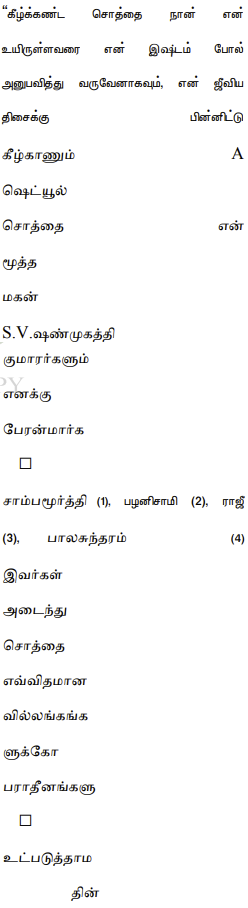
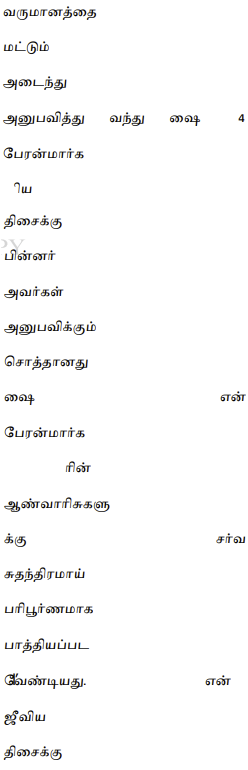
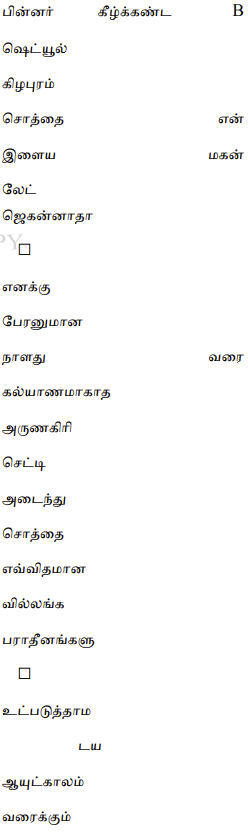
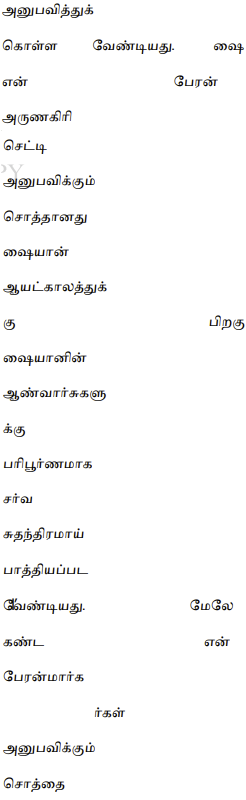
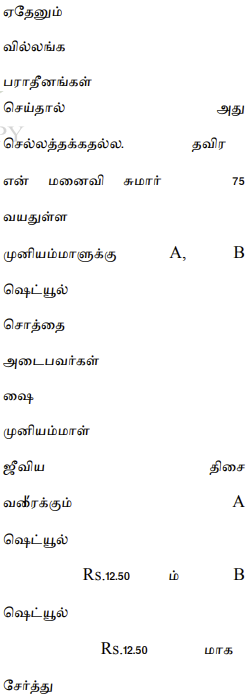
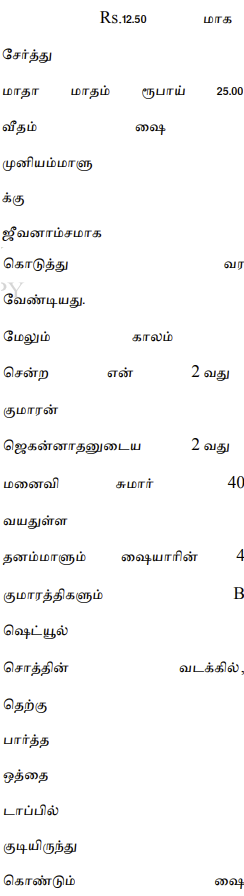
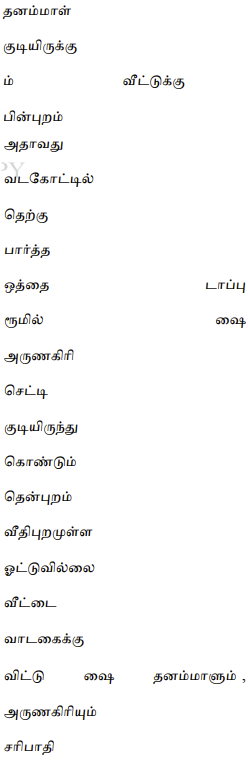
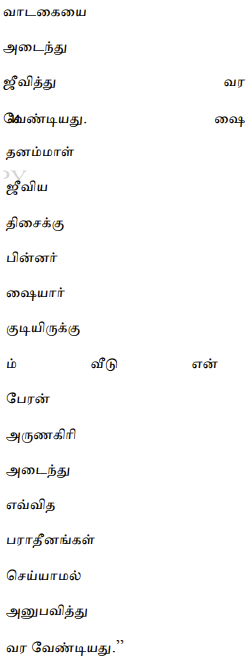
| I will enjoy theproperty described hereunder as I wish throughout my lifetime and after my lifetime, the rental income from the property morefully described in the Schedule A hereunder, shall be acquired by my grandson namely 1) Sambamurthy 2) Pazhanisamy 3) Raju 4) Balasundaram, sons of my eldest son S.V.Shanmugam without subjecting the property to any alienation or encumbrance and after the lifetime of all the said grandsons, it shall be acquired with absolute rights by the male heirs of my aforesaid four grandsons. After my lifetime, the property at Krishnapuram described morefully in the B schedule shall be acquired by grandson, S/o Late. Jaganathan, my younger son, without subjecting it to any encumbrances until his lifetime. The property thus enjoyed shall be acquired by his male heirs with absolute rights. If my aforesaid grandsons subject the respective properties under their enjoyment, to any encumbrances, It shall not be maintainable. The persons acquiring the A and B schedule properties shall pay to my wife Muniyammal aged about 75 years until her lifetime i.e. The person acquiring A schedule property shall pay Rs.12.50 per month and the person acquiring B schedule property shall pay Rs.12.50 per month in all Rs.25.00 per month to the said Muniyammal towards maintenance. Further Dhanammal, second wife of my late second son Jeganathan aged ab |
AI
A life estate granted under a will does not automatically convert into an absolute estate unless the will explicitly provides for such a conversion; the intent of the testator must be respected in de....
The main legal point established in the judgment is the interpretation and application of Sec.14(1) and Sec.14(2) of the Hindu Succession Act in determining the property rights of the parties based o....

Hindu Law – property given to wife - Property had been given to the female Hindu in recognition of or in lieu of her right to maintenance, it was held that the situation fell within the ambit of subs....

Hindu Women’s right to maintenance – Right of maintenance is sufficient for property given in lieu thereof to transform into absolute ownership, by way of Section 14(1) of HSA, 1956.

The main legal point established in the judgment is the liberal interpretation of Section 14 of the Hindu Succession Act to advance the objective of enlarging the limited interest possessed by Hindu ....
![Prahaladhan, [Died & Legal Heirs Impleaded] VS Pankajakshi - 2024 Supreme(Ker) 539](https://supremetoday-s3.b-cdn.net/Kerala_1.png)
The central legal point established in the judgment is the interpretation and application of Section 14(1) and (2) of the Hindu Succession Act in the context of a will, emphasizing the intention of t....


The main legal point established in the judgment is that a female Hindu possessing property under limited rights, as per Section 14(1) of the Hindu Succession Act, 1956, does not have the right to se....

Section 14(1) of the Hindu Succession Act grants absolute ownership to a female Hindu in possession of property acquired in lieu of maintenance.

(1) Presumption as to documents thirty years old – Period of 30 years shall be reckoned from date when such document is tendered in evidence. (2) Hindu male could testamentarily dispose of his proper....



An indispensable Tool for Legal Professionals, Endorsed by Various High Court and Judicial Officers
Please visit our Training & Support
Center or Contact Us for assistance

Scan Me!
India’s Legal research and Law Firm App, Download now!


For Daily Legal Updates, Join us on :



 Back to top