


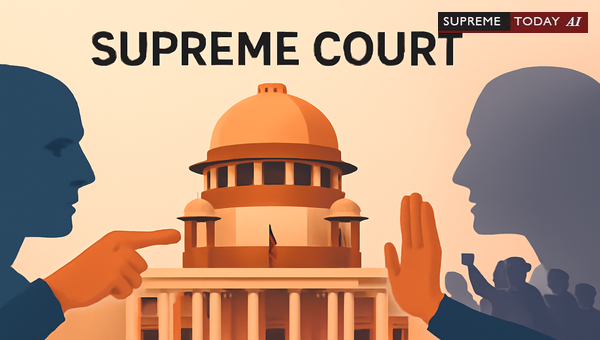
Supreme Court Curbs &
In a diverse society like India, tensions often arise from societal norms, caste prejudices, and impulsive crowd behavior. A pressing legal question emerges: Some Decisions of the Uska and Cast Superiority and —highlighting how judicial rulings address , caste superiority, and . The Supreme Court has consistently ruled that must triumph over fleeting societal biases, safeguarding personal freedoms from mob-driven interventions.
This blog post delves into landmark decisions, analyzing how the Court balances individual rights against societal pressures. While not legal advice, it offers general insights into these evolving principles.
Main Legal Finding: Prevails
The Supreme Court recognizes that and notions of caste superiority frequently stem from and deep-rooted biases. Courts must intervene based on constitutional principles, not societal prejudices, exercising restraint to avoid infringing on personal liberties. 2014 0 Supreme(SC) 201
Key points include:- Societal biases and often fuel and discrimination.- overrides obscure societal notions.- is protected against mob mentality. 2018 1 Supreme 605
Recognition of Societal Biases and
The Court has candidly observed how caste prejudices and mob dynamics distort justice. For instance, it noted that the collective political will, bureaucratic setup, and law enforcement agencies are oblivious to the aforementioned social trend2025 0 Supreme(All) 3088, pointing to systemic failures that perpetuate discrimination.
In addressing social unrest, the judiciary highlights psychological and economic roots: explosive tensions and return to tranquility is curing the inner man through proven meditational mental moral neural technology, elimination of social provocation and economic injustice1979 0 Supreme(SC) 289. This underscores mob behavior's role in escalating conflicts.
High Courts echo this. The firmly stated: In no circumstance can the State bypass , permit or condone any acts of or mob mentality... cannot be allowed to dictate the actions of the state nor can by the public at large be allowed or forgiven
SUNITA AND ANR Vs STATE OF HARYANA AND OTHERS
. Similarly, in a Kerala case involving a mob assault over an inter-community relationship, petitioners were accused of virtually doing 2022 Supreme(Online)(Ker) 77379.These rulings reveal a pattern: law enforcement often mirrors societal flaws, demanding judicial oversight to restore balance.
Judicial Stance Against
The Supreme Court mandates that the emphasis to be given to is miniscule, when they are in conflict with , and that the Courts must uphold and rely on the same rather than obscure notions of societal morality, which have no legal tenability2014 0 Supreme(SC) 201. cannot eclipse constitutional values, especially when individual protections under are at stake. 2018 1 Supreme 605
In workplace contexts, courts limit institutional overreach. The under the cannot engage in : ‘’ is not the job of the Management or of the ... Any consensual relationship among adults would not be the concern of the Management or of the
. A charge-sheet based on such overreach was quashed, affirming promotion eligibility.
Preventive measures against mob violence are also emphasized. The Supreme Court in held that any mob violence and crime by self appointed keepers of terrorizing common man without legal sanction... should be dealt with seriously2019 0 Supreme(Ker) 108. In a hartal-related violence case, bail was denied for attacks under the guise of protest, rejecting pretexts. 2019 0 Supreme(Ker) 108
Protecting Personal Autonomy and Fundamental Rights
Individual choice reigns supreme in a democracy. The Court affirms: the principle of , which cannot be hampered by societal expectations in a vibrant democracy2022 0 Supreme(P&H) 645. Protection under is a constitutional mandate for all. 2023 0 Supreme(Raj) 1079
Even in religious processions, state intervention must respect rights under and 26, distinguishing law/order from public order without undue moral impositions. Courts direct time-bound approvals to prevent arbitrary halts.
The State must protect citizens without exceptions, upholding : the state went above and beyond to protect the terrorist kasab because India is a country where is supreme and no liberty can be taken away without of law2021 0 Supreme(Raj) 138. Torture or vigilante justice offends .
Judicial Restraint and Limitations
While championing rights, courts caution against overreach: the Court should not pass any judicially unmanageable order which is incapable of enforcement2014 0 Supreme(SC) 201. Laws against hate speech or obscenity are valid if constitutionally grounded, not prejudice-driven.
Community policing initiatives, like 'Maithri' or 'Friends of Police', succeed by fostering cooperation without moral overtones. 2018 0 Supreme(UK) 320
Recommendations from Judicial Wisdom
Drawing from these precedents:- Prioritize constitutional over societal morality.- Base decisions on law, not mob sentiment.- Train enforcement to counter biases.- Legislate protections against caste and mob prejudices.
Key Takeaways
India's Supreme Court strikes a vital balance: recognizing societal ills like caste superiority and while elevating . Rulings from 2014 0 Supreme(SC) 2012018 1 Supreme 6052025 0 Supreme(All) 3088 reinforce that —by state, mobs, or institutions—has no place in a rights-based democracy.
High Court affirmations, such as SUNITA AND ANR Vs STATE OF HARYANA AND OTHERS
This analysis is for informational purposes only and does not constitute legal advice. Consult a qualified lawyer for specific matters.
In summary, the judiciary's evolution ensures thrives amid societal flux, curbing 's overreach.
#SupremeCourtIndia, #MoralPolicing, #ConstitutionalMorality












