


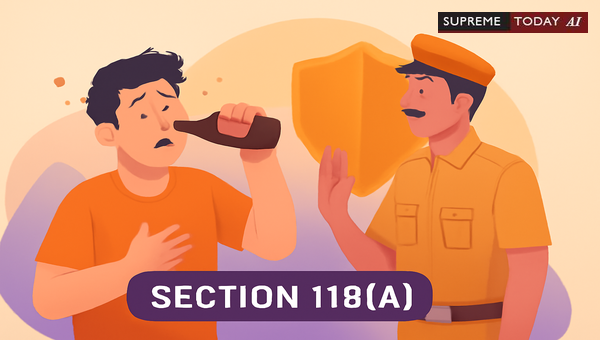
Understanding : A Comprehensive Guide
In Kerala, maintaining is a priority, and laws like the play a crucial role. Many individuals find themselves facing charges under Section 118(a) after incidents involving alcohol in public spaces. While queries about various statutes, such as What is , highlight interest in organized crime laws, Section 118(a) specifically addresses everyday public disturbances due to intoxication. This provision penalizes those found in public places in an , , or . Penalties may include imprisonment up to three years, a fine not exceeding ten thousand rupees, or both. 2017 0 Supreme(Ker) 1039
This blog post breaks down the section, explores judicial interpretations through key cases, and offers practical insights. Note: This is general information and not specific legal advice. Consult a qualified lawyer for your situation.
Overview of Section 118(a): What Does It Prohibit?
targets behaviors that disrupt public peace. It applies to individuals who are:- In an in a public place.- In a .- due to intoxication or similar causes.
The word 'intoxicated' is not defined in the Act, but courts have adopted meanings from legal lexicons: a man is intoxicated whenever he is so much under the influence of spirituous or intoxicating liquors that it so operates upon him, that it so affects his acts or conduct or movement, that the public or parties coming in contact with him could readily see and know that it was affecting him in that respect. 2021 0 Supreme(Ker) 873
Similarly, '' implies behaving in a way that is violent and/or not in control. Behaving in a noisy and/or violent or tumultuous manner may come within the expression ''. 2021 0 Supreme(Ker) 873
Key factors for 'incapable of looking after himself' include weakening of self control, weakening of self awareness, and incapacity to know or realize the consequences of the action etc. Incoherent speech, unsteady gait, staggering etc., and the manner in which he conducts himself towards fellow men are also relevant factors. 2021 0 Supreme(Ker) 873
Sec.118(a) reads as a penalty for causing grave violation of or danger, linking it to broader public safety goals. 2015 0 Supreme(Ker) 929 2016 0 Supreme(Ker) 137
Penalties and Consequences
Violations under Section 118(a) are serious, with potential punishments of:- Imprisonment for up to 3 years.- Fine up to ₹10,000.- Or both.
In practice, may be notified by the State Police Chief, allowing some cases to be settled without full trial. 2011 0 Supreme(Ker) 1128
Conviction can lead to further repercussions, such as employment termination under service rules. For instance, in a case involving conviction under Section 118(a), courts noted the power under to prevent , especially after fine payment rendered default sentences irrelevant. 2015 0 Supreme(Ker) 929
Judicial Interpretations and Landmark Cases
Kerala courts have refined the application of Section 118(a) through numerous rulings, emphasizing evidence and .
C.C. No.158 of : The petitioner was accused of intoxication in a public vehicle, causing nuisance. The court refused to dismiss, stressing proper investigation and compounding options. 2011 0 Supreme(Ker) 1128
Bail and Misuse Concerns: In one case, bail was granted due to fears of police misuse of Section 118(a), urging careful enforcement. 2017 0 Supreme(Ker) 1039
Requirement: Courts mandate a clear between the alleged act and the offence. Mere intoxication isn't enough; it must cause grave violation. 2021 0 Supreme(Ker) 1114
: Where evidence lacked proof of public danger or disorder, proceedings were quashed. 2012 0 Supreme(Ker) 1086
Police Station Incident: In C.C.No.422 of , the accused was called to identify a suspect but found under influence. The court analyzed if this met Section 118(a) thresholds, focusing on incapacity indicators. 2021 0 Supreme(Ker) 873
Evidence of Incapacity: Prosecution must prove not just intoxication but inability to self-care. 2016 0 Supreme(Ker) 17
Judicial Discretion: Courts may quash if allegations fail statutory standards. 2021 0 Supreme(Ker) 1089
Related provisions like for other violations (e.g., grave danger) show the Act's scope, but often requires complaints, not just police reports. 2020 0 Supreme(Ker) 849
In sand removal cases under , intoxication linked to Section 118(a) was scrutinized similarly—no and context mattered. 2021 0 Supreme(Ker) 873
Key Legal Principles for Section 118(a)
To succeed in prosecution or defense, consider these principles:- : Intoxication must disturb . 2021 0 Supreme(Ker) 1114- Proof of Incapacity: Beyond smell of alcohol—show unsteady gait, incoherent speech, etc. 2021 0 Supreme(Ker) 873 2016 0 Supreme(Ker) 17- No Automatic Culpability: Private consumption or minimal impact doesn't trigger the section.- Contextual Obscenity/Disorder: Drawing from analogies, vulgarity alone isn't obscene or riotous without depraving effect. 2016 0 Supreme(Ker) 137- : Bail, quashing under 482 if misuse evident. 2017 0 Supreme(Ker) 1039 2021 0 Supreme(Ker) 1089
Common Misuses and Defenses
Police sometimes invoke Section 118(a) loosely, leading to bail grants or dismissals. Focus defenses on:- Lack of public place evidence.- No proven nuisance or incapacity.- Procedural errors in arrest/FIR.
For prosecution: Gather witness statements on behavior, medical tests for intoxication levels.
In defamation-linked cases under 118(d), courts clarified limits—e.g., letters insulting modesty don't always fit without direct complaint. 2020 0 Supreme(Ker) 849
Recommendations for Legal Practitioners
- For Defense Lawyers: Challenge evidence , highlight no antecedents, seek compounding or quashing. 2021 0 Supreme(Ker) 873
- For Prosecutors: Document visible effects on conduct/public. 2021 0 Supreme(Ker) 1114
- General Advice: If charged, pay fines promptly if applicable; appeal convictions affecting livelihood. 2015 0 Supreme(Ker) 929
Conclusion and Key Takeaways
balances public safety with fair enforcement. Courts consistently require solid evidence of disorder beyond mere drinking, quashing weak cases and cautioning against misuse. 2012 0 Supreme(Ker) 1086 2011 0 Supreme(Ker) 1128
Key Takeaways:- Intoxication must visibly impair conduct in public.- to violation is essential.- Judicial oversight protects against overreach.
Stay informed, drink responsibly in private, and seek legal help promptly if accused. For deeper case analysis, review references like 2017 0 Supreme(Ker) 1039 2011 0 Supreme(Ker) 1128 2021 0 Supreme(Ker) 1114 2012 0 Supreme(Ker) 1086 2016 0 Supreme(Ker) 17 2021 0 Supreme(Ker) 1089 2021 0 Supreme(Ker) 873 2020 0 Supreme(Ker) 849 2016 0 Supreme(Ker) 137 2015 0 Supreme(Ker) 929.
This post is for educational purposes. Laws evolve; verify with current statutes.
#KeralaPoliceAct #Section118a #PublicIntoxication












