


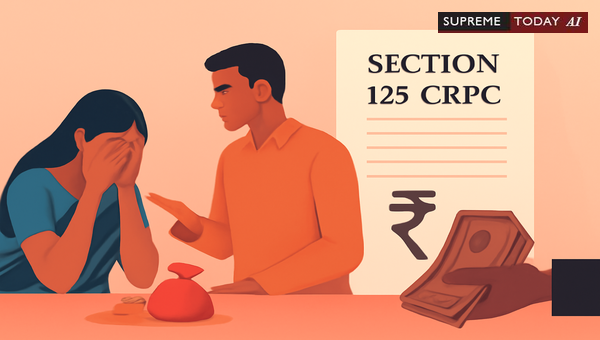
Husband's Primary Obligation to Maintain Wife under Section 125 CrPC: Judicial Interpretations
Introduction
In Indian family law, few issues spark as much debate as a husband's duty to provide for his wife. A provocative query often arises: : Beg, Borrow, Steal for Wife's ? Husband's Obligation for Wife's case name. This phrase, rooted in longstanding judicial rhetoric, underscores the intensity of the obligation under . Section 125 CrPC mandates that a husband with must maintain his wife if she cannot support herself.
But does this mean a husband must truly beg, borrow, or steal to fulfill this duty? While courts have historically affirmed a husband's primary responsibility—drawing from ancient texts like the Manusmriti—modern rulings introduce balance, considering both spouses' earning capacities. This post examines key principles, landmark interpretations, enforcement mechanisms, and evolving judicial perspectives. Note: This is general information based on precedents and not specific legal advice; consult a lawyer for personalized guidance.
The Core Principle: Husband's First and Foremost Duty
Courts have repeatedly emphasized that the husband's obligation to maintain his wife is paramount and arises from the marital bond itself. This duty persists even during separation or litigation, independent of property ownership or current employment.
A seminal view captures this starkly: The first and foremost duty of the husband is to maintain the wife and the child – He may beg, borrow or steal 2018 0 Supreme(P&H) 2589. This echoes ancient wisdom from the Manusmriti, as interpreted in Mitakshara: The aged parents, a virtuous wife and an infant child must be maintained even by doing a hundred misdeeds 1987 0 Supreme(Raj) 83 1987 0 Supreme(Raj) 449.
Under , is interpreted broadly, focusing on rather than current income:- A healthy, able-bodied husband—even if unemployed or a student—is presumed capable of earning. If he does not use his potentialities for earning, the wife cannot be denied the on that account. In the proverbial saying, the husband may beg, borrow and steal but must maintain his wife 1988 0 Supreme(Raj) 776.- This holds during ongoing disputes, like cruelty claims, prioritizing the wife's immediate support 1987 0 Supreme(Raj) 83 1987 0 Supreme(Raj) 449.
Foundational precedents, such as Sri Raja Bommadevara Raja Lakshmi Dave Amma Gari v. Sri Raja B. Naganna Naidu Bahadur Zamindar Garu (AIR 1925 Mad 757) and Mulla's Hindu Law (Art. 554), reinforce this under Hindu law, seamlessly applied via Section 125 CrPC 1987 0 Supreme(Raj) 83 1987 0 Supreme(Raj) 449.
Interpreting '' and
The threshold of typically includes not just visible assets but potential earnings. Courts impute income to idle husbands, ensuring wives aren't left destitute.
However, judicial nuance emerges in contemporary cases. For instance, where both spouses are qualified and capable:- No law provides that a husband has to maintain a wife, living separately from him, irrespective of the fact whether he earns or not. Court cannot tell the husband that he should beg, borrow or steal but give to the wife, more so when the husband and wife are almost equally qualified and almost equally capable of earning and both of them claimed to be gainfully employed before marriage 2017 0 Supreme(Bom) 1598.
This perspective
highlights reciprocity: under laws like , weighs both parties' capacities. In one case, the court upheld for a wife who had left her job, citing the husband's improved reflected in his salary slip 2017 0 Supreme(Bom) 1598.
Similarly, under the (Section 20), aligns with existing rights under CrPC. Courts reduce awards if the wife is qualified to earn: Having regard to the qualifications of wife, there is no reason as to why she ought not to be in a position to maintain herself 2015 0 Supreme(Del) 515. An appellate court appropriately slashed from Rs. 2,50,000 to Rs. 50,000 monthly based on evidence 2015 0 Supreme(Del) 515.
In another ruling, unemployment isn't a blanket defense: Inability of earning is not a valid defence—While granting the court has to weigh the comparative hardship of husband and of the wife 2011 0 Supreme(Raj) 423. Courts below were upheld in allowing despite the husband's jobless claim, as non-payment constitutes .
Enforcement Mechanisms and Penalties for Default
provides robust enforcement:- Imprisonment up to one month per defaulted month, as is a continuing liability 2018 0 Supreme(P&H) 2589.- For 12 months' arrears, up to 12 months' imprisonment is legal 2018 0 Supreme(P&H) 2589.- Crucially, imprisonment doesn't erase arrears: On undergoing imprisonment in default of , liability to pay will not wipe out, which shall subsist till the payment is made 2018 0 Supreme(P&H) 2589.
These measures ensure compliance, treating as an unyielding right.
Perspectives and Absence of Direct Phrases
While the query seeks affirmations of beg, borrow, steal, the reviewed contexts lack direct invocations from the apex court. Principles thrive in (e.g., , 1982 Cr LJ 485) and lower rulings, rooted in pre-independence cases. precedents like Bhagwan Dutt v. Kamla Devi (1975) and Chaturbhuj v. Sita Bai (2008) broadly uphold Section 125 but don't employ the queried phrasing.
Researchers should consult databases like SCC Online or Manupatra for nuanced affirmations.
Modern Balance: Weighing Both Spouses' Capacities
Recent trends shift from absolute duty to equitable assessment:- Courts scrutinize wives' , especially post-marriage employment history
.- Under Act, orders mirror CrPC limits; no new rights created 2015 0 Supreme(Del) 515.- Comparative hardship guides awards, rejecting one-sided burdens on unemployed but capable husbands 2011 0 Supreme(Raj) 423.
This evolution reflects gender-neutral family law principles, promoting self-reliance while safeguarding vulnerable parties.
Conclusion and Key Takeaways
The husband's duty under Section 125 CrPC remains a cornerstone of Indian family law—often described as first and foremost, even invoking dramatic phrases like beg, borrow, or steal 2018 0 Supreme(P&H) 2589 1988 0 Supreme(Raj) 776. Yet, enforcement is tempered by realities: earning capacities of both spouses matter, preventing undue hardship 2017 0 Supreme(Bom) 1598
.
Key Takeaways:- Obligation is primarily status-based but considers potential earnings 1988 0 Supreme(Raj) 776.- Defaults invite strict penalties, with arrears surviving imprisonment 2018 0 Supreme(P&H) 2589.- Modern courts balance equities, especially for qualified wives 2015 0 Supreme(Del) 515 2011 0 Supreme(Raj) 423.- No direct use of queried phrases, but principles align with broader jurisprudence.
For those navigating disputes, professional legal counsel is essential. Stay informed on evolving precedents to protect your rights.
#Section125CrPC, #HusbandMaintenance, #FamilyLawIndia















