


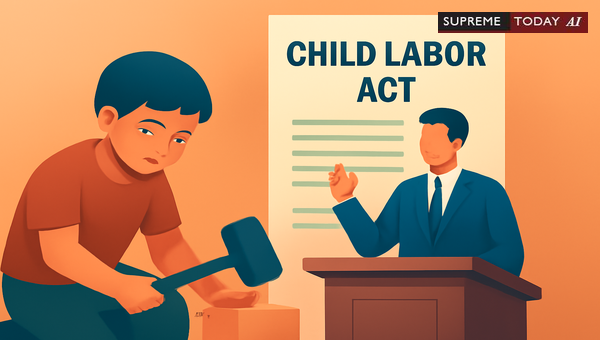
Can a Court an Accused on Under Section 14 of the Child Labour Act?
In the realm of Indian labour laws, employing children in prohibited occupations carries severe consequences. A common query arises: if Accused Plead Guilty can Court Grant Accused Plea and ? This question is critical for employers, legal practitioners, and those navigating child labour prosecutions under the . While a might seem like a shortcut, does it allow the court to simply the accused? This blog post delves into the legal nuances, drawing from statutory provisions, judicial principles, and related precedents. Note: This is general information and not specific legal advice. Consult a qualified lawyer for your case.
Nature of Section 14: Penalties for Child Labour Violations
, is a stringent penal provision targeting those who employ children in contravention of , which prohibits child labour in certain occupations and processes. It prescribes imprisonment, fines, or both as penalties. Specifically, Section 14 primarily prescribes penalties for employing a child in contravention of , including imprisonment, fines, or both 2002 0 Supreme(AP) 1215 2006 0 Supreme(Guj) 834.
This section mandates and by a . Unlike some statutes with built-in mechanisms, Section 14 does not explicitly provide for upon a . It emphasizes accountability to protect vulnerable children, making it a under Indian law.
Court's Approach to Guilty Pleas in Criminal Proceedings
Under general Indian criminal law, particularly the , a plea of guilty can streamline proceedings but does not automatically result in or acquittal. Generally, under Indian criminal law, a plea of guilty can lead to but does not automatically result in or acquittal; the court considers the nature of the offence, the circumstances, and the law 2002 0 Supreme(AP) 1215.
In or , courts may exercise discretion under CrPC provisions like , which allows stopping proceedings at any stage, effectively discharging the accused. However, for serious penal provisions like Section 14, this discretion is limited. One source notes, Criminal Procedure Code - – ... such release shall have effect of 2014 0 Supreme(AP) 1037. Yet, this applies typically to minor offences, not child labour violations carrying mandatory minimum sentences.
The court's role remains to ensure proper adjudication. Even with a , judges must verify the plea is voluntary, informed, and supported by evidence. The legal documents do not explicitly mention whether a court can grant a plea of guilty and the accused under Section 14 2006 0 Supreme(Guj) 834.
Judicial Principles: Requires More Than a Plea
Courts prioritize substantive justice over procedural shortcuts in child protection cases. under Section 14 hinges on proven employment of a child, with the bearing the on the child's age and violation. The courts have emphasized that the regarding the child’s age rests on the , and failure to prove this can lead to acquittal 2001 0 Supreme(Chh) 116 2001 0 Supreme(All) 1132.
A alone does not bypass this. The law mandates that under Section 14 is based on proven employment of a child in violation of the law, and a plea of guilty alone does not automatically entitle the court to the accused; the court must still evaluate the evidence and the law 2002 0 Supreme(AP) 1215.
Related precedents from other domains reinforce safeguards around guilty pleas:- In , strict procedures govern pleas. If an accused person pleads 'Guilty', that plea shall be recorded as the finding of the Court; but before it is recorded, the Court shall ascertain that the accused understands the nature of the charge 2007 0 Supreme(Gau) 286 2010 0 Supreme(All) 918. Non-compliance can vitiate proceedings, as seen in Army Rules cases where retrials were ordered due to improper plea recording 2006 0 Supreme(All) 2514.- Under CrPC , magistrates must apply their mind before accepting pleas. It is needless to say in preparing to ask the accused by the Magistrate, he must apply his mind on the accusation once there is an accusation 2014 0 Supreme(AP) 1037.- Juvenile justice cases highlight mandatory procedures. Procedure provided under has been held to be mandatory 2024 3 Supreme 429. Though not directly applicable, it underscores procedural rigor in child-related matters.
These principles analogously apply: courts under Section 14 typically convict on a but impose penalties rather than , absent exceptional circumstances.
Limitations on and Sentencing Discretion
implies no , which contradicts Section 14's punitive intent. Plea of guilty under Section 14 does not automatically lead to . The court may convict based on the plea but will still consider the evidence and legal requirements 2006 0 Supreme(Guj) 834. Penalties include up to 1 year imprisonment for first offences, escalating thereafter, with no provision for plea-based leniency like compounding.
Factors influencing the court:- Voluntariness of Plea: Must not be coerced, as in cases where accused claimed misleading by counsel 2023 Supreme(Online)(KAR) 21816.- Evidence Review: Age proof via birth certificates or ossification tests is crucial.- Mitigating Circumstances: First-time offenders or lack of knowledge might reduce sentence, but not lead to .- Exclusion: excludes like child labour from bargaining.
In or (common for these cases), guides sentencing post-, focusing on proportionality.
Practical Implications for Accused and
For employers accused under Section 14:- Plead Strategically: A may expedite but negotiate for minimal sentence via mitigation.- Challenge : Contest child's age or employment facts if weak.- Compliance Measures: Implement age verification and no-child-labour policies to prevent violations.
Prosecutors must adhere to mandatory proofs, as lapses lead to acquittals. Judicial trends favour child protection, with increasing convictions in recent years.
Insights from diverse cases, like BSF or Army courts, show guilty pleas lead to findings of guilt but require judicial confirmation. on plea of guilty.-- If the accused pleads guilty, the Magistrate shall...
. Similarly, The accused persons plea – 'Guilty' or 'Not Guilty'... shall be recorded on each charge 2007 0 Supreme(Mad) 1314.
Conclusion and Key Takeaways
Under Section 14 of the Child Labour Act, a typically results in and penalty imposition, not . Courts retain discretion but are guided by the statute's protective mandate and CrPC safeguards. Based on the legal documents and prevailing principles, if the accused pleads guilty under Section 14, the court can convict but is not necessarily obliged to grant a plea and unless specific statutory provisions or judicial discretion permit such 2002 0 Supreme(AP) 1215 2006 0 Supreme(Guj) 834.
Key Takeaways:- No automatic on .- must prove key elements like child's age.- Courts evaluate pleas rigorously, drawing from broader criminal jurisprudence.- Prioritize prevention through compliance.
For definitive guidance, review specific precedents or consult legal experts. Stay informed on evolving child rights laws to avoid pitfalls.
This analysis is for informational purposes only. Laws may vary by jurisdiction and case facts.
#ChildLabourAct #GuiltyPlea #IndianLaw















