


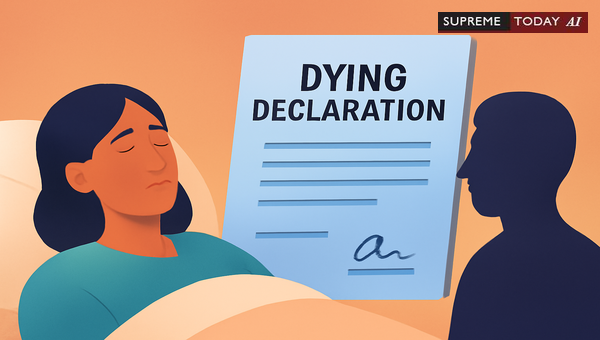
Understanding Under Section 32 of the Indian Evidence Act
In high-stakes criminal cases, particularly those involving homicide or suspicious deaths, the statements made by victims on their deathbeds can hold immense evidentiary value. Often referred to as , these statements are governed by . But what exactly constitutes a valid dying declaration, and under what conditions can courts rely on it? This blog post delves into the key principles of admissibility, reliability, and procedural safeguards surrounding Section 32, drawing from judicial precedents and statutory interpretations. Whether you're a legal practitioner, student, or someone navigating a case, understanding these nuances is crucial—though note that this is general information and not specific legal advice.
What is Section 32 of the Indian Evidence Act?
Section 32 falls under statements made by persons who cannot be called as witnesses, specifically clause (1), which deals with . These are statements made by a person as to the cause of their death or circumstances leading to it, when that cause comes into question in the case. Unlike regular , are an exception because the declarant is unavailable due to death. 2022 5 Supreme 303
The rationale is rooted in the belief that a person facing imminent death speaks truthfully, without motive for falsehood. However, courts approach these with caution, as their weight may be less than declarations under common law rules. -
Key Principles of Admissibility
For a dying declaration to be admissible under , several foundational requirements must typically be met:
- : The declaration must relate directly to the cause of the person's death, which must be a live issue in the proceedings. 2022 5 Supreme 303
- : It should pertain to the events or circumstances leading to the death. 2022 5 Supreme 303
- : The statement must be made voluntarily and inspire confidence in its reliability. Courts rigorously test for any tutoring, inducement, or coercion. 2011 7 Supreme 233
are admissible even without if deemed true and voluntary. They can even form the when reliable. 2014 7 Supreme 25 2011 7 Supreme 233
In a similar vein, under the (analogous to the Indian Evidence Act), Section 32 allows of a deceased person's statement on the cause of death, emphasizing its weight. Really it amounts to the admission of but section 32 of the allows such evidence to be led.
QUEEN THE v. VINCENT FERNANDO
Reliability and the Need for
While admissible sans , reliability is paramount. Courts must scrutinize:
- Internal Consistency: Absence of contradictions or variations within the declaration or against other evidence.
- Surrounding Circumstances: Investigative processes and contextual factors.
- Veracity Doubts: If doubts arise about truthfulness, the accused gets the . 2021 3 Supreme 111 1983 0 Supreme(SC) 110
can form the if they are found to be reliable and credible. 2014 7 Supreme 25 2011 7 Supreme 233 The court in one case stressed careful examination: courts must carefully scrutinize the dying declaration, the investigative process, and the surrounding circumstances to determine its reliability. 1983 0 Supreme(SC) 110 2011 7 Supreme 233
This scrutiny ensures justice, preventing miscarriages based on potentially flawed statements.
Procedural Safeguards in Recording
No rigid format or specific authority is mandated for recording under Section 32. 2016 0 Supreme(SC) 998 However, best practices include:
- : The attending doctor should certify the to make the statement, confirming mental alertness despite physical condition. 2016 0 Supreme(SC) 998 2011 0 Supreme(SC) 761
- Declarant's Authentication: Signature or thumb impression of the declarant on the record. 2016 0 Supreme(SC) 998
- Detailed Recording: Accurate depiction of the incident, including names of accused persons. 2016 0 Supreme(SC) 998
These steps bolster evidentiary value, minimizing challenges to authenticity.
Judicial Interpretations and Broader Contexts
Courts have consistently upheld these principles across jurisdictions. For instance, in cases under analogous provisions like the , misdirection on Section 32's weight led to appeals, underscoring the need for precise jury instructions.
QUEEN THE v. VINCENT FERNANDO
While Section 32 primarily addresses criminal evidence, contrasts appear in civil contexts. Under the , declarations (e.g., ) seek judicial affirmations of rights, but lack Section 32's hearsay exception—highlighting evidentiary differences. 2022 Supreme(Online)(Bom) 4748
In tenancy laws, like the , Section 32 deals with , where no further application under is needed if status is conferred by law. If a person has a deemed status, there is no need for him to apply for purchase under . 2019 2 Supreme 673 This illustrates Section 32's varied applications, though unrelated to evidence.
Similarly, in insolvency under , declarations grant immunity post-resolution, overriding attachments—a stark procedural contrast to evidence scrutiny. 2024 Supreme(Online)(Bom) 11077 2024 0 Supreme(Bom) 406
These examples show Section 32's contextual adaptability, but in evidence law, the focus remains on life-and-death statements.
Challenges and Common Pitfalls
Common issues include:1. Lack of Fitness Certificate: Undermines voluntariness.2. Multiple Declarations: Contradictions erode credibility.3. Influence Suspicions: Family or police presence raises tutoring flags.
Courts often prefer magistrate-recorded declarations over police ones for impartiality.
Key Takeaways for Practitioners
- Prioritize Voluntariness: Always secure medical endorsement.
- Scrutinize Thoroughly: Treat as potent but fragile evidence.
- Corroborate Where Possible: Strengthens conviction chances.
In summary, while are admissible under Section 32 of the Indian Evidence Act, their weight and reliability are subject to careful scrutiny by the courts. The key factors... are its voluntariness, truthfulness, and the absence of contradictions. Proper recording is crucial.
under Section 32 embody a delicate balance between necessity and caution in India's justice system. For case-specific guidance, consult a qualified lawyer. This overview aims to inform, not advise.
Word count: Approximately 1050
#DyingDeclaration, #EvidenceActSection32, #IndianEvidenceAct















