Searching Case Laws & Precedent on Legal Query.....!
Analysing the retrieved Case Laws
Scanned Judgements…!



Searching Case Laws & Precedent on Legal Query.....!
Analysing the retrieved Case Laws
Scanned Judgements…!
Section 474 CrPC pertains to the powers of the State Government or Court to order detention or release of prisoners, especially in cases involving remand, bail, or detention orders, and to pass final orders regarding their custody (various references).
Key Points & Main Insights:
Relation with Other Sections: Section 474 works in conjunction with other provisions like Sections 427, 428 (set-off of detention periods), and Sections 397, 482 (interference in interlocutory orders), emphasizing its role in the broader legal framework of criminal procedure (e.g., ["2023 0 Supreme(Mad) 1169"], ["2025 0 Supreme(Jhk) 441"]).
Judgments & References:
Section 474 CrPC empowers the State Government and courts to issue final orders regarding the detention or release of prisoners, particularly in serious criminal cases such as murder or fraud. It provides a revisional mechanism to ensure justice and proper detention management, often invoked alongside other procedural provisions to safeguard legal rights and prevent abuse of process. Recent judgments reinforce its importance in the criminal justice system, ensuring that detention orders are subject to review and proper execution by authorized authorities.
References:- ["1973 0 Supreme(Ori) 172"]- ["2018 0 Supreme(J&K) 593"]- ["1988 0 Supreme(SC) 337"]- ["2010 0 Supreme(Del) 1"]- ["2023 0 Supreme(Mad) 1169"]- ["2025 0 Supreme(Jhk) 441"]
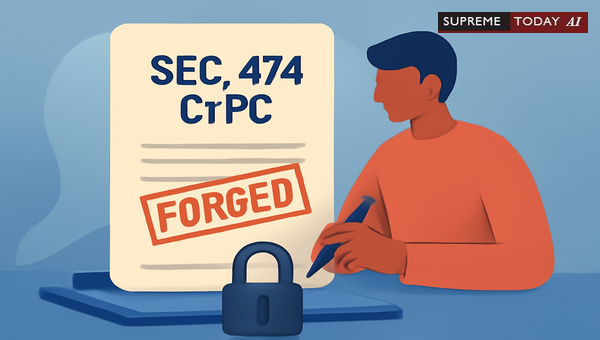
In the realm of criminal law in India, forgery cases involving valuable security documents can have serious implications for individuals and businesses alike. A common query from legal practitioners and those facing charges is 'Sec 474 Crpc Latest Judgement'. This section of the , addresses the procedure for dealing with forged or valuable security documents. But what do recent judicial interpretations say about prosecution, trial procedures, and requirements like prior complaints or sanctions?
This blog post breaks down , drawing from key judgments to provide clarity. We'll explore its scope, linked offenses, procedural nuances, and practical recommendations. Note: This is general information based on analyzed cases and not specific legal advice. Consult a qualified lawyer for your situation.
pertains to offenses involving the possession, forging, or use of with . Valuable securities include documents like , , or that hold monetary value. The provision outlines the procedural framework for prosecution and trial, often intersecting with substantive offenses under the .
Key elements include:- Forging or counterfeiting valuable security documents.- Possession or use of such documents knowing they are forged.- Intent to commit an offense, making it punishable.
It is closely linked with IPC Sections 467 (forgery of valuable security), 468 (forgery for cheating), and 471 (using forged documents as genuine). Courts have clarified that Section 474 offenses can stand independently. 1965 0 Supreme(SC) 158 1983 0 Supreme(SC) 261 1987 0 Supreme(SC) 946
Recent judgments provide critical insights into how courts handle these cases, emphasizing the continuing nature of the offense and procedural flexibilities.
In one key ruling, the court held that possession of a forged permit with knowledge of its forgery constitutes an offense under Section 474. Importantly, it is a , meaning it can be tried where the document is detected or used, not just where originally forged. The judgment states: the offense under Section 474 is a , and possession of a forged permit with knowledge of its forged nature constitutes an offense under this section. 1965 0 Supreme(SC) 158
This ruling aids in determining jurisdiction, allowing trials at convenient locations based on detection.
A pivotal clarification comes from another case: prosecution under Section 474 does not require a prior complaint from a civil court when the forged document is produced in a criminal investigation or trial. The court elaborated: for the offense under Section 474, the prosecution can proceed without a prior complaint from a civil court, especially when the forged document is produced in a criminal case or investigation. 1983 0 Supreme(SC) 261
Production of a forged document in civil proceedings does not bar subsequent criminal action under this section if used in a criminal context. This distinguishes it from scenarios needing sanctions.
Proceedings under Sections 467, 468, 471, and 474 IPC/CrPC are distinct yet related. A police complaint or magistrate's order can initiate action, even without the original document in a civil case, if the forgery is evident in criminal proceedings. As noted: proceedings under Sections 467, 468, 471, and 474 are distinct but related, and that a complaint by the police or magistrate can initiate proceedings. 1987 0 Supreme(SC) 946
Initiating prosecution typically follows standard CrPC protocols:- Police Report or Private Complaint: Depending on the case, a or magistrate complaint suffices.- No Mandatory Sanction in Criminal Trials: Unlike some offenses, forged documents in criminal probes bypass civil court complaints. 1983 0 Supreme(SC) 261
However, if the document was produced in a civil or judicial proceeding, may require prior sanction. Courts have ruled this inapplicable for criminal contexts. 1983 0 Supreme(SC) 261
Related procedural aspects from broader CrPC jurisprudence reinforce timely action:- under have a 90-day limit for state appeals, with condonation possible for sufficient cause, as seen in cases emphasizing procedural diligence. 2024 0 Supreme(Sikk) 8- under applies elastically to advance justice, provided explanations are genuine. 2024 0 Supreme(Cal) 26
These principles ensure Section 474 cases proceed efficiently without undue delays.
While flexible, exceptions exist:- Trigger: If forgery involves court-produced documents in civil matters, a complaint from that court is needed. But criminal production overrides this. 1983 0 Supreme(SC) 261- Evidence of Intent: Prosecution must prove knowledge of forgery and .- Interlinked Offenses: Trial courts assess forgery (467/468), use (471), and possession (474) holistically.
In practice:- Document circumstances thoroughly.- Check context (civil vs. criminal) for sanctions.- Leverage doctrine for jurisdiction.
Other CrPC cases highlight enforcement rigor, such as under (no jurisdiction to alter via compromise) or under 436A, underscoring procedural adherence. 1999 0 Supreme(Ori) 191 2022 0 Supreme(Bom) 1250
Recommendations:- Prosecutors: Verify intent and context; file via police/magistrate.- Accused: Challenge lack of prior sanction if applicable; argue no knowledge.- Always document evidence meticulously.
offers a robust framework for tackling forged valuable securities, with latest judgments streamlining procedures—especially no need for civil complaints in criminal scenarios. By understanding these nuances, legal professionals can navigate cases effectively. Stay updated, as interpretations evolve.
References:1. 1965 0 Supreme(SC) 158: and jurisdiction.2. 1983 0 Supreme(SC) 261: No prior complaint in criminal contexts.3. 1987 0 Supreme(SC) 946: Interplay with related sections.
For tailored advice, reach out to a legal expert. Share your thoughts below!
#Section474CrPC #ForgeryLawIndia #CrPCJudgments


-In any proceeding for the winding-up of a banking company, every depositor of the banking company shall be deemed to have filed his claim for the amount shown in the books of the banking company as standing to his credit and, notwithstanding anything to the contrary contained in Sec. 474 of the Companies ... service, the claim shall not be treated as a claim entitled to be paid under Sec. 530 of the Companies Act, 1956 (1 of 1956), in prio....

. 474 of the Companies Act, 1956 (1 of 1956), the High Court shall presume such claims to have been proved, unless the official liquidator shows that there is reason for doubting its correctness. ... —Notwithstanding anything to the contrary contained in Sec. 466 of the Companies Act, 1956 (1 of 1956), the High Court shall not make any order staying the proceedings in relation to the winding up ... (2) Every notice under sub-section (1) sent to a cla....

Sec., 474 F.3d 830, 833 (6th Cir. 2006). “‘[S]ubstantial evidence’ is a ‘term of art’” in this setting. Biestek, 139 S. Ct. at 1154 (citation omitted). And it is “not [a] high” threshold. Id. ... Sec., 280 F. App’x 456, 459 (6th Cir. 2008); see also Lambdin v. Comm’r of Soc. Sec., 62 F. App’x 623, 625 (6th Cir. 2003) (order); Trandafir v. Comm'r of Soc. Sec., 58 F. App'x 113, 115 (6th Cir. 2003); Nabours ....

It is to be noticed that the Applicant has sought 'leave' to appeal under Section 378(3) Cr.P.C. instead of 'special leave' to appeal under Section 378(5) Cr.P.C. ... Section 378 Cr.P.C. for convenience is extracted hereinbelow:- '378. ... . - The Union of India (Applicant) has moved this application under Section 5 of the Limitation Act, 1963 seeking condonation of delay of 54 days in filing the Leave to Appeal under Section 378(3) of the ....

In other words, since Section 397(2) CrPC prohibits interference with the interlocutory orders, it would not be permissible to resort to Section 482 CrPC. To set aside an interlocutory order, prohibition in Section 397 CrPC will govern Section 482 CrPC. ... When Section 397(2) CrPC prohibits interference in respect of interlocutory orders, Section 482 CrPC cannot be availed of to achieve....

Petitioner claiming to be a senior citizen invoked provision of Section 378 (4) of the Code of Criminal Procedure (for short CrPC) by filing a special leave petition to file appeal against the order of discharge of the opposite party (for short O.P) herein passed by Learned Additional Sessions Judge, ... In the aforesaid view of the matter I am not inclined to refuse the prayer for condonation of delay of 20 days in filing special leave to appeal within the ....

A plain reading of Section 428 of the Cr.P.C., makes it very clear that the period of set-off contemplated is case-specific. ... This will be the effect of a combined reading of Sections 427 and 428 Cr.P.C. 14. ... Thus, this Court held that the accused may be given the benefit under Section 428 Cr.P.C. to set off the period of detention from 23.01.2006 of the two judgments referred above, the judgment in Crl.A.No. 526 of 2009 applies to th....

The Calcutta High Court held that right of bail to an undertrial prisoner flows from Article 21 of Constitution of India. The Court referred to import of Sec. 436-A of Cr.P.C. However, the decision does not refer to distinction between directions of Supreme Court for NDPS cases and Sec. 436-A of Cr.P.C. It is pertinent to note that Sec. 436-A does not exclude offences under NDPS Act.

This is an Appeal under sec. 374 of Cr.P.C. directed against the judgment and order dtd.

During the course of treatment, Parvati died and they have no suspicion about it. On this, an inquest case No.5/12 under sec.174 CrPC was registered.

Misc. Pet No. 2885/2014, and the law laid down by the Apex Court in the case of State of Kerala vs. M.M. Manikantan Nair (supra) and Hari Singh Maan vs. Harbhajan Singh Bajwa (supra), in my view, the application filed by the petitioner before this court for recalling the Harbhajan Singh Bajwa reported in (2002) 1 SCC 169, wherein in para No. 7, it has been held that Sec. 362 of the Code mandates that no court, when it has signed its judgment or final order disposing of a case shall alter or re....

The appellant-husband having not complied with the order and having defaulted in payment, the respondent filed an application under Sec. 128, Cr.P.C. for enforcement of the order of maintenance. 2. The short facts of the case is that an order under Sec. 125, Cr.P.C. was passed in Misc. Case No. 79 of 1991 against the appellant on 8.8.1991 directing him to pay monthly maintenance of Rs. 250/- with effect from 25.5.1989.


An indispensable Tool for Legal Professionals, Endorsed by Various High Court and Judicial Officers
Please visit our Training & Support
Center or Contact Us for assistance

Scan Me!
India’s Legal research and Law Firm App, Download now!


For Daily Legal Updates, Join us on :



 Back to top


