Searching Case Laws & Precedent on Legal Query..!
Scanned Judgements…!



Searching Case Laws & Precedent on Legal Query..!
Scanned Judgements…!
Hypothecation and Ownership - When a person purchases a vehicle under a hypothecation or hire-purchase agreement, the owner is typically considered to be the person in possession of the vehicle under that agreement, not necessarily the registered owner. The law recognizes that the person in possession under such agreements is deemed the owner for legal purposes ["2016 0 Supreme(Raj) 702"], ["2022 0 Supreme(Jhk) 1025"], ["MANAGER, ICICI BANK LTD vs G. MANGULU PATRO - Orissa"].
Transfer of Vehicle Without Consent - Selling or transferring the vehicle without the bank’s consent, especially after hypothecation, constitutes a wrongful act. Several cases highlight that such transfer, particularly without informing or obtaining approval from the financier, can amount to an offense under Section 403 IPC (dishonest misappropriation or conversion of property) ["2025 Supreme(Online)(GUJ) 3511"], ["2017 0 Supreme(Gau) 988"], ["2023 Supreme(Online)(KAR) 21387"].
Offense Under Section 403 IPC - To establish an offense under Section 403, it must be shown that the property (vehicle) was moved or transferred dishonestly and without the consent of the owner (bank/financier). Selling the vehicle without bank’s approval, especially if done fraudulently or with forged signatures/seals, can amount to this offense ["2025 Supreme(Online)(GUJ) 3511"], ["2017 0 Supreme(Gau) 988"], ["2023 Supreme(Online)(KAR) 21387"].
Legal Precedents - Courts have consistently held that repossession by the financier as per the hypothecation agreement does not amount to theft or criminal offense if done lawfully. However, unauthorized sale or transfer, especially with forgery or without notice, can lead to criminal liability under IPC ["2014 0 Supreme(HP) 843"], ["MANAGER, ICICI BANK LTD vs G. MANGULU PATRO - Orissa"], ["2022 0 Supreme(Jhk) 1025"].
Conclusion - Selling a hypothecated vehicle without the bank’s consent, particularly when done fraudulently or without proper notice, can amount to an offense under Section 403 IPC (dishonest misappropriation or conversion). The key factors are whether the transfer was authorized, whether it involved forgery or deception, and whether the bank’s rights were violated ["2025 Supreme(Online)(GUJ) 3511"], ["2017 0 Supreme(Gau) 988"].
References:- ["2025 Supreme(Online)(GUJ) 3511"]- ["2024 0 Supreme(Cal) 189"]- ["2017 0 Supreme(Gau) 988"]- ["2023 Supreme(Online)(KAR) 21387"]- ["2016 0 Supreme(Raj) 702"]- ["2014 0 Supreme(HP) 843"]- ["2022 0 Supreme(Jhk) 1025"]- ["MANAGER, ICICI BANK LTD vs G. MANGULU PATRO - Orissa"]- ["MANAGER, ICICI BANK LTD vs G. MANGULU PATRO - Orissa"]
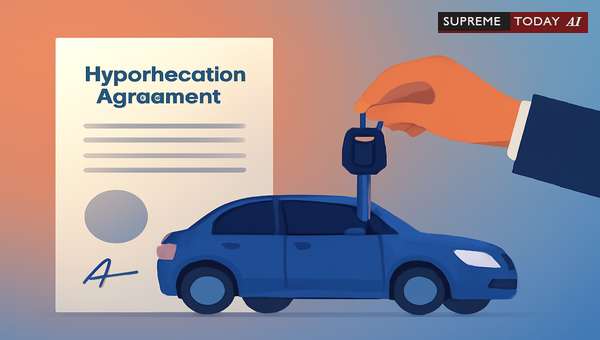
Imagine you've financed a car through a bank loan, signing a that pledges the vehicle as security. Later, facing financial crunch, you sell it to clear debts—without asking the bank. Suddenly, you're facing a police complaint under (IPC) for . Is this a criminal act?
This scenario raises a common question: A person purchases a vehicle by executing a with a bank. He later sells the vehicle without the consent of the bank. Would it amount to an offence under Section 403 of the IPC?
In this post, we'll break down the legal nuances, drawing from key judicial interpretations and statutory provisions. While hypothecation creates a , it doesn't always trigger criminal liability for sale without permission—absent dishonest intent. Let's dive in.
Hypothecation is a form of pledge where the borrower retains possession and ownership of the asset (like a vehicle) while granting the lender (bank) a . Crucially, hypothecation does not transfer ownership of the vehicle to the bank; ownership remains with the borrower1997 0 Supreme(P&H) 1492.
Under the , Section 2(30) defines owner as the person in whose name the vehicle is registered, but with a key exception: in relation to a motor vehicle which is the subject of a , or an agreement of lease or an agreement of hypothecation, the person in possession of the vehicle under that agreement2017 Supreme(Online)(All) 129 2014 8 Supreme 359
2020 0 Supreme(Cal) 476 2019 0 Supreme(Guj) 588 2019 0 Supreme(Ori) 261 2018 6 Supreme 400 2013 0 Supreme(MP) 1475. This reinforces that the borrower, not the financier, is typically treated as the owner.
Courts have consistently held that the financier, even if noted in the registration certificate, does not become in control and possession of the vehicle2014 8 Supreme 359. For instance, in accident liability cases, the borrower in possession bears responsibility, not the bank 2014 8 Supreme 359.
punishes dishonestly misappropriating or converting to one's own use any movable property claimed or known to belong to another. The essential ingredients are:
Misappropriation or conversion requires dishonest intention or act to the detriment of the owner2003 6 Supreme 286. Mere retention or sale doesn't suffice without this (guilty mind).
Generally, no—provided there's no dishonest intent. In a pivotal ruling, the court quashed proceedings against sellers of hypothecated goods, stating: the ownership of the hypothecated goods remains with the person who has hypothecated them, and the bank only has a as security. The act of selling hypothecated goods by the owner, without transferring ownership, does not constitute a criminal offence under Section 406 or 403 IPC, unless accompanied by dishonest intent1997 0 Supreme(P&H) 1492.
Sale of hypothecated goods without the bank’s permission, in the absence of dishonest intent, does not automatically amount to or 1997 0 Supreme(P&H) 1492. The absence of entrustment to the bank further weakens claims under .
This aligns with broader principles: even repossession by owners in hire-purchase scenarios lacks dishonest intention, negating 2010 0 Supreme(Kar) 78.
Multiple precedents affirm borrower ownership:
These cases, often from motor accident tribunals, highlight that possession defines ownership under hypothecation, empowering the borrower to deal with the vehicle, subject to contractual terms.
Exceptions exist if:
Banks must demonstrate these elements for criminal charges; civil remedies (like recovery suits) are often preferred otherwise.
Relatedly, in robbery or analogies, there must be either '' or ''... '' requires intending to take dishonestly any movable property—lacking here without intent 2010 0 Supreme(Kar) 78.
Liability chains underscore caution: face fines/claims until transfers register, even post-sale 2018 6 Supreme 400 2019 0 Supreme(Guj) 588. Hypothecation possessors are owners for insurance, accidents 2014 8 Supreme 359 2019 0 Supreme(Ori) 261.
In summary, while risky contractually, such sales typically evade Section 403 absent fraud. Courts prioritize intent over mere non-consent 1997 0 Supreme(P&H) 1492.
Disclaimer: This is general information based on cited documents, not legal advice. Consult a lawyer for case-specific guidance. Laws evolve; verify current positions.
References:- 2003 6 Supreme 286: Elements of misappropriation.- 1997 0 Supreme(P&H) 1492: Ownership in hypothecation, no offence sans intent.- Other MV Act cases: 2017 Supreme(Online)(All) 129, 2014 8 Supreme 359, etc., on possessory ownership.
#IPC403, #HypothecationLaw, #VehicleSaleIndia


the person taking loan without following the legal procedure to recover the loan amount. ... That the respondent No.3 purchased a tractor bearing registration No.GJ-12-AN-8472 with the financial assistance of the petitioner bank by executing hypothecation agreement. ... under section 381, 403, 414, 418 and 114 of the IPC. ... Therefore, in order to recover the loan amount, HDFC bank after informin....

It is further submitted that in spite of hypothecation of the said vehicle, the petitioner has handed over the said vehicle to a third person without consultation or consent of the bank/opposite party no. 2. ... one Kartick Shaw in return for a Zen without any consultation or consent of the lender Bank. ... Petitioner had availed a loan of Rs. 2,86,000/-for the purpose of purchasing a vehicle (ALT....

(2) That the vehicle was repossess by unlawful means, ... (3) Taking away of the vehicle was without the consent of the complainant. ... In such premises the learned trial Court should also took cognizance U/S 403/406 IPC against the financer company and accordingly it is prayed to direct the Court to take cognizance of offences U/S 403 and 406 IPC along with Section 379/427 IPC. ... To constitute an offence U/S 37....

in favour of the bank for purchase of a vehicle by executing Hypothecation Agreement. ... and defaulted to pay loan amount as per agreed terms in the loan agreement. ... offences punishable under Sections 403, 405, 406, 415, 420 and 471 of IPC was referred to police for investigation, consequent to which, Cr.No.241/2016 came to be registered by Mangalore North Police ... On verification, it was learnt that t....

In the present case, as the facts have been unfurled, the appellant bank had financed the owner for purchase of the vehicle and the owner had entered into a hypothecation agreement with the bank. ... The High Court failed to appreciate the underlying legislative intention in including in the definition of "owner" a person in possession of a vehicle either under an agreement of lease or agreement of hypoth....

It is settled law by now that the recovery of the possession of goods by owner-financier, as per terms of the hire-purchase agreement, does not amount to a criminal offence. Respondent No.4 defaulted in making the installments, which led to taking over the possession of the vehicle by the bank. ... Before the learned single Judge, the respondent had contended that the vehicle was in the possession of the respondent and it was taken out of his custody without....

PW.2 without the consent or without even intimating the complainant hirer and without drawing a valid panchanama. ... But in the instant case, the owner repossessing the vehicle ' delivered to the hirer under the hire-purchase agreement will not amount to theft as the vital element of "dishonest intention" is lacking. ... In other words the financier would be entitled to possession of the vehicle under the #HL_STAR....

The definition clause itself states that vehicle which is subject matter of a hire purchase agreement the person in possession under agreement shall be 'owner' and that the name of Financier in registration certificate would not be decisive for determination as to who was the owner of vehicle. ... Court held that the person in possession of Vehicle under hypothecation agreement is treated as owner....

In the present case, as the facts have been unfurled, the appellant bank had financed the owner for purchase of the vehicle and the owner had entered into a hypothecation agreement with the bank. ... “owner” means a person in whose name a motor vehicle stands registered, and where such person is a minor, the guardian of such minor, and in relation to a motor vehicle which is the subject of a hire-purchase....

agreement of lease or an agreement of hypothecation, the person in possession of the vehicle under that agreement.” ... It is reproduced herein below: “2(30) “owner” means a person in whose name a motor vehicle stands registered and where such person is a minor, the guardian of such minor, and in relation to a motor vehicle which is the subject of a hire-purchase, agreement, or a....

Under that definition 'owner' means a person in whose name a motor vehicle stands registered and in relation to a motor vehicle which is the subject of a hire-purchase agreement or an agreement of lease or an agreement of hypothecation, the person in possession of the vehicle under that agreement. It is contended by the learned Advocate that there is nothing to show in the instant case that at the relevant point of time, the motor vehicle in question was subject of a hire-purchase agreement or an agreement of lease etc, therefore under the law as it stands now, the O.P./Com....

In relation to a motor vehicle which is the subject of an agreement of hire purchase, lease or hypothecation, the person in possession of the vehicle under that agreement would be the owner. Otherwise the definition stipulates that for the purposes of the Act, the person in whose name the motor vehicle stands registered is treated as the owner. Where such a person is a minor the guardian of the minor would be the owner. The latter part of the definition is in the nature of an exception which applies where the motor vehicle is the subject of a hire purchase agreement or of a....
In relation to a motor vehicle which is the subject of an agreement of hire purchase, lease or hypothecation, the person in possession of the vehicle under that agreement would be the owner. The latter part of the definition is in the nature of an exception which applies where the motor vehicle is the subject of a hire purchase agreement or of an agreement of lease or hypothecation. Where such a person is a minor the guardian of the minor would be the owner. Otherwise the definition stipulates that for the purposes of the Act, the person in whose name the motor vehicle stan....
The latter part of the definition is in the nature of an exception which applies where the motor vehicle is the subject of a hire purchase agreement or of an agreement of lease or hypothecation. In relation to a motor vehicle which is the subject of an agreement of hire purchase, lease or hypothecation, the person in possession of the vehicle under that agreement would be the owner. Where such a person is a minor the guardian of the minor would be the owner. Otherwise the definition stipulates that for the purposes of the Act, the person in whose name the motor vehicle stan....

Act, it is clear that a person would be owner of the motor vehicle in whose name it stands registered and in case of minor, guardian of such minor, and if the motor vehicle is subjected to hire purchase agreement, lease agreement, hypothecation agreement, than a person in possession of vehicle under such agreement. While appreciating the definition of the owner under the old M.V. Act, Hon'ble the Apex Court in the case of Rajasthan State Road Transport Corporation Vs. Kailash Nath Kothari and other etc. (1997) 7 SCC 481, in para-1/observed as under:


An indispensable Tool for Legal Professionals, Endorsed by Various High Court and Judicial Officers
Please visit our Training & Support
Center or Contact Us for assistance

Scan Me!
India’s Legal research and Law Firm App, Download now!


For Daily Legal Updates, Join us on :



 Back to top


