Searching Case Laws & Precedent on Legal Query.....!
Analysing the retrieved Case Laws
Scanned Judgements…!



Searching Case Laws & Precedent on Legal Query.....!
Analysing the retrieved Case Laws
Scanned Judgements…!
Limited scope of enforcement: The Senior Citizens Act, 2007 primarily aims to protect the welfare, maintenance, and dignity of senior citizens. Its provisions, especially Section 3, are intended to have overriding effect to ensure immediate relief and support for senior citizens, but do not extend to civil disputes over property titles or eviction proceedings (e.g., ["2025 0 Supreme(Ker) 2262"], ["2024 0 Supreme(Telangana) 502"], ["
K. Lokesh VS Bangalore District Maintenance and Welfare of Parents and Senior Citizens Appellate Tribunal and Special Deputy Commissioner-1 - Current Civil Cases
"], ["2024 0 Supreme(P&H) 150"]).Procedure and jurisdiction: The Act emphasizes summary proceedings for protection and maintenance, where authorities like the Collector or District Magistrate are expected to consider relevant provisions without delving into property title issues. The exercise under the Act is not meant to determine ownership or title of property but to safeguard the senior citizen’s welfare (e.g., ["2024 0 Supreme(Telangana) 502"], ["2025 0 Supreme(Ker) 2262"], ["
K. Lokesh VS Bangalore District Maintenance and Welfare of Parents and Senior Citizens Appellate Tribunal and Special Deputy Commissioner-1 - Current Civil Cases
"]).Protection of rights and limitations: The Act recognizes that rights under Section 23 are personal rights of the senior citizen that cease upon their death. It cannot be extended to heirs or used to annul transfer deeds unless specific conditions are met. Moreover, the Act does not empower courts or authorities to order eviction of occupants or resolve civil property disputes, which are governed by civil law and other statutes like the Transfer of Property Act (["2025 0 Supreme(Mad) 2776"], ["2023 0 Supreme(Raj) 386"], ["2024 0 Supreme(P&H) 150"]).
Legal interpretation and judicial views: Courts have consistently held that the Act should be interpreted broadly to protect senior citizens, but not as a machinery for eviction or property disputes. The Supreme Court and High Courts have emphasized that the object of the Act is welfare-oriented, and its provisions cannot override other legal protections or civil law procedures (e.g., ["2025 0 Supreme(Ker) 2262"], ["2025 0 Supreme(Mad) 2329"], ["2024 0 Supreme(Telangana) 502"]).
The Senior Citizens Act, 2007 is not a tool for eviction or property title disputes. Its provisions are designed to provide immediate welfare, maintenance, and protection for senior citizens, not to serve as machinery for civil or property law enforcement. Courts have clarified that the Act cannot be used to bypass civil procedures or determine property ownership, and any attempt to do so would be contrary to the Act’s purpose and judicial interpretation. Therefore, the Act should be applied within its intended scope, focusing on welfare and protection, rather than as a substitute for civil law machinery.
References:- ["2025 0 Supreme(Ker) 2262"], ["2024 0 Supreme(Telangana) 503"], ["2024 0 Supreme(Bom) 79"], ["2025 0 Supreme(Mad) 2776"], ["2024 0 Supreme(Telangana) 502"], ["
K. Lokesh VS Bangalore District Maintenance and Welfare of Parents and Senior Citizens Appellate Tribunal and Special Deputy Commissioner-1 - Current Civil Cases
"], ["2023 0 Supreme(Raj) 386"], ["2025 0 Supreme(Mad) 2539"], ["2024 0 Supreme(P&H) 150"], ["2025 0 Supreme(Mad) 2329"]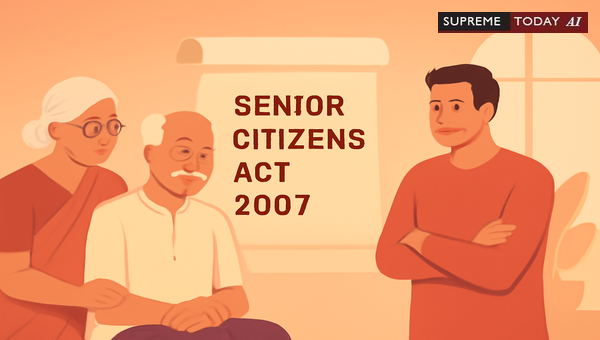
In an era where joint family systems are fading and reports of elder abuse are rising, the (Senior Citizens Act) stands as a vital legal safeguard. But can this Act be dismissed as mere machinery – a procedural tool without real teeth? The legal question at hand is clear: Senior Citizens Act Cannot be Used as Machinery. Courts have repeatedly affirmed that it's far more – a substantive framework enforcing rights to maintenance, property protection, and dignity. This blog delves into judicial interpretations, key provisions, and real-world applications, helping families and seniors understand its power. Note: This is general information, not legal advice. Consult a lawyer for specific cases.
The Senior Citizens Act primarily aims to protect the life, property, and dignity of senior citizens, emphasizing their right to maintenance, protection from abuse, and safeguarding their property 2023 0 Supreme(Mad) 3288 2024 0 Supreme(Pat) 5 2024 0 Supreme(P&H) 65 2023 0 Supreme(Del) 1677
2013 0 Supreme(P&H) 872 2016 0 Supreme(Kar) 940 2015 0 Supreme(P&H) 2191
. It's crafted as a simple, speedy, and inexpensive mechanism to prevent seniors from being left helpless or exploited 2024 0 Supreme(Pat) 5
.
Unlike routine procedural laws, the Act grants that courts must enforce directly. For instance:- Protection of property: Seniors can seek eviction of harassing relatives from their homes.- Maintenance obligations: Children or relatives must provide financial support for a 'normal life,' broadly interpreted to include physical, mental, and psychological well-being 2024 0 Supreme(Bom) 1017.
Judicial views underscore this: The words 'normal life' as used in these provisions would possess a far deeper and wider concept, deriving its meaning and having a bearing on the of livelihood as guaranteed and enjoyed by senior citizens under of the Constitution. Certainly, this would include a right to prevent themselves from being harassed by children and by relatives 2024 0 Supreme(Bom) 1017.
Courts have firmly rejected treating the Act as a procedural gimmick. Instead, it's a substantive legal framework upholding elders' rights 2018 0 Supreme(Kar) 888
. Key principles include:- Direct enforceability: Provisions for property protection and maintenance are invocable in courts 2023 0 Supreme(Mad) 3288 2024 0 Supreme(P&H) 65
2013 0 Supreme(P&H) 872
.- Active judicial enforcement: Tribunals and courts must actively apply the Act, not relegate it to procedure 2023 0 Supreme(Mad) 3288 2024 0 Supreme(P&H) 65
.
In one poignant case, a senior citizen in her nineties faced harassment from her son and grandson over a flat. The court lamented the greed for property and money eroding family values, upholding the tribunal's eviction order: It is so disheartening that at such old age when only expectation of a senior citizen... is of care, concern, affection and love, instead, what has been returned is harassment, wretchedness, suffering and abuse 2021 0 Supreme(Bom) 476. Petitioners lacked legal rights to occupy the grandmother's flat during her lifetime, reinforcing the Act's protective bite.
Another ruling emphasized broad definitions: The Act's 'property' under covers a wide spectrum, obligating children to ensure seniors lead a normal life, free from neglect or psychological distress 2021 0 Supreme(Bom) 1641.
The Act empowers tribunals with for quick relief, including:- Eviction orders under , if necessary for maintenance and protection 2021 0 Supreme(Bom) 476.- Maintenance awards, adjustable later under
.
However, these aren't unchecked. In cases intersecting with the (PWDV Act), courts harmonize laws. A senior mother-in-law successfully evicted her daughter-in-law from a self-purchased property after harassment, as the daughter-in-law wasn't part of a '' at filing. Yet, the Supreme Court cautioned: Right of a woman to secure residence order in respect of a cannot be defeated by simple expedient of securing order of eviction by adopting summary procedure under Senior Citizens Act
. The overriding effect under doesn't nullify PWDV protections; interpreters must harmonize statutes.
Broad welfare extends to old age homes. A government order regulating private facilities was upheld, invoking – the state's duty to protect vulnerable elders. The definitions of 'maintenance' and 'welfare' of senior citizens is broad, ensuring dignity beyond indigents or state homes 2022 0 Supreme(Mad) 2267.
Seniors often face eviction threats or property grabs by children. The Act counters this robustly:- Children's rights limited: Offspring can't assert property claims during parents' lifetime 2024 0 Supreme(Bom) 1017. In a case post-husband's death, a 69-year-old mother evicted her son and daughter-in-law for harassment, with tribunals prioritizing her superior rights.- Overriding domestic violence claims: PWDV proceedings don't bar Senior Citizens Act relief, but balance is key
.
Courts stress societal values: An ordeal of a senior citizen who would be soon in her nineties... harassment caused to her... was such that she desired to end her life 2021 0 Supreme(Bom) 476. Such empathy drives enforcement.
While substantive, the Act interacts with other laws:- PWDV Act: Women's residence rights in shared households prevail if genuine; summary eviction can't bypass them outright
.- : Even financial disputes don't override elder maintenance 2021 0 Supreme(Bom) 476.
Principles of interpretation favor harmony: Primary effort of Interpreter must be to harmonize, not excise
. Later special acts or dominant purposes guide precedence.
The Senior Citizens Act is no mere procedural machinery – it's a comprehensive law embodying enforceable rights for dignity, property, and welfare 2023 0 Supreme(Mad) 3288 2024 0 Supreme(Pat) 5 2024 0 Supreme(P&H) 65 2018 0 Supreme(Kar) 888. Courts duty-bound to uphold it reject dismissive arguments.
Key Takeaways:- Seek tribunal relief for maintenance or eviction promptly – it's speedy and senior-friendly.- Children/relatives must ensure a 'normal life,' linked to rights 2024 0 Supreme(Bom) 1017.- Balance with other laws like PWDV, but elders' protections hold strong.- States must regulate old age homes for comprehensive welfare 2022 0 Supreme(Mad) 2267.
For seniors or families navigating disputes, understanding this Act's depth can prevent exploitation. Always consult legal experts for tailored guidance, as outcomes depend on facts. Stay informed, respect elders – it's not just law, it's societal duty.
#SeniorCitizensAct, #ElderRightsIndia, #SeniorProtection


Maintenance and Welfare of Parents and Senior Citizens Act, 2007 (in short “Senior Citizens Act, 2007”). 2. ... S.3 of the Senior Citizens Act, 2007 cannot be deployed to over-ride and nullify other protections in law, particularly that of a woman's right to a 'shared household' under S.17 of the PWDV Act#H....

For instance, where there is a serious title dispute between the children of the senior citizens or between the senior citizens and the children, the eviction proceedings under the Act and Rules thereunder can be used to obtain an order of eviction. 19. ... Compliance of the procedure also becomes necessary as rights of senior citizens can be #HL_START....

Certainly the Court’s approach cannot be narrow and pedantic in applying the provisions of the Senior Citizens Act to the grievances of the senior citizens falling within the ambit of the said Act. ... It was observed that in dealing with the grievances of the senior citizens falling under Section 4, the Court's approach can....

Citizens Act. ... The interpretation of Section 23 (1) of the Act is intended to protect the property of the Senior citizens. Section 23 (1) of the Senior Citizens Act must be read long with Section 126 of the Transfer of Property Act. ... Since there is no specific condition to maintain the senior citizen in the set....

For instance, where there is a serious title dispute between the children of the senior citizens or between the senior citizens and the children, the eviction proceedings under the Act and Rules thereunder can be used to obtain an order of eviction. 14. ... In the light of the aforesaid submissions, it is apt to note that the object behind the Maintenance and Welfare of Parents and #HL_S....

10.5 It is further submitted that the right to senior citizens under Section 23 of the Act is a personal right. The right to protection under the Act would exhaust itself with the death of the senior citizen. Such right cannot be extended/continued by the legal heirs. ... The relevant provisions of this Act which have been quoted/reproduced hereinabove therefore will h....

Citizens Act, 2007 (for short ‘Act of 2007’) was rejected. ... the life and property of the senior citizens. ... Whereas section 5 of the Act of 2007 is the machinery provision which prescribes the manner and authority who shall pass the order of maintenance. ... (44) A reading of sections 4 and 5 of the Act of 2007, unravels that the Tribunal constit....

Citizens Act. ... The interpretation of Section 23 (1) of the Act is intended to protect the property of the Senior citizens. Section 23 (1) of the Senior Citizens Act must be read long with Section 126 of the Transfer of Property Act. ... Consequently, a complaint was instituted under the Maintenance and Welfare of Parents and #HL_ST....

Citizens Act; and (iii) that under the Senior Citizens Act there was no provision empowering the Magistrate to order eviction. ... Respondent No.3 filed an application before the District Magistrate, Gurugram (for short – the Magistrate) under the Maintenance and Welfare of Parents and Senior Citizens Act, 2007 (for short – the Senior....
'Senior Citizens Act']. ... Citizens Act. ... The Kerala High Court observed in the case of Radhamani and Others (cited supra), Section 23 (1) of the Senior Citizen Act, cannot be interpreted to the disadvantage of the senior citizen. ... The entire purpose and object of the Senior Citizens #HL_STAR....

as used in these provisions would possess a far deeper and wider concept, deriving its meaning and having a bearing on the fundamental rights of livelihood as guaranteed and enjoyed by senior citizens under Article 21 of the Constitution. Certainly, this would include a right to prevent themselves from being harassed by children and by relatives. A protection from harassment, exploitation, neglect, psychological disturbances, psychological needs, and all possible facets to safeguard their phys....
The Second and Third Respondents are at liberty to make a subsequent application under Section 10 of the Senior Citizens Act 2007 for alteration of the maintenance allowance, before the appropriate forum. Act 2005 would have to be determined by the appropriate forum. The claim cannot simply be obviated by evicting the appellant in exercise of the summary powers entrusted by the Senior Citizens Act 2007.
It does not qualify maintenance and welfare to relate only to indigent or residents of state run old age homes (iii) Section 19 of the Senior Citizens Act provides for the establishment of old age homes by the state government. The definitions of “maintenance” and “welfare” of senior citizens is broad as well. The Government Order therefore cannot be said to be outside the scope of the Senior Citizens Act, 2007 for the following reasons: (i) Preamble of the Senior Citizens Act is bro....

It is thus clear that the intention of the legislature in making such provisions in the interest of senior citizens, covers a wide spectrum of the senior citizens rights, which are fundamental to the their very survival and/or livelihood at their old age. The words “normal life” as used in these provisions would possess a far deeper and wider concept, deriving its meaning and having a bearing on the fundamental rights of livelihood as guaranteed and enjoyed by senior citizens under Article 21 ....
A protection from harassment, exploitation, neglect, psychological disturbances, psychological needs, and all possible facets to safeguard their physical and mental health are required to be recognized when sub-section (2) and sub-section (3) of Section 4 clearly provide that the obligation of the children or relatives would be to cater to the needs of the senior citizens so that they ‘live a normal life’. The words “normal life” as used in these provisions would possess a far deeper and wider....


An indispensable Tool for Legal Professionals, Endorsed by Various High Court and Judicial Officers
Please visit our Training & Support
Center or Contact Us for assistance

Scan Me!
India’s Legal research and Law Firm App, Download now!


For Daily Legal Updates, Join us on :



 Back to top


