Searching Case Laws & Precedent on Legal Query.....!
Analysing the retrieved Case Laws
Scanned Judgements…!



Searching Case Laws & Precedent on Legal Query.....!
Analysing the retrieved Case Laws
Scanned Judgements…!
Social Boycott as a Violation of Constitutional Rights - Courts and legal frameworks recognize social boycott as inherently harmful and incompatible with constitutional morality, especially when it deprives individuals of rights to dignity, equality, or liberty under Articles 14, 19, and 21 of the Indian Constitution. Several cases highlight that social boycott lacking credible support or ongoing cause is unconstitutional and impermissible ["2025 Supreme(Online)(Tel) 37129"], ["2025 0 Supreme(Telangana) 1595"], ["2025 0 Supreme(Raj) 1690"].
Lack of Credible Evidence and Support for Social Boycott Claims - Multiple judgments state that allegations of social boycott are often unsupported by credible material or continuous cause, and such acts are often based on intimidation or emotional pressure rather than legitimate grounds ["2025 Supreme(Online)(Tel) 37129"], ["2025 0 Supreme(Telangana) 1595"]. Courts emphasize that for a social boycott to be legally actionable, it must involve a credible, ongoing cause and substantial evidence.
Social Boycott and Extortion: Distinction and Legal Implications - Social boycott, in itself, does not necessarily amount to extortion unless it involves threats of harm or deprivation of fundamental rights with a demand for money or property. The courts have clarified that mere social ostracism, without a demand or delivery of valuables, does not constitute extortion ["2024 Supreme(US)(ca2) 204"], ["2025 0 Supreme(Raj) 1690"], ["1930 0 Supreme(Lah) 350"]. Extortion requires a threat or pressure with an actual demand for money or property, and the creation of fear alone may suffice if it leads to the delivery of valuables ["
SUDEEP KR. DEB vs THE STATE OF ASSAM - Gauhati
"].Demand for Money Without Actual Delivery and Its Legal Significance - Courts have distinguished between threats and actual demands for money, noting that without delivery, the act may not constitute extortion. However, if a threat induces fear leading to the delivery of money, it can be classified as extortion. The presence of a demand, coupled with threats to cause harm or damage reputation (e.g., viral videos), can establish extortion ["2023 0 Supreme(Jhk) 999"], ["
NILA KANTA KALITA vs THE STATE OF ASSAM - Gauhati
"], ["2022 Supreme(Online)(GAU) 24"].Threats Without Money Transfer and Extortion - Threatening harm or reputational damage without actual transfer of money or valuables generally does not meet the threshold of extortion. For instance, threats to prevent demand for repayment or to harm reputation, without actual delivery of money, are often viewed as intimidation rather than extortion ["2023 0 Supreme(Bom) 497"], ["2023 0 Supreme(Bom) 493"].
Social Boycott as a Form of Emotional or Social Pressure - Social boycott can function as emotional or social pressure, potentially violating fundamental rights if it causes deprivation or fear, but its classification depends on the context and evidence. The process may involve persuasion, picketing, or social ostracism, but the last step—actual harm or threat—must be substantiated to qualify as illegal ["1930 0 Supreme(Lah) 350"].
Analysis and Conclusion:Social boycott, in the absence of credible evidence, ongoing cause, or a demand for money or property, does not automatically amount to extortion. The law distinguishes between social ostracism and criminal extortion, which requires threats or pressure with a demand and actual transfer of valuables. Threats alone, without delivery, generally constitute intimidation rather than extortion. Courts emphasize that for social boycott to be unlawful or criminal, it must involve substantial evidence, a credible ongoing cause, and, usually, a demand for money or valuables with corresponding threats ["2025 Supreme(Online)(Tel) 37129"], ["2024 Supreme(US)(ca2) 204"], ["2025 0 Supreme(Raj) 1690"].
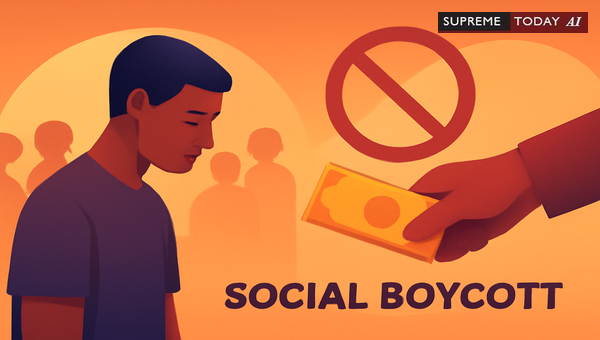
In today's interconnected society, disputes often escalate into social pressures like boycotts or . But does a without demanding money amount to under Indian law? This question arises frequently in community conflicts, caste-based issues, or business rivalries. Understanding the legal boundaries is crucial to avoid misuse of criminal laws.
This article breaks down the legal position based on the , key judicial interpretations, and related case laws. Note: This is general information and not specific legal advice. Consult a qualified lawyer for your situation.
is defined in , which states:
Whoever intentionally puts any person in fear of any injury to that person or to any other and thereby dishonestly induces the person so put in fear to deliver to any person any property, or or anything signed or sealed which may be converted into a commits ''. 2013 0 Supreme(SC) 1205
The essential elements include:- Intentional inducement of fear of injury (physical, reputational, or otherwise).- Dishonest compulsion to deliver property or .- A clear link between the fear and the delivery of property. 2013 0 Supreme(SC) 1205
Without these, particularly the demand or inducement for property delivery, no occurs. Courts have emphasized: unless property is delivered to accused person pursuant to threat no offence of is made out. 2013 0 Supreme(SC) 1205
A demand for money, property, or is the cornerstone. Mere threats or pressures without this element fall short. For instance:
Mere acceptance of money without there being any other evidence that it was demanded would not be sufficient for convicting the accused. 2013 0 Supreme(SC) 1205
This principle extends to various scenarios. In one case involving alleged honey-trapping and blackmail, the court noted demands for ransom but scrutinized if payment occurred or if accusations were motivated otherwise. 2023 0 Supreme(Guj) 833
Similarly, in linked to business pressures like forcing sales above MRP, process was issued under only where for money was evident.
typically means exclusion, non-cooperation, or —often in village panchayats, caste disputes, or economic rivalries. By itself, it causes harm but lacks the demand for property.
Key judicial finding: A without a demand for money does not, by itself, constitute under Indian law. 2013 0 Supreme(SC) 1205
The court's rationale:- Social pressure alone induces moral or reputational fear, not tied to property delivery.- Threats must directly aim at extracting valuables: The threat or inducement must be linked to a demand for property or . 2013 0 Supreme(SC) 1205
Some rulings highlight that fear creation alone can suffice without actual delivery:
The creation of fear itself constitutes an offence of under , even without actual delivery of property. 2023 0 Supreme(UK) 389
Here, applicants argued no sans delivery, but the court held fear inducement completes the offense, distinguishing it from . However, this still requires for property—not mere . 2023 0 Supreme(UK) 389
In contrast, economic or social boycotts under other laws (e.g., or ) are treated differently:- Denying fellowships or employment was alleged as 'economic boycott' under , but quashed as misuse when not genuine atrocity. 2019 0 Supreme(Mad) 1549- includes threat of social or economic boycott as compulsion, but only for untouchability offenses against protected groups. 2006 0 Supreme(Bom) 10
Thus, may invoke civil rights laws if linked to untouchability, but not IPC without a property demand.
| Scenario | ? | Key Reason ||----------|------------|------------|| Pure social | No | No property demand 2013 0 Supreme(SC) 1205 || Boycott + money demand | Yes | Meets Section 383 elements 2023 0 Supreme(Guj) 833 || Fear without delivery | Possible | If inducement for property exists 2023 0 Supreme(UK) 389 || Civil rights boycott | Separate offense | Under specific Acts 2006 0 Supreme(Bom) 10 |
Social boycotts often trigger FIRs under or , but courts caution against abuse:
Act cannot be converted into a Charter for exploitation... Such false complaints... will only promote caste hatred. 2019 0 Supreme(Mad) 1549
In NGO-related bail pleas, no motive led to bail grant. 2023 0 Supreme(Guj) 833
U.S. analogies (e.g., §875 ransom demands) reinforce demand necessity, though not binding. 2024 Supreme(US)(ca9) 380
In conclusion, while social boycotts inflict real harm, they generally do not amount to under IPC without a demand for valuables. This protects against frivolous cases while upholding Section 383's intent. Stay informed, but seek professional advice for disputes. 2013 0 Supreme(SC) 1205
References:1. 2013 0 Supreme(SC) 1205: Core definition and demand requirement.2. 2007 1 Supreme 21: Ingredients emphasizing demand connection.3. Additional insights from 2023 0 Supreme(Guj) 833, 2023 0 Supreme(UK) 389, 2019 0 Supreme(Mad) 1549, 2006 0 Supreme(Bom) 10.
#ExtortionLaw #SocialBoycott #IndianPenalCode



But Plaintiffs claim that, once the Boycott Defendants learned of this arrangement, they threatened to boycott BrokerTec as a “group,” without specifying which Boycott Defendants learned of the arrangement or were part of this “group.” Id. (Am. Compl. ¶ 445). ... Thus, when the Auction Defendants knew demand at an auction was low, they could coordinate to avoid bidding low yields/high prices; and when they knew demand was high, they could coordinate to bid the low yields/high prices re....

Therefore, the allegations of social boycott are not supported by credible material or continuing cause. ... under Article 14 17 and 21 of the Constitution of India and to lift the social boycott of the petitioner and his family and to pass….” ... Coming to the second contention, the allegation pertains to social boycott or ostracism of the petitioner and his family members by the unofficial respondents. ... State of Maharashtra, 2015 SCC OnLine Bom 6397, while examining the validity o....

Therefore, the allegations of social boycott are not supported by credible material or continuing cause. ... under Article 14 17 and 21 of the Constitution of India and to lift the social boycott of the petitioner and his family and to pass….” ... Coming to the second contention, the allegation pertains to social boycott or ostracism of the petitioner and his family members by the unofficial respondents. ... State of Maharashtra , 2015 SCC OnLine Bom 6397, while examining the validity ....

Here, in this case, at the best, it can be said that it's an attempt to commit an offence of extortion without rebutting or assessing the allegation of the victim. ... Illustrations (a) A threatens to publish a defamatory libel concerning Z unless Z gives him money. He thus induces Z to give him money. A has committed extortion. (b). ... In the present case, no offence of extortion is made out, as the allegations pertain only to a threat, with no delivery of money or....

upon the demand of extortion, the petitioners have received Rs.4,88,500/-. ... Further, there is allegation against the petitioners of putting the complainant in fear of injury in order to commit extortion also through the drivers of the said four trailers from whom forcibly the trailers were taken away; which amounts to constitute the offence punishable under Section 385 of the ... In our opinion the point is so wholly without substance that it has been stated merely to be rejected. ... Money....

Thereafter, she had demanded more money. ... Meanwhile, the informant realized that he was trapped by accused nos.1 to 3 in the said honey trap and it is a case of extortion and blackmailing. ... It needs to be noted that till date, it has not come on record that despite demand of ransom amount, nothing being paid to the accused by the complainant. The issue cropped up when accused no.6 published an article in a daily newspaper, for proper inquiry by Kutch police, in the matter. ... This is, however, without prejudice to....

Thus, they are induced to pay uncalculated money by way of donation to these balance sheet and if the retailer is not selling the drugs as directed by the associations and their office bearers have induced the traders and retailers these three associations, who are the original accused, have forced the retailers/chemists to sell the products above MRP and the amounts ... The process is issued under sections 403, 406 and 384, i.e., misappropriation of the property, criminal breach of trust and extortion.
Defendants argue that § 880 requires that they knew the money at issue was obtained from the demand for ransom— not just that the money was “unlawfully obtained.” ... This case involves extortion under 18 U.S.C. § 875(a), which criminalizes transmitting “any communication containing any demand or request for a ransom or reward for the release of any kidnapped person.” ... To convict Defendants of violating § 880, the jury instruction here required the jury to find three elements: that (1) “the defendant....
This evidence does not, “without requiring any inferences,” establish that Rehab and Honey Punch joined the boycott only after agreeing with each other to do so. Instead, it simply shows employee movement from one vendor to another. ... A purchase order, without more, is not a contract. 20 HONEY BUM, LLC V. FASHION NOVA, INC. ... Honey Bum asserted a Klor’s-style per se group boycott, or “naked” group boycott, under which competitors enter into a horizontal agreement to boycott#HL_END....

Exclusively delivery of the money may not be an isolated ground to be argued, that until and unless the money is delivered, it is not an extortion, the extortion in its literal sense means to create a pressure or psychological pressure on an individual, to do an act under a threat of fear to deliver ... What he intends to argue is that if the definition of extortion, which is extracted above, is taken into consideration, the basic element to constitute an offence of extortion is that t....

This according to the 2nd respondent amounts to economic boycott. This according to the 2nd respondent amounts to an offence under Section 3(1) (r) of the Act. By denying the fellowship, the 2nd respondent alleges that she has been deprived of the monthly fellowship amount. This allegation is also sought to be made as an offence on the ground that the 2nd respondent was not permitted to enquire about the same in the concerned office and the staffs were directed not to respond to the queries of the 2nd respondent and the petitioner when questioned had insulted the 2nd respon....

The case attributed to him amounts to extortion and since while extorting money from the complainant he was put in fear, such extortion amounts to the offence of robbery as defined in Section 390 IPC and punishable under Section 392 IPC. There is nothing on record to show that he had used any such fabricated document at the time of commission of the alleged offence.
He has admitted that he had not lodged any case with respect to demand of extortion money by the appellant neither does he have any knowledge of demand of extortion by appellants. He has admitted that earlier a case was lodged against him and some articles were seized from his shop for which he could not show the papers. D.W.-3 has stated that the appellant had helped in recovery of illegal articles from the shop of the victim. P.W.-3 has stated that 1-2 months prior o the occurrence, a bomb was thrown on his shop and there used to be telephone calls by persons who said the....

At paragraph 7, he has deposed that deceased persons used to supply labourers to the brick-kiln. Dharamjay Mukhiya used to demand Rs. 10/- per labourer as extortion money. At paragraph 15 he has deposed that he had gone to inform Baleshwar Chowkidar and he came to know that Baleshwar Paswan had gone to Police Station to inform the police about the occurrence. At paragraph 18, he has deposed that he had gone to Barh Police Station with the dead body.
- For the purposes of this section "compulsion" includes a threat of social or economic boycott.


An indispensable Tool for Legal Professionals, Endorsed by Various High Court and Judicial Officers
Please visit our Training & Support
Center or Contact Us for assistance

Scan Me!
India’s Legal research and Law Firm App, Download now!


For Daily Legal Updates, Join us on :



 Back to top


