


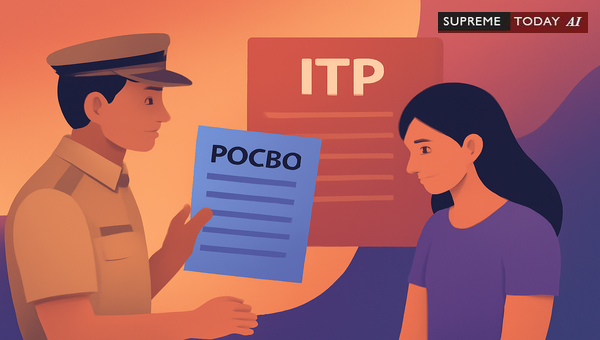
Can a Sub-Inspector Investigate and File in POCSO Act and Immoral Traffic Prevention Act Offences?
In the realm of serious crimes involving child sexual offences and human trafficking, is paramount. A common question arises: can a sub inspector investigate and file in offence under Pocso Act and Immoral traffic prevention act? This issue strikes at the heart of legal validity, as improper investigations can lead to entire proceedings being quashed. Understanding the statutory mandates and judicial interpretations is crucial for victims, accused persons, law enforcement, and legal practitioners alike.
This article delves into the legal framework, key judgments, and practical implications, drawing from authoritative sources to provide clarity. Note that while this offers general insights, it is not a substitute for professional legal advice.
Main Legal Finding
A Sub-Inspector (SI) of Police generally does not have the authority to investigate offences under the , and the (ITP Act), nor to file a , unless specifically empowered by law or rules2022 0 Supreme(Megh) 244. Investigations under these Acts are typically reserved for officers of a certain rank—often not below Inspector—or designated (SPOs). Violations render proceedings illegal and vulnerable to quashing
2017 0 Supreme(Kar) 1356.
Courts have consistently emphasized that these are provisions, not mere formalities, to ensure sensitive cases are handled by trained, authorized personnel.
Investigation Authority under the POCSO Act
The POCSO Act prioritizes child protection, mandating investigations by empowered officers. and related rules require prompt action by designated authorities, often or officers above a certain rank.
In a pivotal judgment, the court held that the investigation must be conducted by a Special Police Officer appointed under the relevant provisions. It quashed proceedings where a local police officer, not empowered, conducted the probe 2022 0 Supreme(Megh) 244. This underscores that a Sub-Inspector without such designation cannot validly investigate or file a in POCSO cases.
Judicial scrutiny extends to compliance: non-authorized probes lead to , protecting vulnerable victims while upholding .
Investigation Authority under the Immoral Traffic Prevention Act, 1956
The ITP Act explicitly addresses trafficking for prostitution, with outlining investigation protocols. Only a Special Police Officer (SPO), appointed by the State Government and typically not below Inspector rank, holds investigation powers
2017 0 Supreme(Kar) 1356.
Key rulings affirm this:- Power of investigation conferred on a Special officer was one, and proceedings initiated by a Sub-Inspector were erroneous and liable to be quashed
.- In another case, investigation by a Sub-Inspector of Police... is not in accordance with law, and proceedings based on such investigation are invalid 2017 0 Supreme(Kar) 1356.
Additional precedents reinforce this. For instance, under , a Special Officer appointed... has the power to investigate, making it clear that unauthorized officers vitiate proceedings 2014 0 Supreme(Ker) 197. Courts have quashed charge sheets, directing re-investigation by proper authorities
. Similarly, He not being a Special Officer as defined under 2(1) of the , the entire proceedings initiated by him is 2023 0 Supreme(Mad) 2827.
Even where an Assistant Sub-Inspector registered a case involving immoral traffic, procedural lapses highlighted the need for SPO compliance
H N RAVIRAJ Vs THE STATE OF KARNATAKA BY
.Statutory Provisions and Court Interpretations
Both Acts form a overriding general provisions like . While empowers police broadly, specific statutes prevail:- POCSO Act: Empowers designated officers; local SIs lack jurisdiction without notification 2022 0 Supreme(Megh) 244.- ITP Act: define SPOs; searches/investigations require them
2014 0 Supreme(Ker) 197.
Courts distinguish vs. , deeming SPO requirements to prevent abuse 2023 0 Supreme(Mad) 2827. Non-compliance invites intervention under or , often resulting in quashing
.
Implications of Non-Compliance
Unauthorized investigations by Sub-Inspectors lead to:- Quashing of FIRs, charge sheets, and 2017 0 Supreme(Kar) 1356.- Re-investigation orders by competent officers 2014 0 Supreme(Ker) 197.- Potential abuse of process, as seen in habitual offender cases under both Acts 2016 0 Supreme(Ker) 133.
This protects public order while ensuring trafficking and child abuse cases aren't derailed by technicalities—but only if followed diligently.
Exceptions and Limitations
Rare exceptions exist:- Explicit empowerment: If rules designate an SI as SPO, validity holds (though not indicated for these Acts).- General : Subordinate to special laws; SIs may assist but not lead 2022 0 Supreme(Kar) 320 (context: abetment, not these Acts).- Overlaps with (e.g., 370) still defer to special provisions 2023 0 Supreme(Mad) 2827.
In maintenance or child protection contexts, ITP/POCSO references underscore victim safeguards but don't expand SI powers 2022 0 Supreme(All) 516 2017 4 Supreme 494.
Recommendations for Compliance
To avoid pitfalls:- Appoint SPOs per statutes for POCSO/ITP cases.- Train and notify officers in advance.- Courts: Scrutinize investigator authority pre-.- Stakeholders: Challenge invalid probes early.
Authorities must implement child protection schemes, including POCSO monitoring, recognizing victims as children in need of care 2017 4 Supreme 494.
Conclusion and Key Takeaways
In conclusion, a Sub-Inspector cannot generally investigate or file a in offences under the POCSO Act and ITP Act unless specifically empowered or designated as an SPO. Adherence to these rules ensures justice in grave matters. Key takeaways:- SPO involvement; SIs typically barred.- Judicial trend: Quash unauthorized proceedings
2022 0 Supreme(Megh) 244 2017 0 Supreme(Kar) 1356.- Prioritize compliance to safeguard victims and accused.
This analysis draws from established precedents; consult a legal expert for case-specific guidance. Stay informed on evolving laws to navigate these complexities effectively.
#POCSOAct, #PoliceInvestigation, #LegalAuthority












