


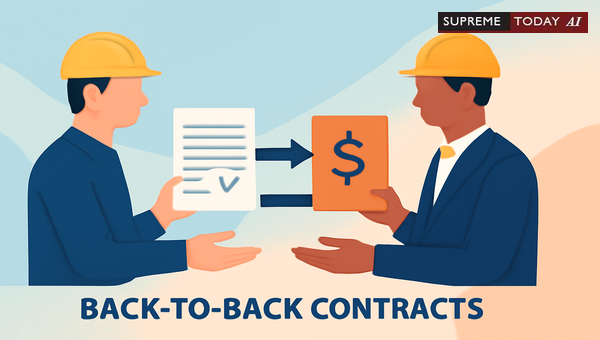
: Navigating Subcontract Payments
In the complex world of construction and large-scale projects, are a common arrangement. They allow main contractors to mirror the terms of their primary agreement with the principal employer when subcontracting work. But what happens when it comes to subcontract payments? Can a main contractor withhold payment from a subcontractor simply because they haven't been paid by the principal? This is the crux of the legal question: Back to Back Contract Sub Contract Payments.
This blog post breaks down the key legal principles, drawing from landmark cases and contractual insights. We'll explore liabilities, payment structures, disputes, and practical recommendations. Note that this is general information based on precedents and should not be taken as specific legal advice—consult a qualified attorney for your situation.
Overview of
create a chain of responsibilities where the subcontract essentially backs the main contract. Payments to subcontractors are often linked to the main contractor's receipts from the principal. However, courts have clarified that these arrangements do not automatically transfer all liabilities or create direct between the principal and subcontractor.
Typically, the of the main contractor toward the subcontractor stems from the subcontract itself, independent of the main contract—unless explicitly stated otherwise. This distinction is critical to understanding payment obligations and avoiding disputes.
in Subcontracts
A cornerstone principle is that the main contractor's duty to pay the subcontractor arises from the subcontract terms, not the main contract. In , the court held that the contractor cannot refuse payment to the subcontractor based on non-receipt of payment from the main contractor. Unless the subcontract explicitly ties payments to upstream receipts, obligations remain separate.
This was echoed in other precedents emphasizing distinct contracts: The back-to-back principle does not serve to transfer or the main contract's liabilities onto the subcontractor unless explicitly stated. 2022 0 Supreme(Del) 1827
Back-to-Back Payment Clauses
When contracts include explicit back-to-back clauses, payments become . For instance, in Larsen & Toubro Ltd. v. SCOPE, the agreement stated that payments to the subcontractor would only be made upon receipt of corresponding payments from the main contractor. This creates a clear dependency, but only if worded precisely. 2014 0 Supreme(SC) 134
From additional sources, such clauses are common: precedent of back-to-back payment as a condition to make the payments of amount due only after the receipt of amount from M/s... 2024 Supreme(Online)(NCLAT) 1146 However, absence of such a clause means no automatic linkage: As per contract, there is no base to BACK-TO-BACK payment Clause. 2024 Supreme(Online)(NCLAT) 1146
In another case, This contract is back to back as Clauses 1.2 and 9 thereof clearly show that terms of main contract to the extent they were 'sensible' stood explicitly incorporated. 2017 2 Supreme 306
Liability and Distinct Contracts
Courts consistently rule that back-to-back setups do not liabilities. The principle of does not automatically transfer or liabilities from the main contract to the sub-contractor. The remains with the party (typically the main contractor) under the specific terms of the sub-contract. 2022 0 Supreme(Del) 1827
Subcontracts are : liabilities are governed independently. For example, in expansion projects, The PPPL had a sub-contract from EPIL on back to back basis however, that was not m... indicating that even mirrored terms don't always bind parties equally. 2013 0 Supreme(Megh) 55
Payment terms often specify: In terms of the sub-contract agreement, the sub-contract work... was required to be executed on a ‘back-to-back’. 2008 0 Supreme(Del) 56
Arbitration and of Contract
Disputes highlight issues. Without a specific in the subcontract, the main contract's clause doesn't apply. The absence of a specific in the subcontract means that disputes cannot be referred to arbitration based on the main contract’s . The court ruled that there is no of contract between the subcontractor and the principal contractor. 1993 0 Supreme(Del) 194
This protects subcontractors from being dragged into upstream arbitrations but limits their access to certain remedies.
Payment Terms, Claims, and Disputes
is permissible under certain conditions, such as for damages or non-performance. The law permits withholding or over payments due to contractors or sub-contractors, often as security for claims or damages. 2024 0 Supreme(Mad) 431
Claims for delays or extras are often rejected in back-to-back setups: Claims for damages or delays are often rejected when the underlying contractual relationship is on a back-to-back basis, especially if the sub-contract's terms mirror the main contract. 2023 0 Supreme(Mad) 3414 2023 0 Supreme(Gau) 570
Subcontractors' rights depend on explicit provisions: Contracts specify procedures for payments, including joint submission requests and compliance with schedule terms. Sub-contracts often include clauses that restrict direct payments unless certain conditions are met. 2023 0 Supreme(Gau) 570
CHEN YI JIN & ORS vs NEO SIN SING & ANOR - High Court Malaya Johor Bahru
In one instance, Back to back to contract with some terms and conditions. Q9: As per clause-3... is it correct to state that the payment shall be made for the actual quantity... 2020 0 Supreme(Mad) 1594
Practical Implications and Recommendations
Back-to-back arrangements streamline projects but breed disputes over timing and certainty. Payments in sub-contracts often depend on the receipt of payments from the main contractor or principal employer. The back-to-back payment arrangement means that the sub-contractor's payments are upon the main contractor receiving corresponding funds.
(ENCLS 240 241 242 243 244 258 261 296 3.... - High Court Malaya Johor Bahru
2023 0 Supreme(Gau) 570 2023 0 Supreme(Mad) 3414To mitigate risks:- Review payment terms: Ensure explicit back-to-back clauses if dependency is intended.- Clarify liabilities: Include provisions on independent obligations to prevent '' ambiguities.- Address arbitration: Draft subcontractor-specific dispute resolution mechanisms.- Document everything: Use joint certifications and adhere to billing procedures.
Key Takeaways
- Main contractors are generally primarily liable to subcontractors under subcontract terms, regardless of principal payments—absent explicit clauses.
- Back-to-back structures align but don't merge contracts; remains key. 1993 0 Supreme(Del) 194
- Disputes over claims and withholdings hinge on specific wording and proof. 2023 0 Supreme(Mad) 3414
Understanding these nuances helps parties draft enforceable agreements and manage cash flow. For tailored advice, engage legal experts familiar with construction law.
References:-
2014 0 Supreme(SC) 134 2022 0 Supreme(Del) 1827 1993 0 Supreme(Del) 194 2024 Supreme(Online)(NCLAT) 1146 2020 0 Supreme(Mad) 1594 2017 2 Supreme 306 2013 0 Supreme(Megh) 55 2008 0 Supreme(Del) 56 2023 0 Supreme(Mad) 3414 2023 0 Supreme(Gau) 570 2024 0 Supreme(Mad) 431
CHEN YI JIN & ORS vs NEO SIN SING & ANOR - High Court Malaya Johor Bahru
#BackToBackContracts, #SubcontractPayments, #ConstructionLaw















