


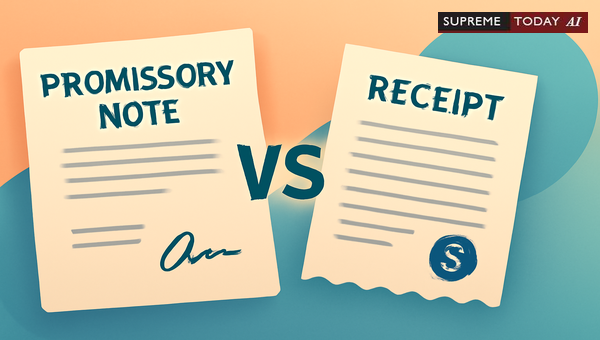
Akbar Khan vs. Attar Singh: Decoding the Judgment on Promissory Notes vs. Receipts
In the realm of financial documents and negotiable instruments, a pivotal question often arises: Is a document a mere or a legally binding ? This distinction can profoundly impact enforceability, rights of parties, and commercial transactions. A common query from legal enthusiasts and practitioners is, Akbar Khan Alam Khan V Scr 1 779 Explain the Judgement of the Case Law. While the citation may point to varied interpretations, the core precedent stems from the landmark case of Nawab Major Sir Mohammad Akbar Khan vs. Attar Singh, reported as AIR PC 171. This ruling provides enduring clarity on classifying documents under the (NI Act). Let's delve into the judgment, its implications, and how it echoes in subsequent cases.
Case Overview
The dispute in Nawab Major Sir Mohammad Akbar Khan vs. Attar Singh centered on a document executed by two individuals on behalf of another, acknowledging of a specific sum with repayment terms including interest. The plaintiff argued it was a , while the defendants contended it was merely a . The , as the apex appellate body then, meticulously analyzed the document's substance over its form. Their Lordships held that it was primarily a , acknowledging the of a specific amount of money, rather than a 1971 0 Supreme(SC) 72
.
This decision underscores a fundamental principle: Documents must be interpreted based on intent and essence, not nomenclature. Labeling something a doesn't preclude it from being a if it embodies an . Conversely, a with repayment stipulations doesn't automatically become negotiable unless it meets statutory criteria 2006 0 Supreme(Del) 1381.
Key Legal Findings:
1. Nature of the Document
The emphasized evaluating the document holistically. Key factors included:- Acknowledgment of money received.- Terms of repayment with interest.- Execution by agents on behalf of a principal.
Despite these, it was deemed a because it lacked hallmarks of a , such as an unconditional undertaking by the maker to pay
. The court clarified, the mere designation of a document as a does not negate its real nature if it serves as a 2006 0 Supreme(Del) 1381. This approach prevents parties from evading liabilities through clever labeling.
2. Negotiability Under the NI Act
For a document to be a like a (), it must:- Contain an a certain sum.- Be payable to order or bearer.- Facilitate transfer by delivery or endorsement.
The document failed here due to no negotiability clauses, leading to commercial confusion if broadly interpreted. As noted, receipts and agreements are generally not intended to be negotiable, and expanding the definition of negotiable instruments could lead to significant commercial confusion 2007 0 Supreme(Del) 591 1961 0 Supreme(Raj) 182.
3. Legal Implications and Precedent Value
The ruling reinforces that a promise to pay within a doesn't elevate it to status. This affects , , and . Parties' intent governs, impacting future adjudications 2007 0 Supreme(Del) 591.
Insights from Related Cases and Sources
This precedent has been invoked across diverse contexts, illustrating its versatility.
In a matter involving property sale agreements, the court cited Akbar Khan alongside others like , to interpret documents under . It held that inferior evidence can't contradict registered deeds, echoing the substance-over-form doctrine: Nawab Major Sir Mohammed Akbar Khan Vs. Attar Singh and Ors., AIR PC 171 (pp 174-175) 2017 0 Supreme(Gau) 1032.
Similarly, in adoption disputes, oral evidence admissibility was discussed, referencing Mohammad Akbar Khan v. Attar Singh where the question was of interpretation of a document as to whether it is a and not a . The held that oral evidence to show that amount was paid by way of loan or debt... 1999 0 Supreme(Bom) 717. This highlights limits.
Distinctions between deposits and loans also draw from this case. In Haji Abdulla Haji Rahimultulla and Nawab Major Sir Mohammad Akbar Khan vs. Attar Singh, courts delineated: the distinction between the terms deposit and loan was clearly brought out 1992 0 Supreme(Del) 344. The noted, a is not confined to a of specific currency... it may involve only the creation of the relation of , a loan under conditions 1986 0 Supreme(Cal) 359.
In tax matters, like losses on deposits under leave-license agreements, tribunals referenced it to classify payments: The deposit of Rs.20 lakhs was not in the nature of a loan or a salami. It was a deposit made by the assessee as security... drawing parallels to Akbar Khan's debtor-creditor analysis 1986 0 Supreme(Cal) 359.
Recent orders, such as in criminal misc. applications, indirectly align by stressing document scrutiny 2023 Supreme(Online)(All) 24231 2023 Supreme(Online)(ALL) 11101.
Practical Recommendations for Legal Practitioners and Businesses
- Drafting Tip: Explicitly state negotiability intent and use standard NI Act formats to avoid ambiguity.
- Review Process: Analyze substance—promise nature, transferability, and context—before litigation.
- Compliance: Ensure proper stamping; misclassification invites penalties under .
- Client Advice: In loans/deposits, clarify via agreements to sidestep Akbar Khan-like disputes.
When handling financial instruments, consult precedents like this to gauge enforceability under NI Act.
Conclusion and Key Takeaways
The in Nawab Major Sir Mohammad Akbar Khan vs. Attar Singh established a timeless benchmark: Classify documents by intent and substance, safeguarding commercial certainty 1961 0 Supreme(Raj) 182. This ruling remains relevant, influencing evidence interpretation, deposit-loan distinctions, and NI Act applications.
Key Takeaways:- Receipts with repayment terms aren't automatically promissory notes.- Negotiability requires specific intent and form.- Oral evidence is limited; prioritize document essence 1999 0 Supreme(Bom) 717.- Applies to modern scenarios like security deposits and agreements 2017 0 Supreme(Gau) 1032.
Disclaimer: This article provides general information based on precedents and is not legal advice. Consult a qualified lawyer for case-specific guidance.
References:- 1971 0 Supreme(SC) 72
2006 0 Supreme(Del) 1381 2007 0 Supreme(Del) 591 1961 0 Supreme(Raj) 182 2017 0 Supreme(Gau) 1032 1999 0 Supreme(Bom) 717 1992 0 Supreme(Del) 344 1986 0 Supreme(Cal) 359 2023 Supreme(Online)(All) 24231 #AkbarKhanCase #PromissoryNote #LegalPrecedent















