



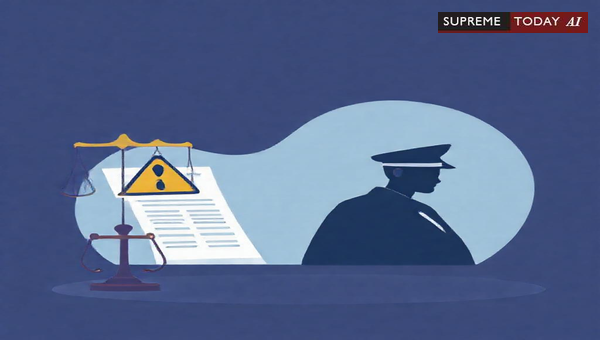
Understanding the Legal Consequences When Investigating Officers Suppress a Written Complaint or Evidence
When a criminal case heads to trial, the integrity of the investigation is the bedrock upon which the prosecution’s argument rests. A common, yet highly stressful, situation arises when a de facto complainant—the person who initiated the criminal proceedings—discovers that their original written complaint was suppressed, altered, or ignored by the investigating officer (IO) when filing the First Information Report (FIR) or the . This raises an immediate and critical question: does this procedural failure automatically grant the accused the and lead to an acquittal?
While the instinct might be to assume that such a significant procedural flaw invalidates the entire prosecution case, the reality under the law is more nuanced. The court’s role is to ensure justice, and it evaluates the impact of such suppression based on whether it prejudiced the defense or resulted in a failure of justice, rather than relying on a hard-and-fast rule of automatic acquittal.
The Standard of Fairness in Criminal Investigations
The Indian legal system places a high value on the fairness of investigations, viewing it as a fundamental component of a guaranteed under . If an investigation is perceived as myopic, defective, one-sided, perfunctory, or tainted, it can indeed undermine the credibility of the prosecution's entire narrative.
Legal precedent clarifies that a criminal trial resting on such a flawed investigation would itself stand , even if procedurally it may be regular 2026 0 Supreme(Pat) 269. However, does not automatically translate to a walk-free order for the accused. Instead, it invites the court to scrutinize the evidence more rigorously to see if the prosecution's core claims still hold water.
Why Suppression Does Not Guarantee Acquittal
It is a common misconception that any irregularity in police procedure serves as a get out of jail free card. The principle of is applied by the court only after a thorough appreciation of all evidence. If the suppression of the original complaint is the only flaw in an otherwise overwhelming sea of incriminating evidence, the court might still convict.
Conversely, in many instances, the suppression of the earliest version of an event—whether in the form of a written complaint or medical records—can cause the entire fabric of the prosecution case to collapse 2024 0 Supreme(Mad) 689. If the defense can successfully prove that the prosecution suppressed the genesis or true origin of the occurrence, the court may indeed find the prosecution's case unreliable, leading to an acquittal. As one court noted, where the prosecution fails to present the true version, the conviction becomes infirm and unsustainable under law 2018 0 Supreme(Mad) 2843.
The Role of the Magistrate Upon Receiving a
When an investigation officer submits a —particularly one that seeks to close the case—the Magistrate is not a mere rubber stamp. They are obligated to apply to the police's findings. If a written complaint was suppressed to justify a closure report, the Magistrate has the power to:
- Disagree with the report: The court is not bound to accept the submitted by the police 2014 0 Supreme(AP) 1527.
- Direct Further Investigation: Under , the court can order the police to conduct further investigation if the initial one appears biased, incomplete, or if vital evidence was intentionally omitted.
- : The Magistrate may decide to of the offence despite the police’s recommendation to drop proceedings 2014 0 Supreme(AP) 1527.
The duty of the Court is to ensure that both the victim and the accused receive justice 2014 0 Supreme(AP) 1527. If the police have selectively examined witnesses or ignored , this duty requires the Magistrate to step in.
Rights of the Informant: The
If you are the informant and you discover that your allegations have been buried or the police have filed a closure report based on a tainted investigation, you are not powerless. The law grants the informant the right to be heard when a Magistrate considers a that recommends closing the case.
The informant can file a to challenge the findings of the police. As established in legal rulings, the informant must be given an opportunity of being heard so that he can make his submissions to persuade the Magistrate to of the offence and issue process 2015 0 Supreme(SC) 541. This petition allows the court to re-examine the facts rather than blindly accepting the police report.
Strategic Considerations for the Accused
If you are the accused and you believe the prosecution has suppressed the original complaint to frame a false narrative, your defense strategy should focus on exposing this suppression. Highlighting the absence of the earliest version of the complaint can be used to impeach the credibility of the investigating officer.
However, be aware that courts perform a balancing act. If the accused alleges suppression, they must demonstrate that this actually caused prejudice to their case. Simply pointing out a minor is rarely enough to secure an acquittal; you must show that the irregularity obscures the truth or prevents a fair assessment of the facts. In situations involving rival versions of an incident, the failure of the police to provide a definitive, reasoned report can lead the court to set aside the charges entirely, as the proceedings become legally unsustainable 2026 Supreme(Online)(Mad) 66233.
Conclusion
The suppression of a written complaint is a serious issue that casts a shadow over the legitimacy of a criminal investigation. While it does not trigger an automatic acquittal, it provides strong grounds for the court to view the prosecution's case with skepticism.
Whether the result is an acquittal or an order for further investigation depends on how effectively the parties present the impact of this suppression to the court. As in all legal matters, these outcomes are highly fact-dependent; parties should consult with experienced legal counsel to determine the best path forward—whether through a for the complainant or a robust challenge to the evidence for the accused. The judiciary remains the final arbiter, tasked with ensuring that procedural errors by investigative agencies do not result in a .
#CriminalLaw #LegalRights #CriminalJustice #FairTrial







