Searching Case Laws & Precedent on Legal Query.....!
Analysing the retrieved Case Laws
Scanned Judgements…!



Searching Case Laws & Precedent on Legal Query.....!
Analysing the retrieved Case Laws
Scanned Judgements…!
Substantial Question of Law & Public Interest - The Supreme Court (SC) considers whether a case involves a substantial question of law related to the interpretation of the Constitution or any order made thereunder, especially when such questions impact public interest. ["2023 Supreme(Online)(Guj) 1191"], ["
DEEPSINGH @ DEEPU S/O GUJARATSINGH KALANI (CHIKILIGAR) V/s STATE OF GUJARAT - Gujarat
"], ["2023 Supreme(Online)(Guj) 1028"], ["2023 Supreme(Online)(Guj) 1033"], ["2023 Supreme(Online)(Guj) 1026"], ["2023 Supreme(Online)(Guj) 1109"], ["2023 Supreme(Online)(Guj) 700"], ["2023 Supreme(Online)(Guj) 706"]Hierarchy of Disorders & Legal Interpretation - The Court distinguishes between types of disorder: public order (more serious), law and order (less serious), and public interest. It states that public order involves disorders of greater gravity than those affecting law and order, which in turn are less severe than those impacting public order or security of the State. This hierarchy influences judicial assessments of cases involving public interest and substantial legal questions. Various sources
Recent SC Decisions & Observations - In the case of Shaik Nazeen v. State of Telangana and related appeals (Criminal Appeal Nos. 908, 4260, 909, 4283 of 2022, dated 22.06.2022), the SC emphasized that questions involving constitutional interpretation and public interest are substantial when they concern disorders of less gravity than those affecting public order or security of the State. The Court's observations highlight its role in balancing public interest with legal and constitutional questions, especially in cases involving civil liberties, law enforcement, and public safety.
Implication for Special Leave Petitions (SLP) - When an SLP raises a substantial question of law affecting public interest, especially in contexts involving disorder, constitutional interpretation, or civil liberties, the Supreme Court is more likely to consider the case of significant constitutional and public importance.
Analysis & Conclusion:The SC's jurisprudence underscores that cases involving substantial questions of law impacting public interest are of high constitutional importance. The Court's hierarchy of disorders clarifies that less severe disturbances can still raise significant legal issues, particularly when constitutional rights or public welfare are involved. Recent rulings reaffirm that the Court actively examines whether legal questions are substantial and whether they affect broader public interests, guiding the admission or dismissal of SLPs based on these criteria.
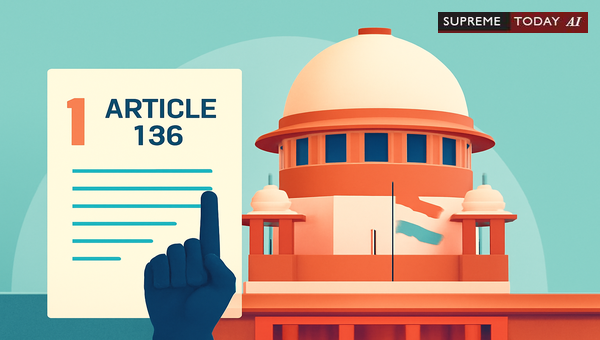
In the realm of Indian jurisprudence, the Supreme Court's discretion under plays a pivotal role in upholding justice, particularly when substantial questions of law intersect with . But what exactly constitutes a affecting in ? This query often arises for litigants, lawyers, and citizens seeking clarity on when the apex court will entertain a (). This blog post delves into the Supreme Court's established principles, drawing from landmark rulings and criteria to provide a comprehensive overview. Note that this is general information based on judicial precedents and should not be construed as specific legal advice—consult a qualified lawyer for your case.
The recognizes that a involves issues of significant importance, especially when they affect . Typically, such a question is deemed substantial if it is of , directly and substantially affects the rights of the parties, and remains open or unsettled by the highest courts. When is at stake—such as in environmental protection, social justice, or constitutional rights—the Court shows greater inclination to entertain SLPs 1962 0 Supreme(SC) 90 2023 8 Supreme 180.
Key criteria include:- Public or general importance: Affecting society at large 2022 0 Supreme(SC) 1069.- Direct impact on rights: Goes beyond mere technicalities 1962 0 Supreme(SC) 90.- Unsettled by precedent: Not finally decided by the Supreme Court 2023 8 Supreme 180.- Alternative views or difficulty: Calls for discussion of differing interpretations 2023 8 Supreme 379.
The Court has clarified that mere errors of law or factual disputes do not qualify unless they raise broader principles or public concerns 1962 0 Supreme(SC) 90 2023 8 Supreme 180.
In Sir Chunilal V. Mehta & Sons Ltd. v. Century Spg. & Mfg. Co. Ltd. ( SCR 549), the Court articulated that a substantial question involves substance, importance, or difficulty, particularly if not finally settled or tied to 2022 0 Supreme(SC) 1069. This test remains foundational.
Under Article 136, the Court's jurisdiction is discretionary. It weighs whether the presents a substantial question of public importance 1962 0 Supreme(SC) 90 2023 8 Supreme 180. For instance, is a question, which is real and substantial or involving 2015 0 Supreme(Raj) 1028.
PILs frequently highlight , where even technical questions gain substance if linked to constitutional principles or societal welfare 2010 1 Supreme 227 2016 2 Supreme 469. In People's Union for Democratic Rights v. Union of India (), the Court emphasized PILs' role in promoting and vindicating , especially for marginalized groups 2017 1 Supreme 11.
Similarly, S.P. Gupta v. Union of India () allowed any member of the public with sufficient interest to address public injury, underscoring 's public dimension 2017 1 Supreme 11.
Recent contexts reinforce this. In challenges to rules under the , the quashed arbitrary appointment rules as violative of , noting the need for uniformity and independence—issues of public importance potentially appealable via if unsettled 2021 0 Supreme(Bom) 1668. The court stressed, The ... includes a right to have the person’s rights, adjudicated by a forum which exercises judicial power in an impartial and independent manner.
The Court is more receptive to SLPs involving:- Constitutional interpretation: E.g., equality challenges, as in university seat reservations where institutional preferences were capped at 50% for fairness 2020 0 Supreme(Del) 749.- Environmental or national concerns: Matters of public trust or degradation 2016 2 Supreme 469.- Social justice: PILs on marginalized rights 2010 1 Supreme 227.
However, limitations apply. SLPs raising settled issues, pure facts, or lacking broader significance are typically refused 1962 0 Supreme(SC) 90 2022 0 Supreme(SC) 1069. A petitioner must approach with clean hands and a clean heart, avoiding abuse of process, as dismissed in a on society registration under 2008 0 Supreme(Mad) 2431. The court held, A petitioner in a litigation must come with clean hands and a clean heart, and not abuse the process of law.
In another instance, dismissal left questions open, signaling potential for future scrutiny 2020 0 Supreme(Del) 749. Sources like
BILKISHBEN W/O YAKUBBHAI MUSABHAI MOTANI V/s COMMISSIONER OF POLICE RAJKOT CITY - Supreme(Online)(Guj) 1232
link public order to broader , extending to constitutional interpretations.Despite openness to matters, the Court retains discretion:- No routine appeals: Only on substantial law, not facts or settled points 2021 0 Supreme(Bom) 1668.- Procedural issues insufficient: Must involve legal principles of public import 1962 0 Supreme(SC) 90.- Grave issues prioritized: Constitutional or environmental gravity merits intervention 2016 2 Supreme 469.
Exceptions include refusals for already settled law or non-public matters 1962 0 Supreme(SC) 90 2022 0 Supreme(SC) 1069. In second appeals under , categorical fact findings limit grounds to substantial law involving 2015 0 Supreme(Raj) 1028.
When drafting SLPs:- Clearly link the question to public importance or constitutional rights2017 1 Supreme 11.- Highlight unresolved issues impacting welfare 2022 0 Supreme(SC) 1069.- Avoid factual disputes or settled precedents.- Emphasize societal impact to bolster admissibility.
For example, in consumer tribunal appointments, highlighting violations and Supreme Court directions (e.g., ) strengthened claims 2021 0 Supreme(Bom) 1668.
In summary, the Supreme Court entertains SLPs on substantial questions of law affecting when they meet criteria of importance, unsettled status, rights impact, and societal relevance—especially in constitutional, environmental, or social spheres. While discretionary, this approach safeguards public welfare without opening floodgates to trivial matters 1962 0 Supreme(SC) 90 2023 8 Supreme 180.
Key Takeaways:- Prioritize unsettled questions of .- Leverage for broader issues, ensuring clean intent.- Court's discretion favors grave constitutional concerns.
This framework guides litigants toward meaningful access to justice. For tailored advice, engage legal experts familiar with Article 136 jurisprudence.
#SupremeCourtIndia, #PublicInterestLaw, #SLP


secondary sense public interest. ... NO 4 Whether this case involves a substantial question of law as to the interpretation of the Constitution of India or any order made thereunder ? ... It will thus appear that just as “public order” in the rulings of this Court (earlier cited) was said to comprehend disorders of less gravity than those affecting ....

secondary sense public interest. ... NO 4 Whether this case involves a substantial question of law as to the interpretation of the Constitution of India or any order made thereunder ? ... It will thus appear that just as “public order” in the rulings of this Court (earlier cited) was said to comprehend disorders of less gravity than those affecting ....
secondary sense public interest. ... NO 4 Whether this case involves a substantial question of law as to the interpretation of the Constitution of India or any order made thereunder ? ... It will thus appear that just as “public order” in the rulings of this Court (earlier cited) was said to comprehend disorders of less gravity than those affecting ....
NO 4 Whether this case involves a substantial question of law as to the interpretation of the Constitution of India or any order made thereunder ? ... secondary sense public interest. ... It will thus appear that just as “public order” in the rulings of this Court (earlier cited) was said to comprehend disorders of less gravity than those affecting ....

NO 4 Whether this case involves a substantial question of law as to the interpretation of the Constitution of India or any order made thereunder ? ... secondary sense public interest. ... It will thus appear that just as “public order” in the rulings of this Court (earlier cited) was said to comprehend disorders of less gravity than those affecting ....

NO 4 Whether this case involves a substantial question of law as to the interpretation of the Constitution of India or any order made thereunder ? ... secondary sense public interest. ... It will thus appear that just as “public order” in the rulings of this Court (earlier cited) was said to comprehend disorders of less gravity than those affecting ....
NO 4 Whether this case involves a substantial question of law as to the interpretation of the Constitution of India or any order made thereunder ? ... secondary sense public interest. ... It will thus appear that just as “public order” in the rulings of this Court (earlier cited) was said to comprehend disorders of less gravity than those affecting ....
NO 4 Whether this case involves a substantial question of law as to the interpretation of the Constitution of India or any order made thereunder ? ... secondary sense public interest. ... It will thus appear that just as “public order” in the rulings of this Court (earlier cited) was said to comprehend disorders of less gravity than those affecting ....
No 4 Whether this case involves a substantial question of law as to the interpretation of the Constitution of India or any order made thereunder ? ... secondary sense public interest. ... It will thus appear that just as “public order” in the rulings of this Court (earlier cited) was said to comprehend disorders of less gravity than those affecting ....
NO 4 Whether this case involves a substantial question of law as to the interpretation of the Constitution of India or any order made thereunder ? ... secondary sense public interest. ... It will thus appear that just as “public order” in the rulings of this Court (earlier cited) was said to comprehend disorders of less gravity than those affecting ....

Any such order may be challenged by the party aggrieved before the Division Bench of the High Court having territorial jurisdiction over the Tribunal or its Appellate Forum. H. Every order emanating from the Tribunal or its Appellate Forum, wherever it exists, attains finality. Whether it is permissible and advisable to provide appeals routinely to this Court only on a question of law or substantial question of law which is not of national or public importance without affecting the c....

It was righty pointed out that against the aforenoted judgment of the Allahabad High Court in the case of Megha Sharma vs. UOI (supra), an SLP was filed in the Supreme Court being SLP No. 20885/2019 which was dismissed by the Supreme Court on 27.09.2019 keeping the question of law open.

Whether it is permissible and advisable to provide appeals routinely to this Court only on a question of law or substantial question of law which is not of national or public importance without affecting the constitutional role assigned to the Supreme Court having regard to the desirability of decision being rendered within reasonable time? Whether direct statutory appeals to the Supreme Court bypassing the High Courts from the orders of Tribunal affects access to justice to ....

Substantial question of law is a question, which is real and substantial or involving public interest. In the event of categorical finding of fact, the only ground available to an aggrieved party is to make out a case that there is substantial question of law involved in the matter.

This action of the petition was explained by the petitioner in the written submissions thus : "The petitioner preferred the present Public Interest Litigation as the question of law involved is affecting the public at large. Originally an individual writ petition was preferred by the petitioner in WP.


An indispensable Tool for Legal Professionals, Endorsed by Various High Court and Judicial Officers
Please visit our Training & Support
Center or Contact Us for assistance

Scan Me!
India’s Legal research and Law Firm App, Download now!


For Daily Legal Updates, Join us on :



 Back to top


