


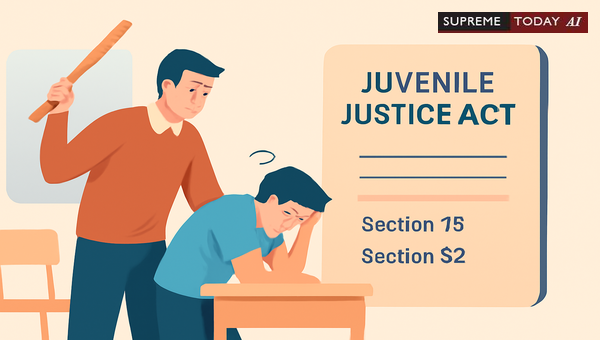
Teacher Liable for Under JJ Act?
In today's educational landscape, maintaining discipline is crucial, but where does the line blur between reasonable correction and unlawful harm? The question arises: The Offence under Juvenile Justice Act against Teacher for Corporal Injuries of Students. This issue pits a teacher's authority against child protection laws, raising concerns for educators, parents, and schools alike.
This blog post delves into the legal framework, judicial precedents, and key considerations under the Juvenile Justice (Care and Protection of Children) Act (JJ Act). We'll examine when may lead to and offer practical recommendations. Note: This is general information based on legal precedents and statutes; it is not legal advice. Consult a qualified lawyer for specific cases.
Legal Framework: Balancing Discipline and Child Protection
Teachers traditionally hold authority to discipline students, including reasonable aimed at correction. Courts have upheld this, provided it's done in good faith without excessive harm. As noted, Teachers have the authority to administer reasonable for the purpose of discipline and correction, provided it is done in good faith and does not cause excessive harm 2021 0 Supreme(Ker) 969 1961 0 Supreme(Mad) 246.
The defines as the deliberate infliction of pain for discipline or reform 2019 0 Supreme(Ker) 871. targets unnecessary mental or physical suffering caused to a child by those in charge 2021 0 Supreme(Ker) 969.
Updated with the , regulations tightened further. Section 75 addresses cruelty to children, while Section 82 specifically tackles in child care institutions by persons in authority. deals specifically with imposed by persons in charge of or employed in child care institutions 2024 0 Supreme(Ker) 638 2024 Supreme(Online)(KER) 7135. However, these provisions aren't triggered for , reasonable discipline.
The act is not triggered when the punishment is administered within the bounds of discipline or is . Excessive or injurious punishment that causes serious injuries falls under 2024 0 Supreme(Ker) 638 2024 Supreme(Online)(KER) 7135 2025 0 Supreme(Ker) 3005. Schools, while not always formal child care institutions, fall under similar scrutiny as educators are .
Judicial Precedents: What Courts Have Ruled
Indian courts have shaped the boundaries through key cases:
- In , the court ruled that chastisement with intent to improve conduct isn't penal if reasonable 2021 0 Supreme(Ker) 969.
- Nirmala K. v. State of Kerala affirmed teachers' inherent disciplinary power, as long as punishment is proportionate 2021 0 Supreme(Ker) 969.
- clarified that (causing hurt) requires proof of intentional bodily pain 2021 0 Supreme(Ker) 969.
Further precedents emphasize context. The registration of cases against teachers for depends on the circumstances and severity of injuries caused. When a teacher exceeds authority and inflicts serious injuries, of the JJ Act, particularly Sections 75 and 82, are applicable 2024 0 Supreme(Ker) 638 2024 Supreme(Online)(KER) 7135 2025 0 Supreme(Ker) 3005 2021 0 Supreme(Ker) 969 2024 0 Supreme(Ker) 1436.
Courts reject generalized principles: There cannot be any generalized pattern of principle in such situations 2004 0 Supreme(Ker) 591. If no intentional injury occurs, considering the student's age, it may not constitute harm. However, If a teacher out of fury and excitement, inflicts injuries which is harmful to the health of a tender aged student, it cannot be accepted 2004 0 Supreme(Ker) 591.
In another view, allegations of cuts, bruises, and swellings require medical evidence; without it, charges may fail 2019 0 Supreme(Raj) 149. The petitioner-Management had levelled specific allegation that due to the act of , the students suffered cuts, bruises and painful swellings on their palms... no medical report was produced 2019 0 Supreme(Raj) 149.
National policy aligns with child rights: The State and the schools are bound to recognise the right of the children not to be exposed to violence of any kind connected with education... has no place in the system of education 2012 0 Supreme(Del) 1649 2012 0 Supreme(Del) 2740.
Key Considerations: When Does It Become an Offence?
Nature and Gravity of Punishment
The crux lies in excessiveness. The nature and gravity of the inflicted by the teacher are critical... If the punishment is excessive or causes unreasonable physical suffering, it cannot be justified by the principle of implied consent from parents 2021 0 Supreme(Ker) 969 2020 0 Supreme(HP) 306.
If the teacher, out of unbridled fury, excitement or rage, inflicts injuries which are of such a nature as to cause unreasonable physical suffering or harm to the child, the same cannot be condoned on any ground or on the principle of express or implied consent 2018 0 Supreme(Ker) 812. Courts assess:- Intent: Discipline vs. anger?- Severity: Minor vs. serious injuries (e.g., bruises needing medical attention)?- Proportionality: Matches the misconduct?
Courts consider whether the was , aimed at discipline, and within reasonable limits. If the act is and does not cause serious harm, it may not constitute an offence under the JJ Act 2024 0 Supreme(Ker) 638 2025 0 Supreme(Ker) 3005 2024 0 Supreme(Ker) 1436.
Applicability to Schools
While Section 82 targets child care institutions, broader JJ Act provisions apply to schools. Cases under Sections 324 IPC and JJ Act Section 23 have been registered against teachers 2021 Supreme(Online)(KER) 25929. Police Station registered under Section 324 of and Section 23 of Juvenile Justice Act 2021 Supreme(Online)(KER) 25929.
The State must ensure that to students is excluded from schools 2012 0 Supreme(Del) 2740.
Recent Developments and Penalties
The JJ Act imposes fines and imprisonment for violations, especially repeated offences 2024 0 Supreme(MP) 63. The Juvenile Justice (Care and Protection of Children) Act, has further tightened the regulations against , making it punishable by fines and imprisonment for repeated offences 2024 0 Supreme(MP) 63. Explicit bans in institutions underscore zero tolerance for excess.
Conclusion and Recommendations
Generally, teachers may administer reasonable with good intent without facing JJ Act offences. However, excessive harm, fury-driven acts, or serious injuries trigger liability under Sections 75, 82, or IPC provisions like 323/324 2024 0 Supreme(Ker) 638 2025 0 Supreme(Ker) 3005 2024 Supreme(Online)(KER) 7135.
Key Takeaways:- Assess punishment's reasonableness based on circumstances.- Document incidents and use alternatives like counseling.- Schools should adopt anti- policies aligned with law.- Train staff on boundaries to prevent litigation.
Educational institutions must prioritize child-centric approaches. The National Policy... has adopted child centered approach, where has no place 2012 0 Supreme(Del) 1649. By fostering positive discipline, teachers protect students and themselves.
References:- 2021 0 Supreme(Ker) 969 1961 0 Supreme(Mad) 246 2019 0 Supreme(Ker) 871 2024 0 Supreme(MP) 63 2020 0 Supreme(HP) 306- 2024 0 Supreme(Ker) 638 2024 Supreme(Online)(KER) 7135 2025 0 Supreme(Ker) 3005 2024 0 Supreme(Ker) 1436 2021 Supreme(Online)(KER) 25929 2019 0 Supreme(Raj) 149 2018 0 Supreme(Ker) 812 2012 0 Supreme(Del) 1649 2012 0 Supreme(Del) 2740 2004 0 Supreme(Ker) 591
#JuvenileJusticeAct #CorporalPunishment #TeacherLiability












