


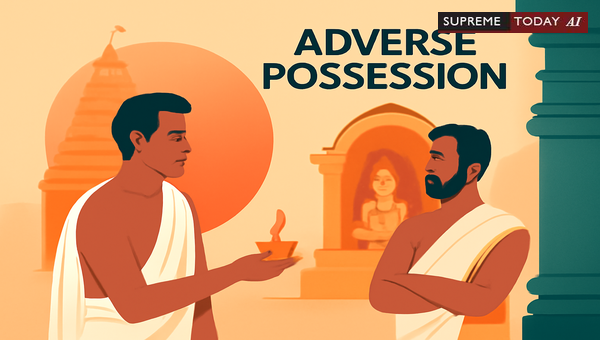
Can Temple Pandits Claim Rights?
In the sacred confines of temples across India, pandits and priests often dedicate their lives to service, managing rituals, properties, and daily affairs. But what happens when long-term possession blurs the line between service and ownership? A common question arises: Do temple pandits have rights over temple property after serving their entire lives?
This issue pits religious against property law principles, raising stakes for temple trusts, devotees, and the priests themselves. While temple properties are often dedicated to deities and protected under trust laws, courts have examined whether continuous possession can ripen into ownership claims. This blog post delves into the nuances, drawing from key judicial findings and legal documents to provide clarity—note: this is general information, not specific legal advice. Consult a qualified lawyer for your situation.
Understanding in the Indian Context
is a doctrine allowing a person to claim ownership of land after possessing it openly, continuously, exclusively, and hostile to the true owner's rights for a —typically under the .
Key elements include:- Continuous and uninterrupted possession.- Open and notorious acts inconsistent with the owner's title.- Hostile (without permission).- Exclusive control, like management or use as one's own. 1971 0 Supreme(SC) 127
Mere possession differs from : Mere possession is different than because in there has to be claim against the world at large including the owner and that the owner does not have title. 2018 0 Supreme(Del) 2762
For temple properties, which are often , claims face heightened scrutiny to protect deity interests.
Nature of Temple Pandits' Rights: Service vs. Ownership
Pandits' roles are primarily service-oriented—performing rituals, maintaining customs, and managing temple affairs under established traditions. Their possession is generally regarded as rather than , and their possession is often considered as a duty or service rather than . 1970 0 Supreme(SC) 473
However, the law does not categorically bar pandits from . Long, continuous, and peaceful possession over temple property, especially when accompanied by , can constitute , regardless of whether the possessor is a pandit or priest. 1971 0 Supreme(SC) 127
Courts emphasize factual control over religious role: The law emphasizes the nature of possession—its continuity, exclusivity, and factual control—over the mere service or religious role of the individual. 1971 0 Supreme(SC) 127
In one analysis, temple authorities hold competence: Therefore, only the Temple authorities are competent to say who is in possession of the above property. 2022 0 Supreme(Mad) 3063
Key Judicial Findings on Pandits and
Legal documents reveal a balanced view. In 1971 0 Supreme(SC) 127, courts held that once it is established that management and possession have been long-standing, peaceful, and uncontested, such possession can give rise to rights, even if the individual is a priest or pandit.
This aligns with broader principles: possession must demonstrate , control, and use—such acts are inconsistent with the rights of the true owner. 1971 0 Supreme(SC) 127
Contrastingly, other sources stress protections for temples. Lifelong service alone doesn't suffice: possession by pandits does not automatically lead to unless there is clear evidence of abandonment or encroachment. References like 2023 0 Supreme(Mad) 262, 2023 0 Supreme(Mad) 35, and 2023 0 Supreme(Ker) 990 highlight courts' reluctance to interfere in ritual matters without legal challenges.
The temple has prescribed title to the same by its long, continuous and open on its own right. 2017 0 Supreme(Mad) 1451 2017 0 Supreme(Mad) 1449
In suits, alone could have saved the defendant from being dispossessed. But without such a defense, relief favors the plaintiff. 2021 0 Supreme(Mad) 3180
Conditions for Successful Claims by Pandits
To succeed, pandits must prove:- of (or 30 for government land).- Acts of ownership: Leasing, cultivating, constructing—beyond mere worship. 1971 0 Supreme(SC) 127- Hostility: No acknowledgment of temple's superior title. 2018 0 Supreme(Del) 2762
Sources affirm: The legal doctrine of requires continuous, open, and hostile possession for a , which is not established merely by serving as a pandit. 2022 0 Supreme(AP) 415, 2024 0 Supreme(J&K) 310, 2023 0 Supreme(AP) 843
Temple properties vest in deities, complicating claims: misappropriation invites action. 2022 7 Supreme 452, 2023 0 Supreme(SC) 117
Exceptions and Limitations
- Service-only possession: If limited to rituals without management, no adverse claim. 1970 0 Supreme(SC) 473
- Temple customs prevail: Courts protect authorized pandits' roles. 2023 0 Supreme(Mad) 2941, 2023 Supreme(Online)(MAD) 33625
- No automatic bar, but high bar: Facts matter; delay alone insufficient unless statutory. 2021 0 Supreme(Mad) 3180
- Trust properties: Deity ownership overrides .
Pandits adhering to customs are generally not liable to claims. Temple frameworks safeguard against encroachment. 2023 0 Supreme(Mad) 262
Practical Recommendations for Temples and Pandits
- Document everything: Temples should record leases, appointments, and boundaries to rebut claims.
- Legal audits: Regular checks prevent ripening titles.
- Pandits: Prove specific acts if claiming; otherwise, respect service tenure.
- Dispute resolution: Approach civil courts early; FIRs for encroachments possible. 2022 0 Supreme(Mad) 3063
Clear demarcation aids: It is advisable for temple authorities and pandits to document and clarify the nature of their rights and possession to prevent claims.
Conclusion: A Nuanced Balance
Temple pandits serving lifelong are not automatically barred from if possession is continuous, exclusive, and hostile with management acts for the . Yet, courts typically view their role as service, protecting temple properties unless concrete evidence shows otherwise. 1971 0 Supreme(SC) 127 1970 0 Supreme(SC) 473
Key Takeaways:- Service ≠ ownership; facts of possession decide.- Temples: Vigilance through documentation.- Pandits: Substantial proof required.
This analysis draws from cases like 1971 0 Supreme(SC) 127, 1970 0 Supreme(SC) 473, 2022 0 Supreme(Mad) 3063, 2018 0 Supreme(Del) 2762, and others 2022 0 Supreme(AP) 415, 2024 0 Supreme(J&K) 310, emphasizing evidence over assumption.
For personalized guidance, consult a property law expert. Stay informed on evolving jurisprudence to safeguard sacred spaces.
#AdversePossession, #TempleLaw, #PropertyRightsIndia












