


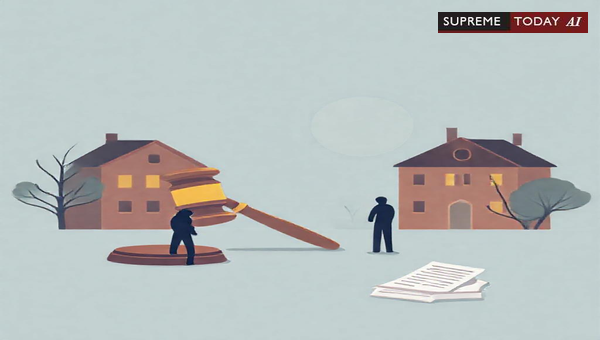
Why Courts Refuse When the Plaintiff Has Neither Ownership Nor Possession of the Property
A recurring question in property litigation is what happens when the court refuses the order of while the plaintiff is neither the owner nor in possession of the suit property. In such circumstances, the consistent judicial position is that the plaintiff is generally not entitled to any injunction order at all. Injunctive relief is an equitable remedy designed to protect an existing legal right — usually lawful possession — and a litigant without both title and possession has, prima facie, no right for the court to protect.
This post explains the settled legal principles, the leading precedents, and the practical remedies available to a plaintiff who is out of possession.
The Legal Framework for Temporary Injunctions
The grant of temporary injunctions is governed by . Courts typically apply the three-part test laid down in 1991 0 Supreme(SC) 726:
- There must be a serious disputed question to be tried and a probability that the plaintiff is entitled to the relief sought;
- The court's interference must be necessary to protect the party from ;
- The must favor granting rather than withholding the injunction.
Because injunction is a discretionary and 1985 0 Supreme(Kar) 329, a plaintiff who establishes none of these ingredients — and who cannot even show a legal right to the property — will rarely satisfy the test.
The Core Rule: No Title, No Possession, No Injunction
The leading authority is 2008 0 Supreme(SC) 526, where the Supreme Court laid down the governing principles:
- A plaintiff in lawful or peaceful possession may protect that possession by a suit for , against any person who does not prove a better title.
- A person in is not entitled to an injunction against the rightful owner.
- A plaintiff whose title is not disputed but who is out of possession cannot seek ; the remedy is a , with injunction as an additional or consequential relief if necessary.
These principles have been repeatedly reaffirmed, including in 2023 0 Supreme(SC) 1069 and 2023 7 Supreme 309.
Why the Court's Refusal Is Legally Sound
When a plaintiff is neither owner nor in possession, the refusal of is consistent with settled law for several reasons:
- No right to protect — Injunction preserves the status quo of an existing right. Without possession or title, there is no status quo favoring the plaintiff.
- Wrongful claims cannot be aided — As held in 1985 0 Supreme(Kar) 329, no court can by its own order help a party found to be in as against the lawful owner, and injunction will not be granted where it would operate oppressively or inequitably.
- Equity demands clean hands — 2022 4 Supreme 658 confirms that injunction cannot issue against a true owner in favor of a trespasser or a person in unlawful possession.
- Judicial experience with such suits — Courts have observed that the primary object of such litigation is often to continue to remain in possession with the intervention of the Court, and a party is not entitled to an injunction as a matter of course 2025 Supreme(Online)(Cal) 9168. Where parties admit they are not in possession, trial courts have rightly refused injunction for failure to make out a 2026 Supreme(Online)(Kar) 34561.
The Limited Exception:
The law does protect possession — even — in one narrow situation. Under 2003 8 Supreme 928, it is the settled or effective possession of a person without title that may entitle him to protect his possession even against the true owner, since the true owner must recover possession through , not force.
Similarly, 1999 0 Supreme(Kar) 525 notes that even a trespasser in may be entitled to restraining the owner from forcible, unlawful dispossession. A case where occupants were in continuous, peaceful, and since 1987 illustrates this: even though their sale deed had been cancelled, the court granted because there was no decree for eviction and forcible dispossession without due process was impermissible 2026 Supreme(Online)(All) 97887.
The critical distinction, however, is that even this limited protection requires actual, . A plaintiff with no possession whatsoever cannot invoke it.
in Vacant Land Cases
Where the property is a vacant site and physical possession is difficult to prove, courts apply the principle that . In 2026 2 Supreme 401, it was held that where two persons claim possession of a vacant site, the one who establishes title is deemed in possession. Conversely, a plaintiff who proves neither title nor physical possession fails entirely.
Position of Co-Owners and Other Claimants
The rule admits some nuances:
- Co-ownership: A co-owner out of possession is generally not entitled to injunction against another co-owner unless there is ouster or detriment to common interests; the proper remedy is partition, as held in 2000 0 Supreme(P&H) 274.
- Persons without any asserted interest: A plaintiff who is neither owner, tenant, licensee, nor even a claimant in possession has no enforceable right to injunctive protection; family members of a tenant, for example, cannot claim injunction without asserting an independent right 2025 0 Supreme(Cal) 573.
- Lessees without possession: Where a lessee claims rights but lacks physical possession, courts have examined whether a legitimate claim exists independently of possession 2025 0 Supreme(Cal) 725 — but a bare claim without prima facie proof will not suffice.
Practical Remedies for a Plaintiff Out of Possession
If you claim ownership but have been dispossessed, the usual course is:
- File a comprehensive suit for declaration of title and recovery of possession, with injunction sought only as a consequential relief — not a bare injunction suit.
- Establish possession prima facie on the date of suit through sale deeds, revenue records, tax receipts, or witnesses.
- Rely on title documents where possession is disputed, invoking the doctrine that for vacant land.
- Approach with clean hands — suppression of material facts disentitles a litigant to .
Key Takeaways
- A plaintiff who is neither owner nor in possession is generally not entitled to temporary or permanent injunction.
- Possession is the essential foundation of an injunction suit; title matters chiefly to establish possession or defeat wrongful claims.
- Only settled, peaceful possession — even of a trespasser — may be protected, and only against forcible dispossession without due process.
- The correct remedy for a dispossessed claimant is a suit for possession and declaration, not .
Refusal of a in such cases is not a procedural setback but a reflection of substantive law: courts protect rights, not litigation strategy. Anyone facing a similar situation should consult a qualified advocate regarding the facts of their specific case.
#TemporaryInjunction #PropertyLaw #PossessionRights #Order39CPC #InjunctionLaw












