


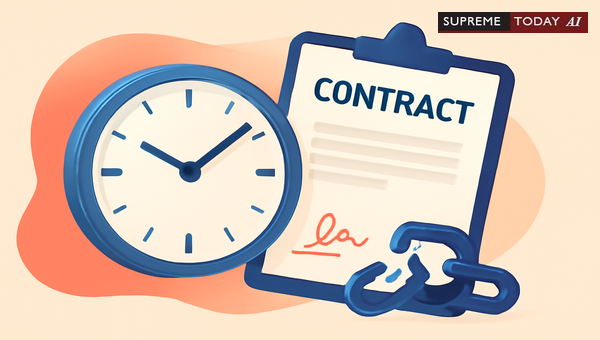
Time of the Essence in Contracts: Breach Risks Explained
In the fast-paced world of business and real estate transactions, timing can make or break a deal. Imagine signing a contract for a property sale or project delivery with a clear deadline, only to face delays that unravel the entire agreement. A common legal question arises: Contract was Strictly Conditioned on a Time Frame—what happens if that frame is missed?
This blog post dives into the principle that when a contract explicitly conditions performance on a specific time frame, time is generally deemed to be of the essence. We'll explore court interpretations, breach consequences, exceptions, and practical tips, drawing from key legal precedents. Note: This is general information, not specific legal advice. Consult a qualified attorney for your situation.
What Does 'Time of the Essence' Mean in Contracts?
When a contract states that , it signals that deadlines are not mere suggestions—they're fundamental conditions. Courts typically view timely performance as a core obligation, and failure to meet it can justify serious remedies like (cancelling the contract) or denial of (forcing the deal through) 2021 8 Supreme 59.
Explicit clauses make this clear. For instance, one court emphasized: the stipulation as time being of the essence of the contract was specifically mentioned in clause 10 and the consequences of non-completion are mentioned in clause 92021 8 Supreme 59. This underscores that parties intend strict adherence, especially in commercial deals where delays ripple through finances and operations.
Key Indicators That Time Is Essential
- Explicit contractual language: Phrases like strongly indicate timely performance is crucial 2021 8 Supreme 59.
- Contract nature and context: Commercial transactions often imply urgency, reinforced by surrounding circumstances 2021 8 Supreme 59.
- Consequences outlined: Clauses detailing penalties for delays solidify the condition 2021 8 Supreme 59.
Courts don't rely solely on wording; they examine the entire contract and circumstances 2021 8 Supreme 59.
Consequences of Breaching a Time-Conditioned Contract
Missing a deadline in a time-essential contract is often a . The non-breaching party may rescind, forfeit benefits, or block 2023 4 Supreme 475. As one ruling states: when a condition of a contract is breached and consequences ensue for that breach, a party cannot claim to escape such consequences2023 4 Supreme 475.
This principle extends to various contracts:- Real estate sales: Delays can void the deal if time is explicit.- Construction projects: Failure to complete within stipulated periods leads to rejection of claims 2023 Supreme(Online)(Pat) 10144.- Performance bonds and leases: Often tied to definite periods; non-compliance invalidates enforceability
SRI LANKA INSURANCE CORPORATION LTD VS. ATTORNEY GENERAL
.In insurance or service contracts, similar logic applies—policies are construed like general contracts, where conditioned terms must be met 2024 Supreme(US)(ca5) 348.
Judicial Approach: Balancing Clauses and Context
Courts adopt a holistic view. Even with explicit clauses, they consider:- Extensions or waivers: Granting more time may relax strictness, unless revoked 2021 8 Supreme 59.- Party conduct: Efforts to uphold the contract, like extensions, show intent but don't erase original terms 2021 8 Supreme 59.- Promisee's role: Delays caused by the other party may excuse non-performance 2021 8 Supreme 59.
Case law, such as in , affirms: even where parties have expressly provided time to be of the essence of the contract, such a stipulation will have to be read along with other terms2021 8 Supreme 59. This ensures fairness without undermining clear intent.
If no explicit clause exists, courts analyze implicitly: the entire contract and circumstances determine time's importance 2009 2 Supreme 749.
Exceptions and Limitations to Strict Time Conditions
Not every delay dooms a contract. Common exceptions include:- No explicit '' clause: Time may not be essential unless context demands it 2009 2 Supreme 749.- Extensions granted: Indicates flexibility, but document carefully 2021 8 Supreme 59.- Waivers or conduct: Repeated acceptance of delays can waive strict enforcement.- External factors: Delays from the other party's acts or unforeseen events 2021 8 Supreme 59.- Quality over speed: In some work orders, adherence to standards within time is key, but minor slips may not trigger breach if quality holds 2023 Supreme(Online)(KAR) 15039.
Additional sources highlight time frames in specialized contracts:- Leases limited to six-year recovery periods
.- Bonds conditioned on payment/performance within limits 2022 Supreme(Online)(Kar) 57374.- Service contracts excluding certain elements if time-bound 2021 Supreme(Online)(MAD) 21190.
Practical Recommendations for Contract Parties
To navigate these risks:- Draft clearly: Include and specify consequences like or penalties.- Document everything: Record extensions, waivers, or delays in writing.- Monitor compliance: Use supervisory oversight for time-sensitive projects 2023 Supreme(Online)(All) 20751.- Seek unconditional assurances: Ensure all conditions are met before finalizing 2023 Supreme(Online)(Pat) 10144.- Anticipate disputes: In arbitral processes, strict time adherence governs validity 2022 Supreme(Online)(Kar) 57374.
Businesses in construction, real estate, or services should prioritize these to avoid invalidation or costly litigation.
Key Takeaways and Conclusion
Contracts strictly conditioned on time frames hinge on time being of the essence, making breaches high-stakes. Explicit clauses, commercial context, and outlined consequences typically enforce strict timelines, leading to or denied remedies if unmet 2021 8 Supreme 59 2023 4 Supreme 475. However, courts weigh the full picture, offering exceptions for fairness.
Ultimately, clarity in drafting and conduct preserves enforceability. As insights from diverse cases show, adherence to deadlines ensures stability—deviations invite challenges
SRI LANKA INSURANCE CORPORATION LTD VS. ATTORNEY GENERAL
.This post provides general educational insights based on referenced precedents. Laws vary by jurisdiction; always consult a legal professional for tailored advice.
References
- 2021 8 Supreme 59: Core case on explicit time clauses and intent.
- 2023 4 Supreme 475: Breach consequences and limits.
- 2009 2 Supreme 749: Implicit time essence analysis.
- Additional:
, 2024 Supreme(US)(ca5) 348, 2023 Supreme(Online)(Pat) 10144, etc., for contextual examples.















