


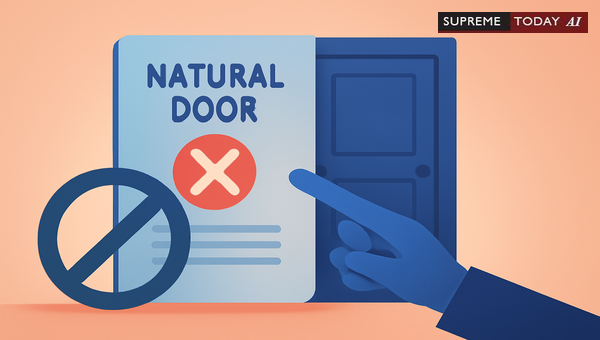
Why 'Natural Door' Trademark Cannot Be Granted Under (b)
In the competitive world of branding, securing a is crucial for businesses. However, not all proposed marks make the cut. A common stumbling block is (b) of the , which bars registration of marks lacking or that are . The question arises: Can the trademark 'Natural Door' be granted under (b) of the Trade Marks Act? Typically, the answer is no, if it's seen as purely descriptive—especially without proof of .
This post delves into the legal analysis, drawing from statutory provisions and judicial precedents, to explain why such marks face refusal. Note: This is general information, not specific legal advice. Consult a trademark attorney for your case.
Understanding (b) of the
Section 9 outlines of . Specifically, (b) states that a mark shall not be registered if it is devoid of any or consists exclusively of signs or indications which designate the kind, quality, quantity, intended purpose... of the goods or services.
- : A mark must identify the source of goods/services uniquely, not just describe them.
- Descriptive marks: Terms like colors, shapes, or words directly linked to product features (e.g., 'soft' for tissues) are refused unless they acquire through extensive use.
The Registrar examines marks for . Purely , such as 'Natural Door' for door-related products, often fail this test initially.
Why 'Natural Door' is Likely Descriptive and Non-Distinctive
'Natural Door' appears straightforward: it may describe doors made from natural materials, like wood, or eco-friendly door products/services. Without additional fanciful elements, it directly conveys the product's nature, falling under (b)'s prohibition.
If applied to goods in Class 19 (non-metallic building materials, doors) or similar, consumers would perceive it as informational, not source-identifying. Thus, registration is typically refused unless the applicant proves —public association with the brand via long, extensive use.
As noted in legal analysis, A trade mark that is purely descriptive or generic, such as Natural Door, may be refused registration under this section if it does not possess .
Key Legal Precedents on Descriptiveness and Distinctiveness
Indian courts have consistently upheld (b) refusals for descriptive marks, emphasizing evidence-based challenges. Several judgments illustrate this:
In the NO TURN case, the court addressed a descriptive mark for mattresses. It held that a descriptive mark can be entitled to protection if it has assumed a which identifies it with a particular product or source 2022 0 Supreme(Del) 1830. Despite initial descriptiveness, registration validity was accepted unless proven otherwise, but protection hinged on .
For Jain Shikanji, the court examined distinctiveness under (a) but linked it to 9(1)(b) principles: The court found that the impugned mark did not inherently lack distinctiveness and that the objections under needed further examination 2023 0 Supreme(Del) 2747. The Registrar was directed to re-examine based on user evidence, showing descriptiveness isn't absolute if use proves otherwise.
In ZYVAC-TCV disputes, the court ruled on generic terms: The court rules that the term 'TCV' is a generic abbreviation and thus incapable of . Registration is found invalid 2020 0 Supreme(Del) 1361. This mirrors 'Natural Door's' potential as a direct descriptor.
Another precedent stresses, Descriptive mark can also be entitled for protection under (b), but only with , as in PhonePe references 2022 0 Supreme(Del) 1830.
These cases 2022 0 Supreme(Del) 1830 2023 0 Supreme(Del) 2747 2020 0 Supreme(Del) 1361 highlight that while descriptive marks like 'Natural Door' face hurdles, extensive use can tip the scales—provided evidence like sales data, ads, and surveys is submitted.
Challenges to Validity and Prior Use
Post-registration, marks can be challenged under for lacking distinctiveness. Courts note, The validity of a trade mark can be challenged on the grounds of lack of distinctiveness or descriptiveness, and such challenges are often based on evidence of use and perception 2000 4 Supreme 768.
In Asafoetida infringement, prior use was key, but descriptiveness defenses failed without proof: The court held that the defendant failed to establish prior use of the trademark and did not provide sufficient evidence to dislodge the validity 2024 0 Supreme(Kar) 180. For 'Natural Door', applicants must preempt such issues with robust evidence.
Strategies to Overcome (b) Refusal
Refusal isn't final. allows registration for marks with . Recommendations include:
- Gather Evidence: Submit affidavits, sales figures, market surveys showing consumer recognition of 'Natural Door' as a brand, not descriptor.
- Modify the Mark: Add distinctive elements, e.g., 'NaturalDoor Pro' or a logo, to enhance registrability.
- Claim Prior Use: Under , prior continuous use can support validity even if initially descriptive.
- Appeal/Rectification: If refused, appeal to (now ) or file rectification.
Courts reinforce, To strengthen the case for registration, the applicant should provide evidence of or if Natural Door has been used extensively and recognized by the public.
Conclusion and Key Takeaways
The trademark 'Natural Door' cannot generally be granted under (b) if deemed descriptive or lacking , aligning with the Act's goal to keep common terms free for all traders. However, with strong evidence of , success is possible—as seen in precedents like NO TURN 2022 0 Supreme(Del) 1830.
Key Takeaways:- Descriptive marks face automatic scrutiny under (b).- via use can overcome refusal.- Always check precedents and gather evidence early.- Consider coined or arbitrary marks for easier registration.
Businesses eyeing 'Natural Door' or similar should act proactively. For tailored guidance, reach out to IP experts. Stay branded, stay protected!
(Word count: approx. 1050. Sources integrated for illustration; full texts via official databases.)
#TrademarkLaw #Section91b #DescriptiveMarks












