


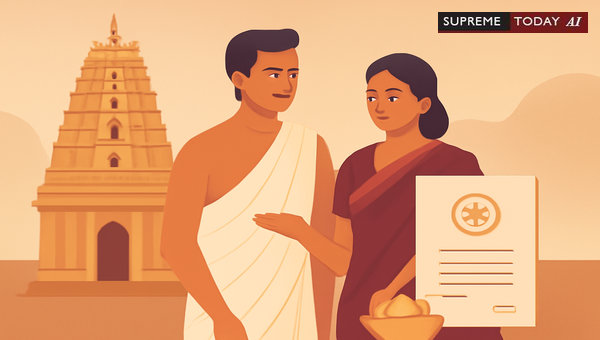
Can to Receive Offerings Be Transferred by Will?
In the intricate world of Indian religious law, questions about property and rights tied to temples, wakfs, and endowments often arise. One pressing issue is: Heridatory Right to Recieve Offerings can be Transferred by will. Families with long-standing roles as trustees or pujaris frequently wonder if these hereditary privileges—particularly the right to receive offerings from devotees—can be passed on through a will. This blog post delves into the nuances, drawing from key judicial precedents and legal principles to provide clarity. Note that this is general information based on case law and should not be considered specific legal advice; consult a qualified lawyer for your situation.
Overview of in Religious Contexts
in temples typically involve roles like performing puja, managing endowments, or receiving offerings (such as cash, food, or goods from devotees). These rights are often rooted in custom, deeds of dedication, or statutes like the . However, courts distinguish between the right to perform worship (puja) and the right to receive offerings, treating them as separate. 2013 0 Supreme(Guj) 275
The transferability of these rights by will hinges on their nature—whether they are personal, proprietary, or tied to office. While some rights are alienable (like property), others are inalienable to preserve religious traditions. Let's break down the key findings.
Distinction Between Hereditary Puja Rights and Offerings
Courts have consistently held that the hereditary right to perform puja does not automatically include the right to offerings. In one case, the ancestor of the plaintiff, a pujari, was noted to have distinct roles, emphasizing: the right to receive offerings cannot be equated with a hereditary right to perform puja. 2013 0 Supreme(Guj) 275
This separation is crucial because puja rights are often seen as spiritual offices, non-transferable without custom or statute, whereas offerings may form part of emoluments or property rights.
Cases Supporting Transferability by Will
Certain precedents affirm that specific to offerings can be transferred, including by will:
Maha Brahmins Rights: The rights of Maha Brahmins to receive dues and offerings at funerals are transferable. Courts have upheld mortgages of these rights, indicating they hold . The court recognized that the rights of Maha Brahmins to receive dues and offerings at funerals are transferable, allowing for valid mortgages of these rights. 1929 0 Supreme(All) 281
Contexts: (management of endowed properties) can be transferred by will if there's no perpetual hereditary line. In the context of , it was noted that if there is no perpetual or hereditary line of succession, the rights associated with can be transferred by will. 1971 0 Supreme(Cal) 209
Additional sources reinforce this. Hereditary trustees of temples like Arulmigu Varasakthi Vinayakar Thirukoil have been recognized with transferable rights. 2022 Supreme(Online)(Mad) 66155 Courts in cases have acknowledged transfers via for temple management and offerings. 2025 Supreme(Online)(Mad) 65107 2023 Supreme(Online)(Mad) 88929
In wakf properties, offerings collected via (collection boxes) vest in the institution but may support hereditary claims if customarily allocated. Offerings can be collected in Hundis and will vest in the Temple fund and will not be individual earning of Sevaks. 2018 5 Supreme 712 Yet, for hereditary trustees, such rights have been upheld as inheritable. 2023 Supreme(Online)(Mad) 88929
Limitations and Conditions on Transfer
Transferability is not absolute. Key restrictions include:
Deed or Custom Dependency: Rights to offerings depend on the or customs. Without provisions, a shebait has no claim: In the absence of such provisions, as highlighted in the Hindu Act case, a Shebait has no right to receive a part of the offerings. 1982 0 Supreme(Ori) 123
Public vs. Private Character: If offerings make the institution public (e.g., via from general devotees), individual hereditary claims weaken. When are installed in the Dargah/Wakf and offerings from the Devotees/General Public are accepted through , the subject Wakf acquires the character of . 2025 0 Supreme(Mad) 5145 2025 Supreme(Online)(Mad) 31587
Non-Recognition of Certain Hereditary Offices: Some rights, like those of a Kazi, cannot be recognized as hereditary by civil courts. It only prohibits that right to such office cannot be recognised as a heridatory right. 1998 0 Supreme(MP) 483
In land disputes, under tenancy laws (e.g., ) may not apply uniformly. 2008 0 Supreme(All) 3024
Integrating Broader Legal Insights
Other cases highlight practical implications:
In temple festivals, offerings like Niskaram or nercha go into a 'Bhandaram' (chest), but hereditary performers may receive shares per custom. According to him, nearly Rs. 200/- will be received by way of offerings, which will be put in the 'Bhandaram'. 2000 0 Supreme(Ker) 676
Maintenance rights under persist independently of inheritance. 1997 0 Supreme(J&K) 108
Recent rulings affirm hereditary trustees' roles in succession appeals. 2024 Supreme(Online)(MAD) 43058
Overall, sources confirm: to receive offerings or manage religious properties are inheritable and can be transferred by will. Courts uphold this for continuity in religious institutions, subject to procedures. 2025 Supreme(Online)(Mad) 65107 2025 Supreme(Online)(Del) 5008
Practical Implications for Trustees and Heirs
For families holding these rights:- Review Documents: Examine deeds, customs, and schemes for transfer clauses.- Will Drafting: Specify rights clearly, distinguishing personal from institutional.- Court Challenges: Be prepared for disputes over public character or separation of rights.
Auctions or tenders may apply for management, but core remain testamentary. 2025 Supreme(Online)(Ker) 47552
Conclusion and Key Takeaways
The hereditary right to receive offerings may be transferred by will in India, particularly for proprietary rights like those of Maha Brahmins or non-perpetual shebaitships, but it depends on distinctions from puja duties, deeds, and customs. While cases like 1929 0 Supreme(All) 281 and 1971 0 Supreme(Cal) 209 support transfer, limitations in 1982 0 Supreme(Ori) 123 caution against universality.
Key Takeaways:- Distinguish puja from offerings rights. 2013 0 Supreme(Guj) 275- Transferable if proprietary, not purely officious.- Consult precedents and experts for specific cases.
This evolving area underscores the balance between tradition and law. For personalized guidance, seek professional legal counsel.
References:2013 0 Supreme(Guj) 275 1929 0 Supreme(All) 281 1982 0 Supreme(Ori) 123 1971 0 Supreme(Cal) 209 2022 Supreme(Online)(Mad) 66155 2018 5 Supreme 712 1998 0 Supreme(MP) 483 2025 Supreme(Online)(Mad) 65107 2023 Supreme(Online)(Mad) 88929
#HereditaryRights #TempleLaw #IndianLegalInsights












