


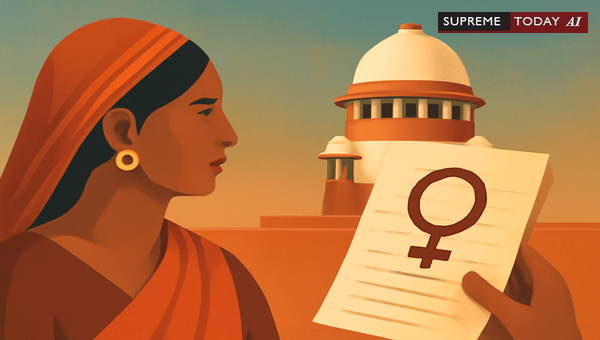
Allows Tribal Women Equal Succession Rights as Men
In a significant stride toward gender justice, the of India has emphasized that tribal women must receive equal inheritance rights as their male counterparts. This ruling challenges longstanding customary practices that often sidelined women in tribal communities, aligning them with constitutional mandates of equality. But what does this mean for tribal families and succession laws? Let's dive into the details of this evolving jurisprudence.
The Push for in Tribal Succession
Historically, tribal customary laws in India have governed inheritance, frequently favoring and excluding women from property rights. However, the has progressively intervened to ensure these customs do not violate fundamental rights. The judiciary has recognized the need for in succession rights, particularly stressing that tribal women should be granted equal inheritance rights as men, consistent with principles of . 1996 4 Supreme 192
Key judicial pronouncements highlight that denying tribal women equal shares is inconsistent with Articles 14, 15, and 21 of the Indian Constitution, which guarantee equality, non-discrimination, and the right to life and dignity. The Court has urged legislative reforms to address discriminatory exemptions in laws like the . 2009 0 Supreme(SC) 687
For instance, the Court has observed that the provisions of the and the ... would apply to the Scheduled Tribes, the general principles contained therein being consistent with . 2023 1 Supreme 652
Influence of Landmark Judgments and Comparative Law
The Indian 's stance draws inspiration from global precedents, notably the 's decision in Bhe & Ors. v. The Magistrate, Khayelisha & Ors. () 18 BHRC 52. This case declared under customary law incompatible with constitutional , influencing Indian courts to scrutinize similar tribal customs. 1996 4 Supreme 192
In India, courts have applied the Hindu Succession Act—even to tribal communities where customs align with its principles—affirming that tribal women are entitled to inherit equally from parents, brothers, or husbands. When evidence shows tribal customs mirror Hindu laws, the Act applies, reinforcing women's rights. 2024 0 Supreme(Telangana) 692 2025 0 Supreme(Jhk) 1417
Moreover, this would not deprive the tribal women from getting equal share in the family property... But the tribal women are deprived of adopting the Hindu Succession Act... Court found it saddening that the tribal women were still denied the equal right to equality after 70 years of the Constitution came into exi....2023 Supreme(Online)(MAD) 43983
Judicial Evolution and Application of Statutory Laws
The , was amended in (Act 39 of ) to confer equal right has been conferred to women in the property by way of succession. Courts have extended these principles to tribals, noting that customs excluding women constitute gender discrimination. 2023 0 Supreme(Mad) 473 2025 0 Supreme(Raj) 1914 2023 0 Supreme(Mad) 959 2023 1 Supreme 652
The has consistently held that tribal women deserve parity in . The has consistently held that tribal women are entitled to in , inheriting family property equally as heirs. 2025 0 Supreme(Raj) 1914 2023 0 Supreme(Mad) 959 2025 2 Supreme 617
However, exceptions persist. exempts Scheduled Tribes, allowing customs to prevail unless reformed. Courts adopt a cautious approach, calling for legislative intervention rather than overriding customs without evidence. 2023 1 Supreme 652 1996 4 Supreme 192
Broader Context: Human Rights and Social Change
These rulings align with international commitments like the Convention on the Elimination of All Forms of Discrimination Against Women (CEDAW). It was stressed to ensure equal rights to men and women. That is how Declaration on the Elimination of Discrimination against Women came into being. 2019 0 Supreme(P&H) 2736 2019 0 Supreme(P&H) 2969 2024 Supreme(Online)(MP) 52690 2024 Supreme(Online)(Mp) 34751
Domestically, the Court laments how though women have equal rights in law, tradition and social customs hinder Indian women in enjoying equal rights with men. With evolving family structures, blind adherence to obsolete customs is detrimental. 2019 0 Supreme(MP) 114 2019 0 Supreme(UK) 153
Judicial interventions mark a shift: from upholding customs (e.g., AIR SC 493) to prioritizing equality. ] the upheld such usage. But recent benches, like in Anjum Kadari vs., reiterate progressive principles. 2024 Supreme(Online)(TEL) 20954
Challenges, Exceptions, and Recommendations
Despite progress, limitations remain:- Exemptions under Section 2(2) of the Hindu Succession Act exclude tribals, perpetuating disparities. 2023 1 Supreme 652- Varying customs require case-by-case scrutiny; courts avoid activism without facts. 1996 4 Supreme 192- Legislative gaps demand amendments for explicit inclusion.
The recommends:- Amending the Hindu Succession Act to remove tribal exemptions and ensure equal rights.- Interpreting laws constitutionally to promote equality.- Harmonizing customs with statutes. 2009 0 Supreme(SC) 687 2023 0 Supreme(Mad) 959
Courts have emphasized that denying tribal women equal inheritance rights constitutes gender-based discrimination and violates constitutional rights.2025 0 Supreme(Raj) 1914 2023 0 Supreme(Mad) 959
Key Takeaways and Conclusion
The 's jurisprudence signals a clear trend: tribal women are entitled to equal succession rights, customs must evolve, and reforms are essential. While current laws may limit application, judicial nudges pave the way for parity.
Final thought: Influenced by cases like Bhe and armed with constitutional tools, India is closing the gender gap in tribal inheritance. This is general information based on judicial trends and not specific legal advice—consult a qualified lawyer for personalized guidance.
In summary:- Tribal women gain equal inheritance under evolving interpretations.- Constitutional equality trumps discriminatory customs.- Legislative action is urged for lasting change.
References
- 1996 4 Supreme 192 - Evolution of customary laws and equality.
- 2009 0 Supreme(SC) 687 - Violations of Articles 14/15; reform calls.
- 2023 1 Supreme 652 - Application of Succession Acts to tribals.
- 2025 2 Supreme 617 - Parity in succession.
- 2023 Supreme(Online)(MAD) 43983 - Denial of equal shares.
- 2025 0 Supreme(Raj) 1914 - Equal heir rights.
- 2023 0 Supreme(Mad) 959 - Discrimination and reforms.
- 2024 0 Supreme(Telangana) 692 - Customs aligning with HSA.
- Others as cited.















