
 Back
Back





IN THE HIGH COURT OF JHARKHAND AT RANCHI
PRADEEP KUMAR SRIVASTAVA, J.
Balia Majhi - Appellant
Versus
Chando Majhi - Respondent
Second Appeal No.181 of 2003
Decided on : 25-07-2025
| Table of Content |
|---|
| 1. title and possession of ancestral land. (Para 2 , 3 , 4 , 5) |
| 2. defendants deny plaintiffs' claim. (Para 6) |
| 3. issues for adjudication outlined. (Para 7) |
| 4. trial court findings on property partition. (Para 8) |
| 5. points from appellate court for consideration. (Para 9) |
| 6. appellate court denies appellant's claims. (Para 10) |
| 7. arguments on customary law and inheritance. (Para 11 , 12) |
| 8. plaintiffs reaffirm their claims. (Para 13) |
| 9. court analyzes customary inheritance law. (Para 14) |
| 10. final ruling on the appeal. (Para 15 , 16 , 17) |
JUDGMENT :
PRADEEP KUMAR SRIVASTAVA, J.
1. Heard the arguments of learned counsel for the appellants and learned counsel for the respondents.
2. The instant second civil appeal is preferred being aggrieved and dissatisfied with the judgment and decree dated 23.12.2002 (decree signed on 06.01.2003) passed by learned First Additional District Judge, Seraikella, Kharsawan in Title Appeal No.7 of 1996, whereby and whereunder the judgment and decree passed by Sub-ordinate Judge-II, Saraikella in Title Suit No.04 of 1991 has been upheld and confirmed and the appeal preferred by the appellants/defendants is dismissed on contest with cost.
3. The plaintiffs/respondents have instituted the Title Suit No.04 of 1991 for a decree of declaration of their right, title and interest and confirmation of possession over the suit Schedule ‘A’ land. Further, declaration that the order passed by Anchal Adhikari of Rajnagar Anchal in Mutation Case No.228 of 1988-89 dated 19/20th March, 1989 and the order passed by learned Additional Deputy Commissioner, Singhbhum under Mutation Revision Case No.37/89-90 is bad in law which do not confer any title and possession to the defendants over the suit land. In alternative, the plaintiffs have also prayed for recovery of possession, if found dispossessed, from Scheduled ‘A’ land.
The case of plaintiffs is that the suit lands recorded under Khata Nos.31 and 32 in the record of rights of Mauza, Bagaraisai, P.S. Rajnagar, District-Singhbhum was recorded in the name of common ancestor of the parties namely Mutu Majhi. The relationship of the parties is based on following genealogy:-
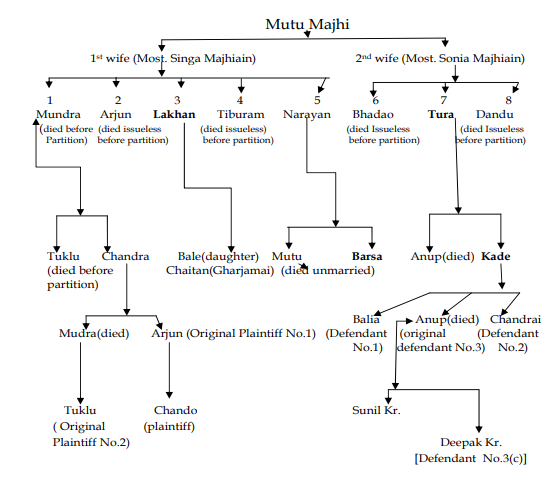
4. It is submitted that out of five sons from first wife, Arjun Majhi and Tiburam Majhi died issueless before 1925 and Mundra Majhi died leaving behind two sons Tuklu Majhi and Chandra Majhi. Taklu Majhi died leaving behind no male issue except daughter namely Nagi Majhian, who was already married. Chandra Majhi died leaving behind Mudra Majhi and Arjun Majhi, the plaintiff No.1. Arjun Majhi is the son of Chandra Majhi and plaintiff No.2 is the son of Mundra Majhi, the full brother of Arjun Majhi, who is residing with the plaintiff, Arjun Majhi after the death of his father. Further, Lakhan Majhi is third son of the Mutu Majhi born through his first wife and died leaving behind a daughter namely Bale Majhian, who has been given in marriage. Narayan Majhi, the fifth son of Mutu Majhi who born through first wife died leaving behind him a son Barsa Majhi, who inherited the property of his father and in current settlement these properties have exclusively been settled in his name pertaining to Khata Nos. 31 and 32 (suit property). Further, the case of the plaintiffs is that Mutu Majhi has also 3 sons from his second wife namely, Bhadao Majhi, Tura Majhi and Dandu. Out of them, Bhadao Majhi and Dandu Majhi died issuless. Tura Majhi died leaving behind two sons, namely Anup Majhi and Kade Majhi, who inherited the properties of their father. Anup Majhi has no male issue and died leaving behind him a daughter Ganga Manjhain, who was married. Kade Majhi died leaving behind his 3 sons i.e. defendant Balia Majhi (Defendant No.1) Chandrai Majhi (Defendant No.2) and Anup Majhi (Defendant No.3), who inherited the properties of their deceased father.
5. It is further stated that both the parties are ab-original and not governed by Hindu Succession Act, 1956 they are governed rather by their own customary law in the
AI
The court affirmed that, under Santhal customary law, inheritance rights apply equally to all sons born from different wives, prioritizing nearest agnates over distant kindred in property claims.


The burden of proof for establishing a custom rests on the party asserting it, and clear and unambiguous evidence is required to prove the custom. The court emphasized the need for continuity, certai....

(1) Revenue records are not documents of title, but they are evidence of possession. (2) Succession—Customs are not fossilized structures, nor are they etched on stone but are living organism rooted ....
Custom – Custom evolves by conduct – Customs too, like law, cannot remain stuck in time and others cannot be allowed to take refuge in customs or hide behind them to deprive others of their right.

(1) Among Santals, succession law is Hindu Law and not Customary Law.(2) Suit for declaration of title and recovery of possession cannot be maintained in respect to joint and undivided property witho....

A Devadasi, under customary law, is entitled to inherit property as if she were a son, validating the plaintiff's claim for half share in estate.

Co-owners of property cannot seek exclusive title or recovery of possession without partitioning the property, reaffirming shared ownership under Hindu law.



An indispensable Tool for Legal Professionals, Endorsed by Various High Court and Judicial Officers
Please visit our Training & Support
Center or Contact Us for assistance

Scan Me!
India’s Legal research and Law Firm App, Download now!


For Daily Legal Updates, Join us on :



 Back to top


