
Searching Case Laws & Precedent on Legal Query.....!
Analysing the retrieved Case Laws
Scanned Judgements…!
Searching Case Laws & Precedent on Legal Query.....!
Analysing the retrieved Case Laws
Scanned Judgements…!
References: ["2022 0 Supreme(Guj) 1531"], ["2025 0 Supreme(All) 2325"], ["2024 0 Supreme(Guj) 1660"], ["2024 0 Supreme(Pat) 1160"], ["2024 0 Supreme(Pat) 1056"], ["2025 Supreme(Online)(DRAT) 94"]
Returned with Endorsement & Deemed Service When a demand notice under Section 13(2) is returned unclaimed or with endorsement, courts have held that such service can still be treated as valid if the notice was properly dispatched and the bank has proof of dispatch. The doctrine of deemed service applies, and the unclaimed status does not invalidate the notice. The legal principle is that the burden shifts to the borrower to prove non-receipt, which is often not established if the notice was sent via registered post.
References: ["2025 0 Supreme(All) 2431"], ["2022 0 Supreme(Guj) 1531"], ["2024 0 Supreme(Pat) 1160"]
Legal Precedents & Judicial View Courts have consistently recognized that a demand notice under Section 13(2), when sent properly (registered post, acknowledgment, or endorsement), suffices as valid service even if returned unclaimed or unendorsed. Once such notice is issued, it is treated as effective, and subsequent proceedings under Section 13(4) are based on this deemed service.
References:- ["2022 0 Supreme(Guj) 1531"]- ["2025 0 Supreme(All) 2325"]- ["2024 0 Supreme(Guj) 1660"]- ["2024 0 Supreme(Pat) 1160"]- ["2025 Supreme(Online)(DRAT) 94"]
In the complex world of debt recovery in India, secured creditors often rely on the Securitisation and Reconstruction of Financial Assets and Enforcement of Security Interest Act, 2002 (SARFAESI Act) to enforce their rights. A critical step is issuing a demand notice under Section 13(2). But what happens if this notice is sent via registered post and returns with an endorsement of unclaimed? Does it still constitute valid service? This question arises frequently in disputes before Debts Recovery Tribunals (DRT) and courts, impacting whether banks can proceed to possession or sale of secured assets.
This blog explores the legal position, drawing from judicial precedents and statutory presumptions. Note: This is general information based on case law and should not be considered specific legal advice. Consult a qualified lawyer for your situation.
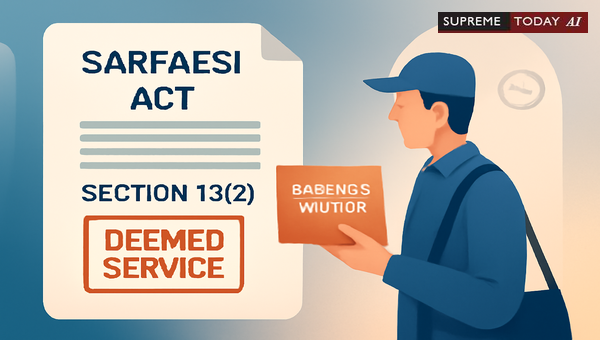
Whether a demand issued under Section 13(2) of the SARFAESI Act returned with endorsement 'unclaimed' can be treated as deemed service?
Generally, yes. A demand notice under Section 13(2) returned unclaimed can be treated as deemed service, provided statutory presumptions under Indian postal service laws are met. Service by registered post is presumed effective if the letter is properly addressed, prepaid, and posted, unless rebutted 2010 0 Supreme(Mad) 418.
Key points include:- The unclaimed endorsement does not automatically negate service; it indicates the addressee failed to collect it despite attempts 2010 0 Supreme(Mad) 418.- The burden shifts to the borrower to prove non-receipt with evidence 2010 0 Supreme(Mad) 418.
Under Section 27 of the General Clauses Act, 1897, service is deemed once a properly addressed, prepaid registered letter is posted. Judicial precedents reinforce this: the Supreme Court holds that dispatch to the correct address creates a strong presumption 2010 0 Supreme(Mad) 418.
In practice, banks must retain proof like postal receipts and tracking. An unclaimed return means the postman attempted delivery, but the recipient avoided it—common in evasion cases 2010 0 Supreme(Mad) 418.
Courts clarify that unclaimed ≠ not served. It shifts the onus: borrowers must adduce evidence like affidavits or postal defects to rebut 2010 0 Supreme(Mad) 418. Mere denial is insufficient.
Several rulings affirm this:- Krishna Kumar Gupta v. Manoj K Sahu: Correctly addressed registered envelopes presume service; recipient must disprove 2010 0 Supreme(Mad) 418.- Alavi Haji v. Muhammed (Supreme Court): Unclaimed does not negate presumption if properly dispatched 2010 0 Supreme(Mad) 418.- M/s Ajeet Seeds Ltd v. K. Gopala Krishnaiah: Upholds validity unless rebutted 2010 0 Supreme(Mad) 418.
These principles directly apply to SARFAESI notices, ensuring creditors aren't stalled by deliberate non-collection.
Section 13(2) mandates a 60-day demand notice. Dispatch via registered post satisfies this if presumptions hold, even if unclaimed. Courts treat it as served, allowing progression to Section 13(4) possession 2010 0 Supreme(Mad) 418.
Presumptions aren't absolute:- Rebuttable if borrower proves defective address, non-dispatch, or receipt elsewhere 2010 0 Supreme(Mad) 418.- Credible evidence required; assertions alone fail 2010 0 Supreme(Mad) 418.- Unclaimed isn't refused or not known, but still valid if procedure followed.
Service disputes often lead to remands or challenges. For instance, in a case where DRT set aside a sale without examining notice service, DRAT remanded for fresh adjudication on issues like service of notice alongside payments and drafts 2023 0 Supreme(Cal) 884. The court noted: The DRAT has the power to remand a SARFAESI application to the DRT for fresh adjudication, where the DRT has not considered various disputed issues raised by the parties, including service of notice 2023 0 Supreme(Cal) 884.
Similarly, challenges to Section 13(4) possession notices highlight procedural scrutiny 2019 0 Supreme(Cal) 91. In another, banks faced quashing for invalid NPAs or missing details in notices, underscoring proper notice essentials
Coventry Spring and Engineering VS ARCI
.These cases emphasize: robust service proof prevents delays. Borrowers succeeding in rebuttals often involve factual inquiries, as in remands for evidence appreciation 2023 0 Supreme(Cal) 884.
Limitation and jurisdiction issues also intersect; e.g., SARFAESI proceedings post-NPA declaration must align with timelines, with delays condonable under Limitation Act Sections 5/14 2021 4 Supreme 496.
For Secured Creditors (Banks/Financial Institutions):- Use registered post with acknowledgment due (RPAD).- Verify addresses from loan docs; retain dispatch proofs 2010 0 Supreme(Mad) 418.- Track returns; prepare rebuttal evidence.
For Borrowers/Guarantors:- Update addresses; collect notices promptly.- If disputing, gather evidence (e.g., postal inquiries) beyond claims.- Approach DRT under Section 17 timely.
For Courts/DRT:- Apply presumptions unless clearly rebutted.
Understanding these nuances helps navigate SARFAESI proceedings effectively. Stay informed on evolving precedents to protect interests.
Disclaimer: This post summarizes general legal principles from cited sources. Laws and interpretations vary; seek professional advice for case-specific guidance.
#SARFAESIAct, #DeemedService, #BankingLaw
It was submitted that in view of the decision of the Division Bench in the aforesaid case, the action / recourse under sub-section (4) of Section 13 of the SARFAESI Act is consequential upon the notice under Section 13(2) of the SARFAESI Act. ... Therefore, the respondent – Bank issued a notice under section 13(2) of the Securitisation and Reco....
Section 13 (4) of the SARFAESI Act. 5. ... With regard to the petitioner no.1, it appears that proper service may not have been made. c)- Notice under Section 13(4) of the Act dated November 27, 2024 was issued upon the petitioners which was received by them.
It has been stated that the petitioner no.1 never received such Demand Notice under Section 13(2) of the SARFAESI Act. ... Noble Kumar (supra), where the Supreme Court has observed that application under Section 14 of the Act can be moved straight away after Demand Notice under Section 13(2) of the Act is issued. ... In this petition, there is....
Whether Bank has violated the provision under section 13(3A) of the SARFAESI Act by not giving reply to petitioner’s representation ... Bank issued demand notice dated 02.02.2015 under section 13(2) of the Securitization and Reconstruction of Financial Assets and Enforcement of Security Interest Act, 2002 (SARFAESI Act) and claimed outstanding amount of Rs. 35,63,076.86/-as on 14.01.2015 plus furt....
SARFAESI - Borrower Rights - Section 13(2), 13(4), 14, 17, 8 - The court interpreted the provisions of the ... The bank issued a demand notice under Section 13(2) of the SARFAESI Act, which the petitioner claimed was not served. ... Issues: Whether the demand notice under Section 13(2) was properly served and whether the petitioner retained ... 4.2 The demand notice under Section 13(2) of the Se....
A title suit bearing No. 595 of 2017 was filed against the declaration of NPA and the bank issued a demand notice under Section 13(2) of the SARFAESI Act, which was replied to. ... Hence, while allowing the review application, the DRT also declared all actions initiated under Section 13 of the SARFAESI Act; for reason of suppression of the representation filed under Section #HL_S....
b) No proof of personal service of possession notice issued under Section 13(4) of SARFAESI Act was produced. 5. ... notice dated 24.7.2015 under Section 13(4) of SARFAESI Act. ... It is seen from the SARFAESI application filed by the respondent in paragraph V(2), that respondent contended that without valid reasons, the appellant bank classified the respondent’s account as a NP....
Patadia submitted that the DRT allowed the Securitization Application No.231/2019 permitting the bank to proceed further in accordance with the notice issued under sections 13(2) and 13(4) of the SARFAESI Act. ... The said company defaulted in payment of dues and therefore, the respondent-bank issued notice dated 1st November, 2008 under section 13(2) of the Securitisation and Reconstruction of Financial Assets and....
The petitioner further contends that despite repeated assurances, the Bank issued a notice dated 17.02.2022 under Section 13(4) of the SARFAESI Act, 2002 to take possession of the secured assets. 4. Thereafter, the Bank issued an E-Auction notice bearing no. ... Nayana Tara B.G., representing respondent No. 1, argued that court fees payable for applications under Section 17 of the SARFAESI Act are governed by Rule 13#HL_EN....
In other words, proceedings were initiated under the SARFAESI Act, 2002, approximately 9 months and 18 days after the date of accrual of the right to issue. The proceedings under the SARFAESI Act, 2002 were stayed by the Calcutta High Court, by an order dated 24th July 2017, on the ground of want of jurisdiction. Proceedings under the SARFAESI Act commenced on 18th January 2014, when a Demand Notice was issued under Section 13(2) of the SARFAESI Act. The relevant dates reveal that the Cash Credit Account of the Corporate Debtor was declared NPA with effect from 31st March, ....
The said notice was followed up by a notice of possession under Section 13(4) on November 4, 2017. 1 having failed to repay such loan, the opposite party no. 1 issued a demand notice dated August 23, 2017 under Section 13(2) of the Securitization and Reconstruction of Financial Assets and Enforcement of Security Interest Act, 2002 (hereinafter referred to as "the SARFAESI Act").
If one account is stamped as NPA, all the other accounts are also to be considered as NPA". Hence, the Demand Notice under Section 13 (2) of SARFAESI Act is in accordance with law.
In the case on hand, since there was no security agreement as defined under Section 2(zb) of the SARFAESI Act, the petitioner, being the borrower, is not liable to make repayment of secured debt or any instalment thereof. Thus, the demand notice issued under the provision of Section 13(2) of the SARFAESI Act and further consequential actions are non-est and deserve to be quashed.
The demand notice also did not indicate when the account of the appellant No. 1 became N.P.A. in fact, the account of the appellant No.1 had never become N.P.A., therefore, neither the State Bank of India nor its assignee, the respondent No.1 could issue demand notice under Section 13(2) of the SARFAESI Act. The demand notice also does not contain the details of the amount payable by the borrower and the secured assets intended to be enforced by the secured creditor in the event of non-payment of the secured debt, therefore, the demand notice issued by the Authorised Officer of the responden....
Login now and unlock free premium legal research
Login to SupremeToday AI and access free legal analysis, AI highlights, and smart tools.
Login
now!
India’s Legal research and Law Firm App, Download now!
Copyright © 2023 Vikas Info Solution Pvt Ltd. All Rights Reserved.








