


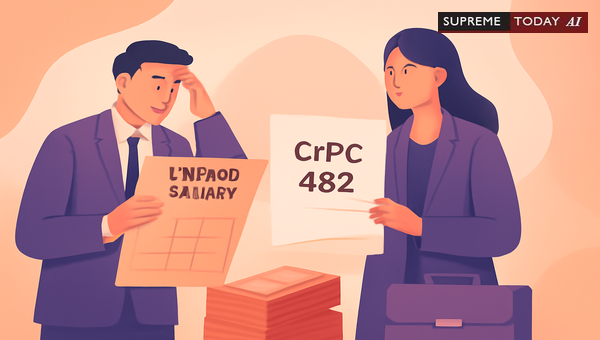
Unpaid Salary: Are Criminal Cases by Workers Against Firm Owners Valid?
In the world of employment disputes, few issues spark as much tension as unpaid salaries. Imagine workers, frustrated after months without pay, marching to the police station to lodge a criminal case against the owner of the firm. But is this the right path? The question arises: Abusing and Monthly Salary Not Paid by Owner of Firm Criminal Case Lodge by Workers. This blog dives deep into Indian law, exploring whether such actions hold water or amount to an .
We'll break down key legal principles, real-world cases, and proper remedies. Note: This is general information based on judicial precedents and not specific legal advice. Consult a qualified lawyer for your situation.
Main Legal Finding
Criminal cases lodged by workers against firm owners for non-payment of monthly salary are generally not sustainable if the dispute is primarily civil in nature. Courts view these as contractual or employment-related issues, best suited for civil or labor courts, not criminal prosecution. Initiating FIRs in such scenarios can be seen as abuse of the process of law, empowering courts to quash proceedings under 1995 0 Supreme(Gau) 209.
Key Points to Understand
- Civil vs. Criminal: Disputes over unpaid wages are civil unless there's clear evidence of , fraud, or 2022 0 Supreme(Cal) 512.
- : Lodging criminal cases purely for salary defaults risks quashing by 1995 0 Supreme(Gau) 209.
- Proper Recourse: Workers should file suits for recovery of wages or use the mechanisms 2005 0 Supreme(Bom) 222.
Detailed Analysis: Nature of Salary Disputes
Why Salary Non-Payment is Typically Civil
Indian courts consistently hold that non-payment of wages or salary stems from contractual breaches, not crimes. For instance, in wage fixation cases, assess income based on minimum wages and evidence, underscoring the civil framework 2010 0 Supreme(Ori) 783. Similarly, allegations of non-payment of remuneration are deemed contractual disputes, with criminal proceedings labeled as abuse 2022 0 Supreme(Cal) 512.
Real-world examples reinforce this. Workers have reported salaries not being paid at regular intervals and often less wages than what they were entitled to, that too, the same was not being paid either through cheque
. Yet, without criminal intent, these don't escalate to FIRs.
Criminal Cases: When Workers Cross the Line
Workers sometimes file criminal cases for unpaid salaries, but courts quash them if rooted in civil matters. In one ruling, proceedings were dismissed as the dispute lacked dishonesty or breach of trust1995 0 Supreme(Gau) 209. The court noted: disputes from agreements like hire purchase (analogous to employment contracts) are civil, and criminal filings amount to abuse of the process of the Court1995 0 Supreme(Gau) 209.
Other cases show owners facing FIRs for wage issues, especially in lodges or mills where workers alleged exploitation. In a lodge ownership dispute, the owner couldn't secure pre-arrest bail as criminal elements persisted 2022 Supreme(Online)(Bom) 5787. However, mere non-payment without fraud doesn't suffice.
Employer's Defenses and Evidence Gaps
Employers often counter by denying monthly salary claims, asserting piece-rate or daily wages. Courts demand proof like salary slips or registers. One petitioner failed to lead any evidence, such as a salary slip, to show that she was paid a monthly salary, with payments noted on a per piece basis2023 Supreme(Online)(DEL) 10691 2023 Supreme(Online)(DEL) 7043 2023 0 Supreme(Del) 5507.
Registers with signature or thumb impression verify payments, as admitted in cases
. Without such docs, workers' claims weaken, but employers must maintain records to avoid liability
.
Role of Labor Courts and Statutory Remedies
The mandates wage resolution via statutory mechanisms, not criminal courts 2005 0 Supreme(Bom) 222. fix salaries, e.g., Rs.3,000/- monthly, but award based on evidence 2022 Supreme(Online)(MAD) 32318. For recovery, approach or —not police stations.
Exceptions: When Criminal Cases May Stick
Criminal proceedings gain traction with criminal intent like or . If an owner intentionally withholds wages dishonestly, it could invoke for breach of trust. Prosecution for wage violations in industrial setups may proceed if supervisors show negligence 2021 0 Supreme(Mad) 2336.
In lodge or hotel cases, owners denying monthly salary while admitting employment faced scrutiny, but evidence decided outcomes 2025 Supreme(Online)(Mad) 61216 2022 Supreme(Online)(Bom) 5787.
Insights from Additional Cases
- Irregular Payments: Workers in firms reported salaries not paid regularly, pushing some to criminal complaints, but courts favored evidence over allegations
.
- Piece-Rate Disputes: Denials of fixed pay, with diary entries showing per piece wages, complicated claims 2023 Supreme(Online)(DEL) 10691 2023 0 Supreme(Del) 5507.
- Employer Accountability: Failure to contest FIRs led to adverse judgments, emphasizing proper records
.
- Pay Structure Variations: Foreign vs. local workers' allowances highlight contractual differences, not crimes
.
These snippets show disputes often boil down to documentation, with criminal tags rarely upheld without .
Recommendations for Both Sides
- For Workers: Opt for civil suits, , or arbitration for faster, cost-effective recovery.
- For Employers: Keep wage registers, issue pay slips, and use bank transfers to rebut claims
.
- Courts' Role: Quash frivolous FIRs under to protect the justice system 1995 0 Supreme(Gau) 209.
Key Takeaways and Conclusion
Unpaid salary disputes are civil at heart, and workers lodging criminal cases against firm owners risk unless fraud is proven. Cases like 1995 0 Supreme(Gau) 209 2022 0 Supreme(Cal) 512 2010 0 Supreme(Ori) 783 affirm: head to labor forums first.
By understanding these nuances, employers can safeguard operations, and workers can pursue rightful dues efficiently. Real cases from lodges to mills 2022 Supreme(Online)(Bom) 5787 2022 Supreme(Online)(MAD) 32318 underscore evidence's power.
Final Word: Prioritize compliance and dialogue. For tailored advice, reach out to a labor law expert.
References
- 2010 0 Supreme(Ori) 783 - Wage disputes as civil.
- 1995 0 Supreme(Gau) 209 - Quashing criminal proceedings.
- 2022 0 Supreme(Cal) 512 - Non-payment as contractual.
- 2005 0 Supreme(Bom) 222 - remedies.
- 2021 0 Supreme(Mad) 2336 - Prosecution limits.
- Irregular payments.
- 2022 Supreme(Online)(Bom) 5787 - Owner liability.
- 2023 Supreme(Online)(DEL) 10691 - Evidence needs.















