


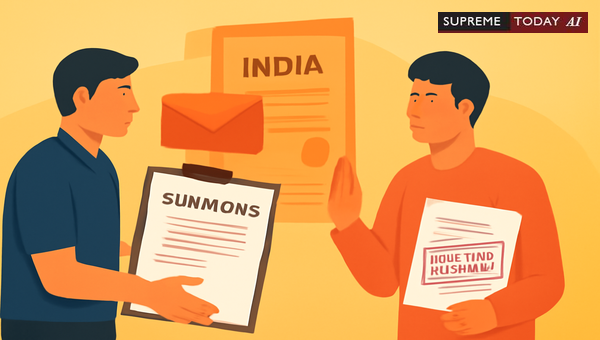
Defendant Moved: Summons Returned, Mother Denies Receipt – Next Steps
Imagine filing a case only to hit a roadblock: the defendant has relocated, the summons comes back unserved, and their mother flatly denies receiving it. This common yet frustrating scenario raises critical questions about and how to keep your case moving. If you're a litigant or lawyer facing Defendant Moved: Summons Returned, Mother Denies Receipt – Next Steps, this guide breaks it down with practical insights from Indian legal principles.
Disclaimer: This article provides general information based on legal precedents and statutes. It is not a substitute for professional legal advice. Consult a qualified attorney for your specific situation.
The Core Issue: Challenges in Serving Summons
In legal proceedings, proper service of summons is foundational. Under the (CrPC), summons must typically be served personally on the defendant or at their . But what happens when the defendant changes location, the process server reports non-availability, and a family member like the mother denies taking delivery? 2024 3 Supreme 199 2024 3 Supreme 130
This isn't just a procedural hiccup—it can signal evasion. Courts view such denials skeptically, as they don't absolve the defendant from responding. The mother's statement may even be interpreted as an attempt to dodge service, prompting the need for strategic next moves.
M/S MAINI SCAFFOLD SYSTEMS & ANR vs S K JAIN & ANR
Key Legal Principles Governing Summons Service
1. Standard Service Requirements
Personal service is preferred, but if the defendant is unavailable, rules allow flexibility. The CrPC mandates attempts at the . A returned summons doesn't end the matter; it triggers evaluation of further efforts. 2024 3 Supreme 199
2. Handling Denials and Evasion
A family member's denial, such as the mother claiming non-receipt, doesn't halt proceedings. Courts have noted similar tactics: Ld. for the respondent no. 1 also argued that only after the receipt of legal notices and service of summons, the appellants and the respondent no. 2 deliberately shifted to nearby location in order to avoid service of summons. M/S MAINI SCAFFOLD SYSTEMS & ANR vs S K JAIN & ANR - Delhi_Delhi_FAO(OS)_(COMM)-51_2020 _DHC_1721-DB
M/S MAINI SCAFFOLD SYSTEMS & ANR vs S K JAIN & ANR
This highlights judicial awareness of deliberate relocation to evade process.
3. Shift to Civil Procedure Insights
While CrPC applies in criminal matters, parallel principles from the (CPC) are instructive. allows if ordinary methods fail. For instance, due to the defendant leaving premises mirrors many cases: On two occasions, the summons was returned un-served and thereafter bailiff submitted the report stating that when he went to serve the defendant, he was informed by the persons residing in the village that the defendant had left the premises two years earlier. 2018 0 Supreme(Bom) 1365 2018 1 Supreme 379
Alternative Service Methods: Court-Approved Options
When personal service fails, courts typically permit alternatives to ensure without undue delay:
- Publication in Newspapers: Affix or publish in a local daily for wide reach.
- Registered Post to : Trackable delivery strengthens records.
- Other Modes: Email, affixture, or even electronic means if court-sanctioned.
The emphasizes that service isn't mere formality: Service is neither an empty formality nor procedural ritual but soul of service is to have knowledge proceedings to defendant contesting party. Even if procedural steps are followed, courts may set aside ex parte orders if actual knowledge is absent, but only with strong evidence. 2018 0 Supreme(Bom) 1365
In one case, failure to affix summons at the last residence led to setting aside an ex parte order: Provisions of have to be followed in service of summons – affixing a copy of summons at the house where the defendant is known to have last resided – Instantly not done. 2018 1 Supreme 379
Documenting Attempts: Building a Strong Case File
Meticulous records are your best defense:
- Log dates, times, and methods of each service attempt.
- Note witness statements, like the mother's denial.
- Preserve process server reports and postal receipts.
This documentation supports motions and counters evasion claims. Without it, courts may question diligence. M/S MAINI SCAFFOLD SYSTEMS & ANR vs S K JAIN & ANR - Delhi_Delhi_FAO(OS)_(COMM)-51_2020 _DHC_1721-DB
Potential Consequences of Non-Service
If evasion persists:
- : Courts may proceed without the defendant, leading to default judgments.
- Enforcement Challenges: Awards are enforceable, but appeals could arise if service flaws surface later.
Remedies for defendants include applications to set aside ex parte decrees, but success hinges on proving lack of knowledge. Remedy against lies in an appeal u/s 96 and/or application under Order IX, Rule 13 CPC. 2018 1 Supreme 379
In NDPS cases, unserved summons didn't derail trials: The summons had returned unserved and the returned unserved cover with the summons has been marked as Ex.P.40. 2017 0 Supreme(Mad) 3928
Practical Recommendations for Litigants and Lawyers
File a Motion for Alternative Service: Cite evasion evidence, like relocation post-notice and family denial. Request publication or .
Pursue Location Intelligence: Use public records, social media, or investigators ethically to update addresses.
Assess Risks: Weigh proceeding ex parte against potential reversals. Costs may be imposed on evasive parties.
In summary suits, service on family was contested but treated valid initially: The issued the summons for appearance, which was served to the mother. 2017 0 Supreme(Guj) 1152
Real-World Case Insights
Judicial precedents reinforce proactive steps:
- Evasion via Relocation: Defendants shifting post-notice faced no leniency.
M/S MAINI SCAFFOLD SYSTEMS & ANR vs S K JAIN & ANR
- Bailiff Reports Key: Repeated unserved returns due to absence prompted . 2018 0 Supreme(Bom) 1365
- Defamation Context: Even in cases, service issues were navigated without derailing merits. 2016 0 Supreme(Kar) 952
These illustrate courts' discretion in adapting to modern evasion tactics.
Conclusion and Key Takeaways
When a defendant moves, summons returns unserved, and the mother denies receipt, don't stall—act decisively. Explore alternative service, document rigorously, and leverage court discretion under CrPC and CPC. While evasion complicates matters, it rarely stops justice.
Key Takeaways:- Denial by family doesn't excuse non-response.- Motions for publication/post can unlock progress.- Ex parte risks exist, but proper records mitigate them.
Stay informed, and for tailored guidance, reach out to a legal expert. Proper service upholds fairness for all parties.
References:- 2024 3 Supreme 199 2024 3 Supreme 130- Various High Court and precedents as cited.
#SummonsService #IndianLaw #LegalProcess















