


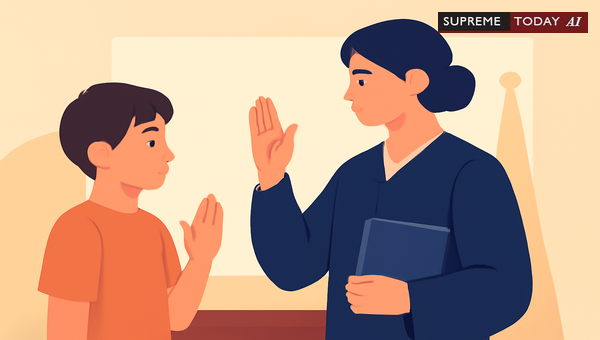
Oath for Child Under 12: Court Rules Explained
In legal proceedings, witnesses typically swear an before giving testimony. But what happens when the witness is a child under 12 years of age? The question arises: Is oath tendered to a child under 12 years of age? This is a critical issue in , balancing the need for truthful testimony with the developmental realities of young children.
This blog post explores the legal principles, exceptions, and judicial practices surrounding oath administration to minors. Drawing from statutes like the and , as well as key case precedents, we'll clarify when oaths are required, optional, or unnecessary. Note: This is general information and not specific legal advice. Consult a qualified lawyer for your situation.
General Rule for Oath Administration
Under standard legal procedure, an must be administered to all witnesses before their testimony is recorded. This ensures the witness understands the duty to speak the truth. As outlined in legal authorities, is generally to be administered to all witnesses before recording their testimony 2009 0 Supreme(Mad) 1147 1987 0 Supreme(Ker) 404 2004 0 Supreme(Ker) 643.
Only persons legally empowered—such as courts or authorized officers—can administer oaths. An unauthorized officer, like a Sheristedar without consent, cannot do so, rendering any resulting affidavit inadmissible. For instance, Oaths or affirmations can only be administered by persons or authorities legally empowered or authorized by law or consent of parties to examine witnesses 1981 0 Supreme(Kar) 343.
Exception for Children Under 12 Years
Children under 12 represent a special category due to their . The law provides flexibility: the court must first assess if the child understands the duty of speaking the truth and the nature of an . If satisfied, the oath can be administered. If not, no oath is needed, but the child's evidence remains admissible, and the obligation to tell the truth persists.
Key provision from the : According to the proviso to , an oath cannot be administered to a child under 12 years of age unless the court records its satisfaction that the child understands the nature and obligation of an oath 2024 0 Supreme(Pat) 129 2023 5 Supreme 122.
Explicitly, For children under 12, the court must determine whether the child understands the duty of speaking the truth and the nature of an 2009 0 Supreme(Mad) 1147 1987 0 Supreme(Ker) 404 2004 0 Supreme(Ker) 643. If the court believes the child does not understand, the oath need not be administered, but the child's evidence remains admissible and the obligation to speak the truth persists 2009 0 Supreme(Mad) 1147 1987 0 Supreme(Ker) 404.
This aligns with , which deems child witnesses competent unless unable to understand questions or give rational answers. deals with the competence of a person to testify before the Court... if the Court is satisfied that the child witness below the age of 12 years is a competent witness, such a witness can be examined without 2022 0 Supreme(Bom) 786.
Court's Role in Determining Competency
The court's satisfaction is pivotal. Before proceeding, judges typically question the child directly. Prior to administering , the court must question the child to satisfy itself that the child understands the duty of truthfulness and the nature of the 1987 0 Supreme(Ker) 404 2004 0 Supreme(Ker) 643
.
Judicial guidance emphasizes documenting this: It is emphasised for the guidance of all the trial Judges/Magistrates, that whenever there is an occasion to decide whether oath should be given to a child witness before recording his/her evidence, it is desirable that they should not only put certain questions to such child witness to ascertain whether they understood the sanctity of oath or not, but also incorporate, at the top of deposition the questions put by the Court and the answers given by the child witnesses 2001 0 Supreme(Bom) 746.
If understanding is demonstrated, oath proceeds; otherwise, testimony is recorded without it. If a child is under 12 years of age, he need not be sworn 2013 0 Supreme(Mad) 1511. Further, Therefore, if a witness is a child under 12 years of age, if the child does not understand the nature of an , the provisions of the Act shall not apply to the said witness. However, it is clearly stated that even in the absence of , it shall not render inadmissible any evidence given by such witness and it will not affect the obligation of the witness to state the truth 2019 0 Supreme(Ker) 113.
Competency of Child Witnesses and Age Determination
Under Section 118, children are generally competent, with 12 years as a threshold. Children 12 or older are typically examined with or without oath based on court assessment 2024 0 Supreme(Pat) 129 2023 5 Supreme 122. Courts have accepted testimony from even younger children, like those as young as 8, after satisfaction checks
.
Age disputes are resolved via birth certificates, medical tests, or . Age determination test conducted on the orders of the or the ... the age of the child as nearly as may be 2025 0 Supreme(All) 3099. outlines procedures, prioritizing reliable evidence like birth records 2025 Supreme(Online)(Kar) 38735
Puspendra Singh VS State of U. P. - Crimes
.Judicial Practice and Implications for Evidence
Courts exercise caution with child evidence due to risks like tutoring, often seeking corroboration. Yet, modern approaches are more benign: In recent years we have adopted a much more benign attitude to children’s evidence, lessening the strict standards of oath taking 2023 Supreme(SRI)(CA) 615. There is no reason to begin with the presumption of untrustworthiness in the assessment of evidence of child 2013 0 Supreme(Mad) 1511.
Evidence without oath is admissible but scrutinized for credibility. In child abuse cases, for example, child means under 18, and oath requirements are relaxed 2025 Supreme(SRI)(CA) 461. Unauthorized oaths invalidate evidence 1981 0 Supreme(Kar) 343.
Key Takeaways and Recommendations
- Oath not mandatory for children under 12 if the court finds they don't understand its nature 2009 0 Supreme(Mad) 1147 1987 0 Supreme(Ker) 404.
- Court must actively assess understanding via questioning 1987 0 Supreme(Ker) 404 2004 0 Supreme(Ker) 643.
- Authorized personnel only can administer oaths 1981 0 Supreme(Kar) 343.
- Evidence remains valid without oath, with truth obligation intact 2019 0 Supreme(Ker) 113.
- Age proof essential using documents or medical evidence 2025 0 Supreme(All) 3099.
In practice, courts question children to gauge comprehension, proceeding accordingly. This framework protects young witnesses while upholding justice.
Conclusion
Oath tendering to a child under 12 is conditional on judicial satisfaction of their understanding. Absent that, is permissible and carries the same truth duty. This reflects a child-centric legal evolution, prioritizing accessibility over rigidity. For case-specific guidance, seek professional legal counsel.
#ChildWitness, #OathInCourt, #LegalTestimony















