


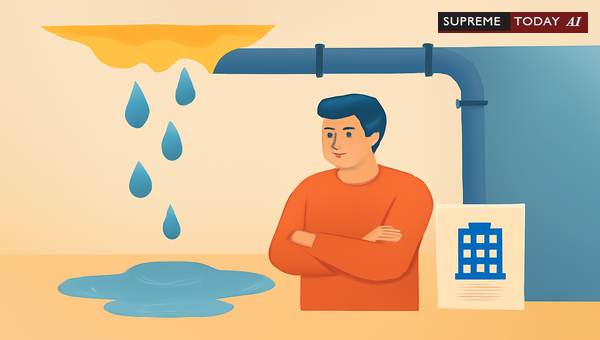
Ruling on Water Leakage from Upper Floor Flats
Water leakage and between floors is a common yet contentious issue in multi-story buildings, often leading to heated disputes among residents. Imagine waking up to damp walls, ruined furniture, and structural damage in your home—all caused by leaks from the flat above. The of India recently addressed such a scenario in a pivotal case, clarifying the responsibilities of upper floor owners. This blog post dives into the court's decision on water leakage from upper floor flats, key legal principles, and practical advice for property owners.
Note: This article provides general information based on public judgments and is not legal advice. Consult a qualified lawyer for specific cases.
The Core Dispute: Decision on Water Leakage from Upper Floor Flats
In the highlighted case, ground floor and basement owners (respondents) sued upper floor owners (appellants) for ongoing water leakage and . They sought a to stop further damage and a for repairs. The sided with the respondents, a decision upheld by higher courts, including the . 2021 0 Supreme(Del) 81
The 's report was crucial, pinpointing damaged and rusted water supply lines in the upper floors as the primary cause. An Assistant Engineer's report confirmed water flowing from upper floors to lower levels due to these faulty pipelines. 2021 0 Supreme(Del) 81
Key Findings from the
The court's ruling outlined several critical points:
Cause of Leakage Identified: and stemmed from upper floor pipelines, not common areas. The court rejected arguments that the 's inspection—conducted by a plumber—was inadequate, deeming the findings reliable. 2021 0 Supreme(Del) 81
Responsibility for Repairs: Upper floor owners were held accountable. The court noted that timely repairs could have prevented escalation. Appellants were ordered to reimburse 50% of the 's fee, as fault lay with their property. 2021 0 Supreme(Del) 81
Upheld: Respondents' applications for restraining further and directing repairs at appellants' cost were validated. This underscores courts' willingness to grant immediate remedies in cases. 2021 0 Supreme(Del) 81
These findings align with broader judicial trends where property owners must maintain their premises to avoid nuisance to neighbors.
Legal Principles Established
The decision reinforces foundational principles in property law:
Duty to Repair and Prevent Nuisance: Owners are generally responsible for negligence causing damage to adjacent properties. Failure to address leaks constitutes . 2021 0 Supreme(Del) 81
Role of Local Commissioners: Courts frequently appoint commissioners for fact-finding in disputes. Their reports carry significant weight unless proven biased. 2021 0 Supreme(Del) 81
Cost Allocation: Faulty parties may bear inspection and partial repair costs, promoting accountability. 2021 0 Supreme(Del) 81
Insights from Related Cases: Common Causes of Water Leakage
Water leakage disputes often reveal recurring issues across Indian jurisprudence. For instance:
Faulty Water Pipelines: Multiple judgments highlight rusted or damaged supply lines as culprits, allowing from upper to lower floors, including basements. Courts have mandated pipeline replacements. 2021 0 Supreme(Del) 81 2021 Supreme(Online)(DEL) 1373
Construction and Structural Flaws: Leakage frequently arises from inadequate in sunken toilet/bath floors. One case noted: Sunken floors of toilet and floor of bath not properly catered with required water proofing and hence severe floor leakage/ in toilet/bath area in all the floors is experienced (as can be seen at the ground floor. 2022 Supreme(Online)(NCDRC) 68 2022 Supreme(Online)(NCDRC) 69 2022 Supreme(Online)(NCDRC) 67
Timing and Historical Complaints: Issues often surface post-monsoon, linked to poor construction like missing floors or demolition impacts. In one matter, leakage stopped after completing a 7th floor, but prior damages warranted compensation.
2022 0 Supreme(Bom) 1663
Structural Deterioration: Corrosion from can lead to collapses, emphasizing 's role. Courts award damages for prolonged suffering. 2024 0 Supreme(Del) 913
C. P. Kukreja Associates (P) Ltd. VS Lt. Udhay Bhan Singh -
Other directives include removing obstructions in common areas and fixing top-floor leaks: Set right the leakage of water on the top floor and set right the damages caused due to leakage inside the rooms.
In , owners confirm resolutions: Respondent no.3 further confirmed that as of date there was no leakage from the upper floor into her flat. 2022 0 Supreme(Bom) 1512
Practical Recommendations for Property Owners
To avoid litigation:
Conduct Regular Inspections: Check pipelines, , and structural integrity annually, especially pre-monsoon.
Prompt Repairs: Address leaks immediately to mitigate neighbor claims.
Engage Qualified Experts: Use engineers or certified plumbers for inspections to strengthen defenses.
Documentation: Maintain records of maintenance, complaints, and repairs.
Society Bylaws: Multi-occupancy buildings should enforce collective maintenance for common infrastructure.
Agreements may allow expansions like new water tanks for upper flats, but with local approvals. 2018 0 Supreme(Del) 2245
Conclusion and Key Takeaways
The 's decision firmly places the onus on upper floor owners for leakage originating from their premises, as evidenced by expert reports. It serves as a reminder that neglect can lead to injunctions, repair mandates, and costs. Broader case law reveals leaks often stem from pipelines, poor , or construction defects—issues resolvable through diligence. 2021 0 Supreme(Del) 81
Key Takeaways:- Upper floor owners typically bear repair responsibility for their pipelines. 2021 0 Supreme(Del) 81- reports are pivotal; challenge them substantively.- Preventive maintenance averts disputes and damages.- Seek compensation for proven losses from prolonged leaks.
Property owners should prioritize upkeep to foster harmonious living. For tailored guidance, consult legal professionals familiar with local laws.
References
- 2021 0 Supreme(Del) 81
2022 Supreme(Online)(NCDRC) 68 2022 Supreme(Online)(NCDRC) 69 2022 Supreme(Online)(NCDRC) 67
2022 0 Supreme(Bom) 1512 2018 0 Supreme(Del) 2245
2022 0 Supreme(Bom) 1663 2024 0 Supreme(Del) 913
C. P. Kukreja Associates (P) Ltd. VS Lt. Udhay Bhan Singh -
2021 Supreme(Online)(DEL) 1373















