


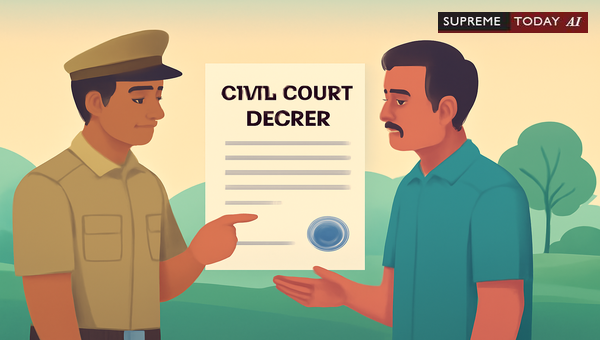
Can Village Officer Refuse After ?
Property disputes in India often hinge on the delicate balance between judicial decrees and administrative processes. Imagine winning a hard-fought case affirming your ownership, only to find the Village Officer—responsible for updating —refusing to mutate the property in your name. This raises a critical question: Whether Village Officer can Refuse to Mutatae the Property on the Basis of the Passed in ?
In this post, we delve into the legal framework, key judicial precedents, and practical remedies. While this provides general insights, consult a legal professional for advice tailored to your situation.
Understanding Property and Village Officer's Role
Property , or 'mutating' land records, is an administrative process to reflect the current owner in revenue records for tax collection purposes. Village Officers (or equivalent revenue officials) handle this under state land revenue laws.
Their jurisdiction is limited: Village Officers have specific responsibilities regarding property , primarily to ensure that land revenue is collected from the rightful owner. Their authority does not extend to adjudicating or the validity of decrees2012 0 Supreme(All) 3248 2020 0 Supreme(MP) 1098.
does not confer title—it's only. Title is determined by civil courts. Thus, Village Officers must typically honor final court decrees without re-litigating ownership.
Binding Nature of Final Decrees
A from a is generally binding on revenue authorities. A passed by a is generally binding and should be the basis for applications. The authority cannot refuse to mutate property based solely on the pendency of appeals or disputes regarding the title, as this would undermine the authority of the 2020 0 Supreme(MP) 1098.
Courts emphasize that refusing on a erodes judicial authority. For instance, revenue entries must align with court orders unless overridden by higher judicial intervention.
In one ruling, the court directed: The Court, while directing the Revenue Authorities to correct the revenue entries in terms of the decree passed by the 2024 0 Supreme(P&H) 798. This underscores the obligation to implement decrees promptly.
Key Findings: Can Village Officer Refuse?
No, a Village Officer cannot refuse to mutate property on the grounds of a from a . The executing authority must respect the decree unless specific legal grounds exist, such as or public policy issues 1937 0 Supreme(Mad) 65.
- Administrative vs. Judicial Role: Courts have consistently held that proceedings do not determine title but are administrative in nature. Therefore, if a has issued a decree regarding property ownership, the Village Officer is obligated to act on that decree2020 0 Supreme(MP) 1098 1986 0 Supreme(All) 360.
- Finality of Decrees: Subsequent purchasers or objectors cannot independently challenge a that has attained finality; their rights are limited to those of the transferor 2023 0 Supreme(Bom) 1582.
- Execution Limits: The 's authority is limited to issues directly related to execution and cannot adjudicate unrelated third-party claims 2024 0 Supreme(P&H) 798.
These principles extend to : Village Officers cannot act as appellate courts over civil decrees.
Exceptions Where Refusal May Be Justified
While refusals based solely on the decree are invalid, limited exceptions apply:
- Inalienable Property: If the property is government land, , or inalienable under custom/statute, may be denied 1937 0 Supreme(Mad) 65.
- Statutory Bars: Specific laws (e.g., tenancy acts) might override, but only with clear evidence. For example, The decision of the authority shall be final and shall not be questioned in any Court of law... the suit property belonged to the public of the Belukurichi village2022 Supreme(Online)(Mad) 93242.
- Pending Higher Appeals: If a superior court stays the decree, can be withheld—but mere appeals without stay do not suffice 2020 0 Supreme(MP) 1098.
Any refusal must be substantiated; arbitrary denials invite judicial scrutiny.
Supporting Case Law and Precedents
Indian courts have reinforced these principles across contexts:
- In partition suits, Subsequent purchasers of property cannot independently challenge a that has attained finality2023 0 Supreme(Bom) 1582. The Supreme Court mandated execution despite objections, applying .
- On execution: The 's jurisdiction is limited to issues directly related to the decree's implementation2024 0 Supreme(P&H) 798. Revenue authorities similarly cannot delve into merits.
- finality: Admittedly, there are decrees for suit schedule property, wherein this Court has passed Judgment and Decree... the was also passed2025 Supreme(Online)(Tel) 17447.
- Rent control overlaps: Decree passed by is valid and executable which is not interdicted by applicability of the Act2022 4 Supreme 536. Rights crystallize at suit filing.
These cases illustrate decrees' presumptive enforceability in administrative actions like 1986 0 Supreme(All) 360.
Practical Steps and Recommendations
If faced with refusal:1. Present the Decree: Submit the certified copy with a formal application.2. Seek Written Reasons: Demand justification; vague refusals are challengeable.3. Escalate: Approach higher revenue authorities (Tahsildar, Collector).4. Judicial Remedy: File a writ petition (e.g., under ) to mandate compliance. If refusal persists, consider filing a writ petition to compel the Village Officer to act in accordance with the ’s decree.
It is advisable for the client to present the to the Village Officer and, if necessary, seek judicial intervention if the officer continues to refuse without valid grounds.
Conclusion and Key Takeaways
In summary, Village Officers lack authority to refuse solely based on a 's . Their role is to facilitate revenue updates, not contest judicial outcomes. Exceptions are narrow and demand robust justification.
Key Takeaways:- Final decrees bind revenue authorities administratively 2020 0 Supreme(MP) 1098.- Refusals undermine court authority and are typically unlawful 1937 0 Supreme(Mad) 65.- Act promptly with decrees to avoid delays in possession or revenue benefits.- Always verify with local laws, as procedures vary by state.
This analysis draws from established precedents, but outcomes depend on facts. For personalized guidance, engage a property law expert. Stay informed, protect your rights!
This post is for informational purposes only and not legal advice.
#PropertyMutation, #VillageOfficer, #FinalDecree












