


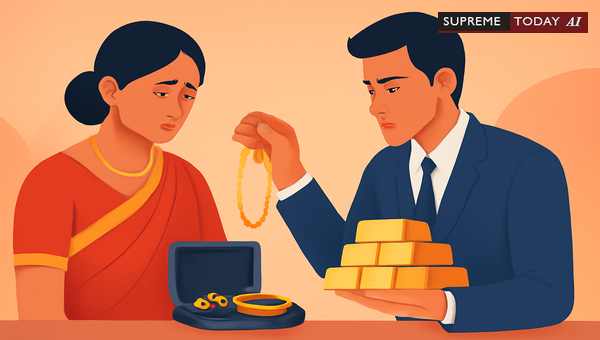
Can Wife Recover Gold Ornaments from Husband Without Pleading ?
In many Indian matrimonial disputes, gold ornaments hold immense cultural and financial significance, often becoming the focal point of legal battles. A common question arises: Husband Misappropriated Gold Ornaments of Wife If it is Proved Whether Without Pleading if Not Pleaded Whether the Wife is Entitled to Get a Decree of Return of Ornament? This query highlights a critical issue in family law—can a wife reclaim her gold even if formal wasn't explicitly pleaded, provided is established?
The short answer is yes, generally speaking. Courts in India, particularly family courts, adopt a , prioritizing evidence of or entitlement over rigid procedural requirements. This post delves into the legal principles, evidentiary standards, landmark cases, and practical insights to help you understand this nuanced area. Note: This is general information based on precedents and not specific legal advice. Consult a qualified lawyer for your situation.
Main Legal Finding: in Family Disputes
Courts recognize that women often face significant challenges in proving claims over gold ornaments in familial settings. Recovery primarily hinges on establishing , , or through a flexible standard of proof——rather than strict documentary evidence. Even without explicit pleading of , if is proved via credible evidence, wives may secure a decree for return. 2025 Supreme(Online)(Ker) 46170
Key points include:- Proof of or informal suffices in most cases.- Familial context excuses lack of formal documentation.- Courts favor to prevent injustice. 2025 0 Supreme(Ker) 1038
Legal Principles Governing Recovery of Gold Ornaments
Under Indian family law, gold ornaments given at marriage or entrusted thereafter are typically considered the wife's (personal property). Husbands hold them in trust for safekeeping, and constitutes a breach. Courts emphasize:
and Without Formal Pleading
Gold adorned at marriage or gifted is the wife's absolute property. For instance, in 2025 0 Supreme(Ker) 555, the court held that gifts given during marriage are the absolute property of the wife, and the husband cannot claim them back. Ornaments like the thali chain symbolize the marital bond and must be returned upon dissolution, but other gifts remain hers unequivocally.
Even if isn't pleaded verbatim, courts infer it from circumstances. In 2025 Supreme(Online)(Ker) 46170, the court noted the petitioner was likely to have entrusted her ornaments for based on inconsistencies in the husband's claims, awarding 53 sovereigns without demanding strict proof.
Standard of Proof:
Matrimonial disputes aren't criminal trials requiring proof beyond reasonable doubt. Instead, courts apply , acknowledging women's evidentiary hurdles. 2025 0 Supreme(Ker) 1038 affirmed: in matrimonial disputes, the standard of proof is based on , enabling recovery of misappropriated property based on credible oral evidence.
This pragmatic stance is echoed across cases. In 2022 Supreme(Online)(KER) 63447, the wife claimed 60 sovereigns (48 from marriage, 12 for the child), and the Family Court allowed recovery, recognizing informal . Similarly, 2025 Supreme(Online)(KER) 10807 granted 41 sovereigns after evidence appreciation, despite appeals.
Evidence and Challenges in Proving Claims
Proving possession and is key, but courts consider oral testimonies, witnesses, marriage photos, and circumstances. Lack of relative examination or specifics can weaken claims, yet credible evidence prevails. 2025 Supreme(Online)(Ker) 53241 2025 Supreme(Online)(Ker) 40821
Husbands often deny possession, claiming ornaments as investments or gifts. Courts scrutinize these defenses. In 2025 Supreme(Online)(Ker) 50216, the husband alleged the wife had only 20 sovereigns, still in her possession, but the Family Court ruled otherwise, challenged on appeal.
From broader precedents:- Wives claim 20-75 sovereigns typically, supported by marriage certificates and testimonies. 2025 Supreme(Online)(Ker) 44069 2025 Supreme(Online)(Ker) 53241- Ornaments are often kept with relatives for safekeeping, inferred from family dynamics. 2022 Supreme(Online)(KER) 43507
If physical return isn't feasible, courts award monetary equivalents, e.g., ₹22,000 per sovereign or ₹11,20,000 total in 2025 Supreme(Online)(Ker) 44069.












